


By Iffath Sharif and Jamele Rigolini
Governments worldwide invest billions in labor market programs—self-employment and micro-entrepreneurship support, training initiatives, job placement services, wage subsidies—all designed to connect people with better employment opportunities. The results? A mixed bag of remarkable successes and underwhelming impacts. However, the key question is not whether these programs work, but rather: What makes the difference between a program that delivers real impact and one that falls flat?
To answer this question, the World Bank Group, in partnership with the Global Labor Market Conference, has released What Works for Work: A Guidebook to Proven and Promising Employment Solutions. The guidebook features a comprehensive catalogue of more than 100 employment solutions from around the world, providing policymakers with a practical resource to identify challenges and select interventions that work.
While structural reforms that promote long-term growth are essential for sustained job creation, there are immediate employment needs that require action now. More than 2 billion people remain trapped in informal, often precarious jobs, and employment solutions such as active labor market programs, regulatory reforms, and alignment of social programs are effective tools to tackle such urgent employment challenges.
Four key findings include:
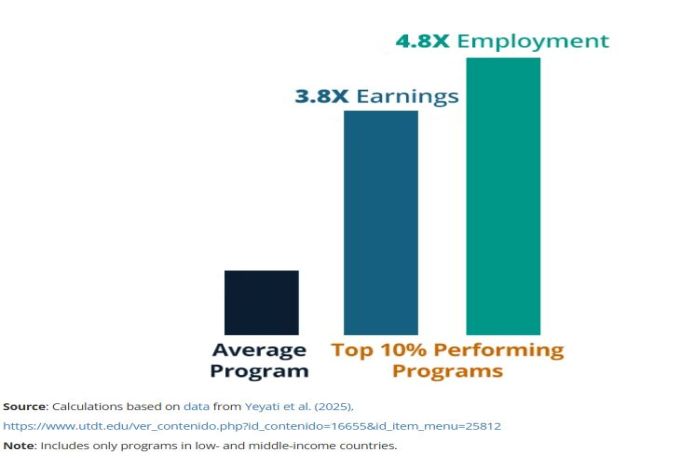
- Top-performing employment programs can deliver game-changing impacts
The best-performing programs in low- and middle-income countries can deliver earnings or employability improvements that are four to five times greater than typical interventions.
Nepal’s Employment Fund Program, for instance, has boosted earnings up to 72 percent through short, market-oriented vocational training and outcome-based partnerships with training providers. Providers receive higher payments for trainees who get jobs, with additional incentives for training individuals from vulnerable groups.
- Impacts can last well beyond the life of the intervention
The best-performing employment programs can have lasting benefits. Evidence from a growing number of evaluations shows that positive impacts on employment or earnings can persist for three to 10 years.
In Colombia, the Jóvenes en Acción program provided three months of classroom training and three months of unpaid internships, plus a small stipend. Training institutions were paid based on student internship completion and hiring outcomes. The program raised formal employment by four percentage points, even three to nine years after the intervention.
- Well-designed employment solutions can pay for themselves
Many programs deliver returns that are higher than the initial investment. Kenya’s Youth Employment and Opportunities Project, which provides grants and training to start or grow a microbusiness, increased annual earnings per beneficiary by $387, achieving an Internal Economic Rate of Return of 100 percent and recovering costs in less than a year.
- Programs can be successful even in fragile and conflict-affected settings
Fragility, conflict, and violence need not preclude success, provided program design and implementation adapt to these challenges. In Nigeria, for instance, the Community Based Skills Training Program focused on the conflict-affected northern region of the country and increased self- or wage employment by 35 to 40%, profits from self-employment by 38 percent, and income from wage employment by 55 percent.
Meeting the labor challenge now
These successful programs all have five design principles in common: contextual tailoring, comprehensive scope, incentive alignment, private sector engagement, and integration with social protection. By following these principles and grounding programs in evidence, governments can transform employment solutions into strategic investments that foster more productive, more inclusive, and more resilient labor markets.
These high-impact solutions can become particularly useful as governments in low- and middle-income countries face growing pressure to create jobs amid shrinking resources and slow economic growth. What Works for Work serves as an operational resource offering concrete examples, a catalogue of adaptable programs, and a step-by-step guide to help policymakers craft interventions that deliver meaningful and lasting results.