

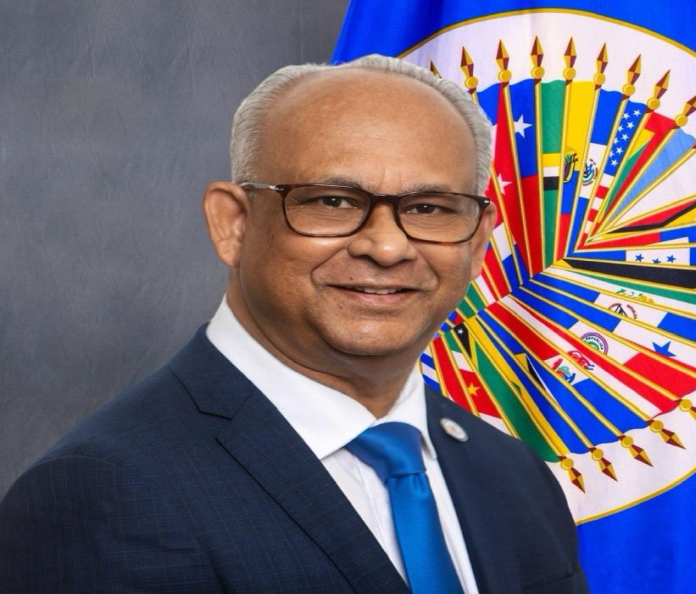
– OAS Secretary General, Albert R. Ramdin, during the Special Meeting of the Permanent Council to consider recent events in the Bolivarian Republic of Venezuela
By Albert R. Ramdin
… Today, with this gathering, I believe the value of multilateralism and inter-Americanism has been once again demonstrated as a valuable instrument in our hemisphere. I believe that today member states have presented their analysis, their arguments and their positions with regard to recent developments in our region, especially in this case in Venezuela. That openness is not a courtesy. It is a cornerstone of our collective legitimacy and our capacity to solve real problems.
Therefore, I thank member states for their views as expressed, the constructive suggestions and looking forward to the future. And the Secretariat will certainly be guided by your views as expressed today in this special Permanent Council. But distinguished permanent representatives, we must be more than a forum for statements.
Exchanging information and viewpoints is essential, no doubt. But it is not sufficient to improve the lives of the people of the Americas. Our words must lead to coordinated, principled, and sustained action. We are not here out of goodwill and solidarity alone. We are here because the OAS Charter mandates it; because member states themselves want it this way.
Let me be clear, the OAS Charter and the inter-American legal framework are not a suggestion, but an obligation and a moral responsibility. It reflects the very purpose for which the OAS was created in 1948, still valuable today. In a more complex world, multilateral institutions are not optional. They are indispensable. We have heard all those sentiments expressed here today.
So if democracy, fundamental principles of international law and the inter-American legal framework are at stake, as has happened before in our Hemisphere, now in Venezuela, the Hemisphere must act collectively to return to accepted norms and principles.
This will require constructive engagement among the OAS member states, full support and certainly also in Venezuela. We must reaffirm the importance of unity within the American region recognizing that diversity of views exists while underscoring the shared responsibility to preserve peace and stability in the Hemisphere.
I wish to recall that member states are the basis of that unity. And there is a shared adherence to international law and the inter-American legal framework, which provides a common point of reverence for dialogue and collective consideration, including respect for sovereignty, human rights, and democratic governance.
And as we go forward, we must consider in what way we all can find the moment to reaffirm the collective commitment of member states to these norms and values that underpin our unity and peaceful coexistence in our hemisphere. We must find a way to get back to that rule-based system.
I would like to emphasise that the Americas have historically aspired to remain a zone of peace and that safeguarding this condition continues to be in the collective interest of all member states. Now, with respect to Venezuela, our commitment is clear. Morally, we owe the Venezuelan people our solidarity. Strategically, a stable, democratic, and prosperous Venezuela is in the interest of every single member state around this table.
At a minimum, we share responsibility for finding solutions that deliver concrete improvements to people’s lives, respecting the inalienable right of the Venezuelan people to determine their own government and their own leadership in a representative democracy.
We must also acknowledge and welcome the expressions of willingness by several member states stated here today to cooperate in good faith and in diverse ways during this particular sensitive period. We must recall that the strength of the inter-American system lies not in uniformity of views, but in the capacity of member states to engage constructively despite ideological differences.
Therefore, we encourage member states to continue using this forum to listen to one another, seek areas of convergence, and avoid actions that could deepen divisions or heighten tensions. We must also reaffirm that maintaining the Americas as a Hemisphere of peace is a shared achievement and a shared responsibility requiring cooperation, prudence, and sustained management and engagement.
We must know that cooperation does not require consensus on all issues, but rather commitment to peaceful processes, mutual respect, and institutional dialogue. Therefore, we invite member states individually and collectively to consider how their engagement within their own approaches and principles can contribute to stability, dialogue and constructive outcomes.
Following the private meeting of yesterday, and some of the requests made regarding the capabilities of the OAS General Secretariat to assist in restoring democracy, I would like to say the following:
The Organization of American States based on its responsibility, mandates, and the provisions of our Charter, is here to safeguard democracy, defend human rights, promote development, and stability, and strengthen multi-dimensional security to keep our Hemisphere a zone of peace. This is not only a Venezuelan issue. It is a hemispheric responsibility. The stability of our region depends on our collective response.
A stable, democratic Venezuela is good for its people and good for the whole Hemisphere. In these circumstances, the role of the Organization of American States in our view will be key as an institutional space for dialogue, reflection, and collective engagement consistent with its mandates and the confidence placed in it by the member states. We must highlight the potential value of the OAS as an honest broker, able when so requested and agreed, to facilitate dialogue, support peaceful approaches and help reduce tensions.
In line with the Charter of the Organization of American States, we act as a cooperative partner, as a trusted partner to our member states in fulfilling this mandate, fully respecting the principles of sovereignty, non-intervention, and constitutional order.
Let me also say that we have been and we will continue to do so, monitoring the human rights situation and documenting and publicly denouncing abuses consistent with the Venezuelan state’s commitments under the Inter-American Human Rights System, with particular attention to political prisoners.
As I stated before in the Permanent Council on October 8th, I strongly support the request of the Inter-American Commission of Human Rights to conduct an in loco visit to Venezuela to assess the situation. But I believe we can do more within this context and subject to relevant political conditions, and of course, formal requests.
The OAS stands ready to support Venezuela and our member states through complementary and mutually reinforcing lines of action aimed at restoring confidence, strengthening democratic institutions, improving public management and fostering sustainable governance. Just to provide the first list of ways to help. We offer our good offices to facilitate an inclusive dialogue platform among the actors of Venezuelan society.
This platform would provide a space to identify priorities, assess needs, and define a shared roadmap going forward. This dialogue can help build confidence and strengthen institutions, including the judiciary, democratic checks and balances, and mechanisms that uphold the rule of law and defend human rights. We have the capabilities and proven experience to provide legal and institutional support, advisory services and technical cooperation to reinforce the independence of the judiciary and the rule of law. This includes access to public information, integrity frameworks, and anti-corruption standards. The OAS can assist in preventing, managing, and peacefully resolving social and political conflicts through mediation, dialogue facilitation, consensus building, methodologies, and institutional tools that bolster democratic stability and peacebuilding.
We can support a democratic transition in depth, strengthen institutions, supporting institutional reforms, assisting election readiness, building capacities, observing electoral process and so much more.
Specifically in the electoral sphere, the OAS can provide independent technical cooperation to support the integrity, transparency, and credibility of electoral processes and electoral authorities with the objective of fostering public confidence in democratic outcomes.
Finally, the OAS, in collaboration with regional and international specialised agencies, can contribute meaningfully, in our view, to addressing migration-related challenges and the situation of groups and conditions of vulnerability in support of social cohesion and democratic resilience.
This is a short list, a high-level overview of what the OAS Secretariat can provide in creating a space for democratic democratic return of the Venezuelan society and providing legitimacy to those who are going to govern. So, the OAS stands ready to assist in this process.
Let me also recall, permanent representatives, distinguished ambassadors, that in all we do, we must acknowledge the right of the Venezuelan people to determine their own future, including through peaceful means and democratic processes in accordance with applicable principles. We must affirm that discussions and efforts should remain guided by the interest and well-being of the people of Venezuela, with due consideration to the broader regional context. We are convinced that Venezuela’s path must be grounded in the will of its people.
Existing institutional arrangements, including the country’s constitutional order, provide an important basis upon which we can build sustainable stability, and democratic legitimacy can only be achieved through peaceful means, including inclusive dialogue and strong institutions. In our view, it should start now.
Recent reports, on top of what we already knew, are giving us reasons to be concerned. Repression and political prosecution cannot be tolerated in Venezuela or anywhere else in our hemisphere.
So, in our view, we must find a way for continued collective engagement, for open channels of communication, and thoughtful coordination with member states. We must emphasize that progress where possible will depend on shared responsibility, collective unity, sustained dialogue and a commitment to peaceful and lawful approaches.
I would like to conclude by reiterating our readiness as a Secretariat, within its mandates keeping in mind the guidance you have provided and, of course, at the request of member states and in this case also Venezuela, to support dialogue and contribute to efforts aimed at preserving peace, democracy, and stability for Venezuela and for the Hemisphere as a whole.
I’d like to finish with a statement made by Simón Bolívar given more than 200 years ago in the Congress of Angostura. But I believe the statement still has currency in the current situation. And the statement reads as follow:
“Each nation may govern itself according to its character and circumstances. But all require order, justice, and cooperation if freedom is to endure. Without unity of purpose and adherence to common principles, no republic can hope to achieve stability, much less peace.”