


 The Science and Technology Directorate (S&T) is developing a new contactless vessel stopping technology for the US Coast Guard (USCG) to bolster interdiction efforts along our maritime borders.
S&T, USCG, and the Naval Air Warfare Center Weapons Division (NAWCWD) have been conducting proof-of-concept demonstrations of a new Contactless Vessel Stopping Capability (CVSC) prototype. The CVSC uses high-energy microwaves to temporarily stop the motor inside of small watercraft, like jet skis. The most recent demonstration, held in December, showed how effective it can be and how much progress has been made.
This effort began when USCG approached S&T seeking a technology that would allow them to safely and consistently stop small non-compliant vessels. The solution S&T is developing with NAWCWD utilises highly energised radio frequency pulses to overwhelm the electronic circuits within the targeted vessel, causing the engine to shut down and bring the jet ski to a stop. NAWCWD was selected to build the prototype because they have specialised expertise with high-powered microwave technologies that have demonstrated disruption, degradation, and denial effects on electronic target types, including outboard vessels and combustion engines.
“We’re looking forward to improving upon the progress we’ve made and accelerating future developments to give USCG a solution to their small vessel gap as fast as possible,” said S&T Maritime and Immigration Security Solutions Program Manager Anthony Caracciolo.
One potential use case for CVSC technology would be assisting USCG with intercepting a jet ski suspected of travelling from Mexico and trying to come ashore in San Diego. Currently, USCG uses a much larger, 33-foot boat to chase it down. Jet skis are small, fast, and very manoeuvrable, and there are not many options when it comes to stopping that kind of vessel. CVSC is akin to law enforcement deploying a spike strip on a road to stop a non-compliant vehicle. Once a watercraft is stopped, USCG can determine whether the vessel is involved in something nefarious, like moving drugs, or human trafficking.
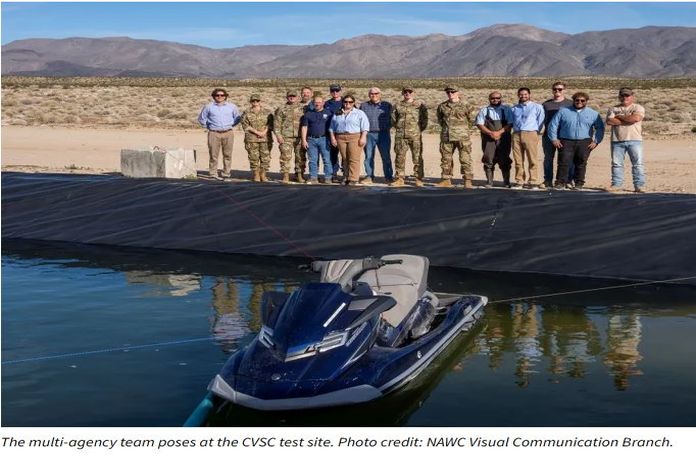
Naval Air Weapons Station (NAWS) China Lake is known for its military research and development facilities and provided an excellent venue to test and evaluate CVSC. The small, teardrop-shaped pond that was used for the test is called PMT, dating back to its previous history as the Pacific Missile Test Center, which merged with NAWS many years ago.
To demonstrate the prototype’s capabilities, a jet ski is tethered in place in the PMT. The engine is started, and a test rig consisting of a server attached to a cone-shaped antenna is powered up and aimed at the idling jet ski. At the first demonstration, held last September, the engine was shut down using the CVSC multiple times, restarted, and shut down again, showing that there was no permanent damage to the craft.
“There are microwave transmitters that can stop a large vessel,” Caracciolo said, “with engines mounted on the back.” The microwave transmitter can be placed on the front of the pursuing boat for a direct line-of-sight engagement. “But jet skis are different. The small engine is inside of the craft, and the operator is blocking it with their body. CVSC is designed to be effective in those challenging conditions.”
A follow-up demonstration was then conducted in December. During the September demo it took some time for the motor in the targeted jet ski to stop. During the December demo, the jet ski was shut down almost instantaneously. The improved response was due to correcting a fault in the transmission cable connecting the pulse generator to the antenna and slightly increasing the pulse repetition rate.
S&T will take the information gathered from this test and apply it to the next prototype, which will refine the power levels, ranges and safety parameters. Follow-on demonstrations are scheduled for early next year.
Until spike strips are invented for the high seas, S&T will be there to develop the next best thing.