
By Caribbean News Global 
CANADA / ST LUCIA – The following is a transcript of an interview conducted by Timothy Poleon, on NewsSPIN, with Wilson Jn Baptiste, Chief Executive Officer of Global Enterprises Management Solutions, LLC, March 3, 2026.
Timothy Poleon: Before we go into the possible impact and what is happening in the Middle East and our vital tourism industry, your general thoughts on the comments made by the Prime Minister of Saint Lucia, Philip J Pierre, regarding what is happening there.
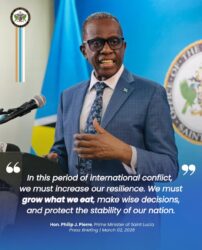
“Water security is a global challenge. The government is actively advancing plans to strengthen and modernise our water infrastructure and building resilience to climate change so every community can have a more reliable supply.
“Government is doing its part. Now we call on every citizen, every household, and every business to do theirs; conserve water, fix leaks, harvest rainwater where possible, and use this vital resource responsibly. Water security is a shared responsibility.” ~ Prime Minister of Saint Lucia, Philip J Pierre.
Wilson Jn Baptiste: Yes, I think he has covered some important points. But what is required is how you position those points, how you position that language. The first thing we need to ask ourselves is whether a crisis exists at this point in time. Are people’s lives being disrupted? And yes, we have a crisis, a global crisis, which is going to impact us on the local scale.
So, I believe the prime minister covered the main points, but I think he needed to use words like crisis. We needed to use words like emergency, sacrifice, and discipline. At this point in time, we cannot continue to live the way we’re living on January 1, 2026.
Timothy Poleon: What do you think is on the horizon?
The crisis you’re talking about there, and what is on the horizon if the trend continues?
Wilson Jn Baptiste: Well, it’s already happening. Lives are being disrupted. Fuel prices are going up. People cannot travel how they want. And we must not underestimate the impact on our health and well-being, because we are now living in a more stressful period than January 1, 2026. And we are going to depict that stress in different ways. Maybe more violence, maybe more crime, maybe less tolerance. So, we have to be careful that we monitor those signals.
Timothy Poleon: And as a society, who should be monitoring those signals?
Wilson Jn Baptiste: There has to be a communication system. What has to happen now in the midst of everything that is happening?
There must be trust, loyalty, and brand image among Saint Lucians as one. Now, these are challenging and precious commodities for the country to burn. Because a controversy or crisis played out in public can cripple an organisation or it can cripple Saint Lucia.
For example, if you have different perspectives, if you have half-truths, if you have half-lies, etc., that can destroy the image of the country. So, we have to be proactive during this time. And also bearing in mind that the frequency and severity of crises are increasing.
What the government needs to do now, and I think they are doing it now, is to build a crisis team. Well-defined, trained, and practised teams that are prepared to manage a variety of crises or this crisis. Every resource the country may need to engage in should be identified, negotiation and ready.
So the government needs to have, and we could say the opposition party and civil society, need to have people now speaking in terms of how we are going to go through the crisis that we are facing now.
Timothy Poleon: […] Do you think that what is happening in the Middle East, and considering we have been through that before, we would come to our senses and realise that we need to put the partisan politics on the back burner and focus on what awaits us and what definitely will be detrimental, not only to supporters of one party or the other but to everyone in our country and as a nation.
Wilson Jn Baptiste: Yeah, that is critical because whatever is happening now will affect LABOUR, UWP, etc, without, discriminating against each other.
What has to happen now, and it happened in the 70’s and 80s with George Odlum, the consciousness of the people must be approached now. Saint Lucians must be made to be very conscious of what is happening and how it is going to impact us. And one of the ways is through building community management teams and using social media to communicate effectively with each other. Because we have the models.
Watch how both political parties were able to mobilise their supporters during the [recent election] campaign. Watch the number of Saint Lucians who turn out at events organised by the political parties.
So we have the model in place to create that level of consciousness. But it will not be about politics or what the government is doing, but about the challenges that we are faced with now. Both parties should engage in that right now.
Timothy Poleon: […] Considering the volatile or fickle nature of tourism, … and considering you have a lot of visitors being stranded in the Middle East, airspaces being closed, […] although this is happening so far away from Saint Lucia and the rest of the Caribbean, how can this impact us long-term?
Wilson Jn Baptiste: Well, it’s not long-term, this can impact us in the immediate term, in-fact, my background is also tourism development, where I hold a Master’s from NYU, so this is going to, and I’m sure it is affecting us at this moment as we speak – Timothy, what we need at this point in-time is clear and specific guidelines.
Now, we can break that discussion down into the macro and micro aspects of tourism. The macro context has to be the hotels. Hotels now have to be more efficient, reduce waste, reduce inefficiency in order that they can survive the drop in occupancy, and that drop is going to be steep at this point.
Look at the West Indies Cricket Team; they’re having problems getting back to the Caribbean, so the level of travel is definitely going to be on the downside.
Then we look at the micro aspect of our society. And I have been speaking about that for maybe over a decade. And that is the household economy. How are you going to bring that level of consciousness to the household and making them more efficient?
In other words, people cannot spend indiscriminately today as they did from January 1. There are different techniques, like operations, supply chain management strategies, where people may have to pull together to go to the supermarket.
If there are two cars in the community, instead of both of them going to the supermarket, we may have to reduce it to one. People come together and go and shop. So, the challenge now is that we have to move from an individualistic society to a more collectivist society at this time.
Timothy Poleon: But those are drastic changes that you’re asking members of the Saint Lucian public to make. Because, okay, yes, they might do that now. But once the threat has disappeared, don’t you think they are back too their old ways? […] And as soon as the threat disappears, we are back to our old ways?
Wilson Jn Baptiste: Well, it could stick, you know, if we make it part of our culture. In other words, where we are now, if we do not do certain things, we are going to die.
As simple as that, or the planet is going to die, or people in Iraq and those areas are going to die. So we have to drill that. Now is the opportunity to transform those new behaviours, which we have as part of our daily culture.
Collectivist society sharing, you know, moving with one another, ensuring that each other succeeds, you know, serving as facilitators to ensure that we move from ground zero to ground 10. So, we have that, it is a perfect opportunity where we can now reinstate those values in our people.
Timothy Poleon: Now, there seems to be a definite delay. I mean, today is already the third of March. This incident occurred in the Middle East on Saturday. And within that period, that like time, you’re not getting a sense that there is this sense of urgency on the part of our authorities, not government in particular, only, but our authorities in general, to bring to the realisation that this threat, this situation is one that should be taken seriously.
Wilson Jn Baptiste: I agree with you, and that’s a good catch. If you want to control the narrative, then you have to be upfront and ahead of the curve in terms of communicating the impact of that crisis on the island.
I believe that the prime minister should have had a crisis management and communication plan to identify and evaluate the risk from Saturday or Sunday to bring it to the forefront. Right now, what you have is a lot of conflict, misinterpretation, and misrepresentation of what will happen.
And then, of course, you have the political perspective. What the Labour Party might say is not what the UWP will say. And you are right. The country now has to move quickly to take control of the narrative with regard to the crisis we are facing. So, we speak with one voice.
Timothy Poleon: Should we have any kind of long-term mechanisms instituted so that whenever things of that nature surface, those are not our doing, but when they arise on the surface, and sometimes it’s imminent that it will happen in the Middle East in particular, an area of immense instability that we know how to cope with, and we just activate those mechanisms?
Wilson Jn Baptiste: Sure. And I’ve been pushing that point of a research and development ministry in our government. And we need to have at least three or five people, and maybe in the diaspora also, sitting on a daily basis and monitoring the activities that are taking place globally and how they will impact Saint Lucia, and how we are going to address them.
And every day, the prime minister should be getting a one-page report on significant issues that are going to impact the country. You could also call it the office of the prime minister, where people are sitting now and just monitoring. We cannot continue to react to situations. We have to be proactive.
For instance, by now, we should have a team of people putting together; What may, what may not? You know, a list of assumptions and working along these assumptions. And I agree with you. We need to be more urgent in how we deal with that situation. Bearing in mind, Tim, that you are no longer a zone of peace.
I mean, what Marco Rubio came in to do to the Caribbean at the 50th regular meeting of the Conference of CARICOM heads of government, is to make sure that that is disintegrated, you know. So we cannot hide being in peace and having a quiet area, a safe area, because at any point in time, aircrafts can be landing on our airports. So, we cannot take it for granted, right now.
Timothy Poleon: Isn’t it very sad, sir, that according to you, we can no longer consider the region a zone of peace, because that is one of our selling points, that proved to be advantageous, compared to the turmoil in the Middle East, what is happening in other parts of the world, other areas and so on that we could have boasted of being in a zone of peace. I mean, that is very scary, don’t you say? Don’t you think?
Wilson Jn Baptiste: It is, and our leaders must be blamed for that. They came out of a CARICOM heads of government meeting, and that should have been the theme of that meeting. The Caribbean is a zone of peace. And nobody wanted to touch it. They touched immigration. They touched on climate change.
That was our marketing strength, in the sense that while the balance of the planet burns, you could come to the Caribbean, and I think we are losing that image, and it is very, very sad. Because we don’t have oil or other natural resources to see us through.
Timothy Poleon: But this, this disintegration, don’t you think we can blame one man, Donald Trump, for taking this away from us? This advantage?
Wilson Jn Baptiste: No, we cannot blame him. We have very smart people in the Caribbean, and when I look at what was happening from their perspective, they have done more psychological damage to the Caribbean than anything else.
You know, we look at the leaders now. No one seems to be trusting each other. They are being pulled one by one on the side. And that is where CARICOM should have really come in and represented the entire region instead of allowing the US or any other nation to be pulling the Caribbean on the side, one by one.
So what we have, leaders are looking for the best now in the interests of the country. I think in the time of Bishop, Barrow, Eric Williams, and Manley, they would have stood up as one unit and spoken. You know, if you want to speak to Trinidad in Washington, we want the CARICOM representative there you know.
So, the Caribbean is now disintegrated. We are vulnerable, and we do not even have a clear definition of who we are as one-region!
Timothy Poleon: Final comments from you, Sir?
Wilson Jn Baptiste: Well, times are going to be challenging. I have confidence in us as Saint Lucians. As I’ve always said, we are the brightest and smartest people on this planet.
But there’s something we are doing wrong to each other, and now is the time to build good relationships with one another, treat each other fairly, and establish the benchmarks for success and failure in my beautiful country.