

-
-
- Infrastructure development
- Fiscal positioning
- Strengthen domestic foundations of growth
- Responsible economic development
-
By CNG Insight 
CASTRIES, St Lucia – Subject to global and geopolitical change, reshaping Saint Lucia’s infrastructure development, investment decisions, risks, and opportunities is worth exploring from the standpoint of positioning the island’s future.
The stated “Vision 2030” focuses on transforming the nation into a more resilient, digital, and sustainable economy, with an emphasis on human capital development and infrastructure improvements – summarised emphasis on “people empowerment”, inclusive of infrastructure development.
A clearly stated intention for the technological transition of Saint Lucia in the context of its strategic resources helps position it to exceed the goodwill of world leaders.
The strategy should consist of taking control of Saint Lucia’s economic future, developing its resources on the island and creating sustainable wealth for “people empowerment.” This is fundamental to investor perception, capital flows and economic growth.
The Pierre administration is asserting a clear ambition to “people empowerment,” through infrastructure development and economic growth. This direction aligns with added value creation, local government transformation, and economic diversification at the centre of government priorities.
Building on this foundation is a strategy that signals a shift in scale to accelerate projects, strengthen implementation and consolidate Saint Lucia’s reputation as a reliable and responsible partner for business and government to function effortlessly.
- There is work to be done! Building infrastructure with meaning, innovation and environmental responsibility includes recycled waste. The long-term use of recycled waste into a resilient, smart, and circular module is a practical approach to “ people empowerment”.
Fiscal positioning
While the ambitious national development programme for 2026 and beyond addresses important development prerequisites, the associated fiscal risks, project administration, and future operating and maintenance costs require careful management.
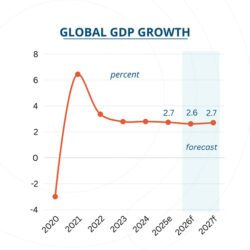
According to the World Bank, global growth is projected at 2.6 percent in 2026, before edging up to 2.7 percent in 2027. The 2020s are on track to be the weakest growth decade since the 1960s. More than one in four developing economies still have lower per capita GDP than in 2019.
“The challenge ahead is clear: sustaining resilience while reversing a widening gap between advanced and developing economies, especially as slower growth, high debt, and job pressures persist.” ~ World Bank.
The IMF noted that, “The overall fiscal deficit excluding natural disaster costs is expected to narrow to 2.3 percent of GDP by FY2030/31, with rising interest and wage bills partly offset by a decline in capital expenditure. Public debt, which also pencils in natural disaster costs, is projected to stabilise at around 77 percent of GDP in the medium term.”
At the World Economic Forum Annual Meeting 2026 in Davos, His Excellency Ahmed Al-Khateeb, Minister of Tourism of the Kingdom of Saudi Arabia, delivered a clear message to global leaders: tourism must be led as economic infrastructure if it is to drive growth, resilience, and human connection in an increasingly fragmented world. The minister emphasised that tourism should no longer be treated as a discretionary sector, but as a strategic system capable of supporting diversification, attracting long-term investment, and creating inclusive employment across regions when planned and governed intentionally.
Strengthen domestic foundations of growth
Clear governance structures, when done right, allow for industry engagement, regulatory capability, and implementation. These are robust necessities to facilitate a clear road map for development and economic stability.
Saint Lucia’s tourism product primarly of coastal, events, and stayovers, features the mainstay of the economy, secondary to Citizenship by Investment (CIP).
Saint Lucians deserve transparency, accountability and accuracy on CIP secrecy, hindrances on the ease of doing business, progress reports on its development agenda, marketing the island’s tourism and its real fiscal position.
To facilitate this, will include improving institutional and human capacity, and technology to source quality data to support well-informed policymaking. Strengthening human capital underpinnings productivity and efficiency, to which, prioritising and aligning the public sector digital futures can administer new methods to facilitate local investment, real-time data and business development enhancement.
- There is outstanding work on a to-do list to be completed! The government should be mindful of deceptive marketing and advertising on social media with the insignia of Saint Lucia. National symbols, artifacts and historic sites should be patented and require permission for use. (revenue module). In addition, areas of national security significance should be protected. (Moule-a-Chique and Vieux-Fort underground architecture).
Responsible economic development
Laying the foundation for ambitious national development programmes includes harmonising legislation, standards and operations, safety and security across multiple institutions. These help facilitate scalable adaptability for “People Empowerment” and to develop social value creation, together with innovation-driven startups and entrepreneurs.
Saint Lucia is at a particularly relevant junction to frame its development model, currently stuck in consumerism, subsistence agriculture, and destination tourism, absent a modern futurist sector.
- Balance is Key! The impact of geopolitical shifts on investor perception and capital flows in the current global environment requires strategic planning. There is outstanding work on a to-do list to be completed!
The suitability of Prime Minister Pierre’s new development focus on strategic infrastructure, including “agriculture in heels,” conveys prominence, particularly to facilitate public affairs and “People Empowerment.”
Buy Saint Lucia, building Saint Lucian and promoting Saint Lucia should go beyond language. This should be enshrined in policy and law. And accompanied by dedicated government infrastructure and related services to support future growth prospects.
Saint Lucia has commenced a bold vision and action plan, development and employment policies to help shape lives and deliver high-quality, well-paying jobs. Implementation is critical!
Related: Part 1