

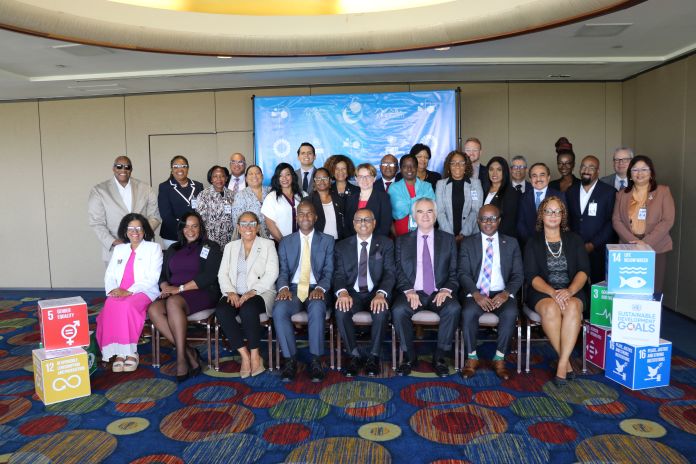
- The Twenty-Second Meeting of the Monitoring Committee of the Caribbean Development and Cooperation Committee (CDCC) was held in Port of Spain, Trinidad and Tobago.
PORT-OF-SPAIN, Trinidad – Three priorities for Caribbean countries’ development include digital transformation, modern services exports and more South-South cooperation, in particular with Latin America. That was the position of ECLAC executive secretary José Manuel Salazar-Xirinachs, expressed at the 22nd meeting of the monitoring committee of the Caribbean Development and Cooperation Committee (CDCC), held Tuesday in Port of Spain.
Salazar-Xirinachs said that “small size has traditionally been seen in the development economics literature as associated with high costs, given the difficulties to take advantage of economies of scale. But this conventional view needs two corrections: first, the digital revolution and AI means that economies of scale in modern services are huge, potentially much larger than in manufacturing. This means that it is important for small SIDS to look carefully and prioritize modern services in their exports and growth strategies. And second, smallness might be a disadvantage in certain dimensions, but being small and nimble, might also be an advantage in today’s fast-moving world.”
Salazar-Xirinachs also said that with the new geopolitical situation, South-South cooperation should be a major avenue to explore for Caribbean countries.
In addition, he emphasised that in “the knowledge and information age,” data has become a critical currency of development. “Good-quality, high-frequency, timely and trusted data can provide the basis for deeper analysis of the development challenges and opportunities facing the subregion.”
The executive secretary also underscored that modern productive development policies need to develop sectoral productivity and competitiveness agendas and are essential to leverage the different assets of this region (human, ocean, natural, etc.) to achieve resilience and prosperity in the new geoeconomic and geopolitical order.
Promising sectors in the Caribbean include the digital transformation, modern services, the creative industries, agriculture, energy transition, transportation, life sciences, medical devices and pharmaceuticals, among many others. It is essential for Caribbean SIDS to develop new growth and development strategies with dynamising sectors such as these and others at their center.
Salazar-Xirinachs also described the ongoing work of ECLAC’s Caribbean office and noted the CDCC’s contribution to Caribbean Development over 50 years.
“We must seriously consider the progress we have made and how we might reinvent the institution to meet the thorny challenges of the future… Since its inception, the CDCC has provided much-needed technical assistance, promoted regional cooperation and acted as a platform for a unified Caribbean voice in Latin America.”
CDCC chair and Trinidad and Tobago’s minister of planning, economic affairs and development, Kennedy Swaratsingh, reinforced the call for stronger data systems, noting that effective digital transformation and resilient development both depend on robust information ecosystems.
“Technology is not a mere upgrade, it is a strategic imperative,” he said. “A harmonised, data-driven approach is essential if we are to strengthen institutions, advance regional integration and unlock the potential of our economies.”
Minister Swaratsingh added that modern data capabilities are central to addressing broader development priorities, including climate finance, public-sector efficiency and regional coordination. He urged countries of the Global South to use the MonCom platform to deepen cooperation, exchange expertise, and advocate collectively for systems that recognise the vulnerabilities of SIDS.
Speaking about the multidimensional vulnerabilities that Caribbean countries face, minister Swaratsingh said:
“Many nations are now spending more on debt interest than on climate or social investments, even as our economies risk significant per capita GDP losses from climate impacts. We must refuse to accept this cycle. The good news is that we are not passive victims; we have the power to create our own solutions by mobilising both public and private finance.”
The meeting also marked the 50th anniversary of the CDCC, an opportunity, the executive secretary said, to reflect on achievements in strengthening statistical capacity, institutionalising disaster loss assessments, supporting SDG implementation, and providing a unified Caribbean voice within Latin America. He noted that the CDCC must now prepare for the next phase of regional cooperation by becoming “the Caribbean’s central hub for high-quality regional data and digital public infrastructure.”
Both minister Swaratsingh and ES Salazar-Xirinachs encouraged delegates to prioritise data and statistics as foundational pillars for building resilience, accelerating structural transformation and shaping forward-looking development models in the Caribbean.
ECLAC is one of the five regional commissions of the United Nations and promotes sustainable economic and social development in Latin America and the Caribbean. Its subregional headquarters for the Caribbean functions as the secretariat for the CDCC.