


By Ron Cheong
Mia Mottley’s third consecutive electoral victory is more than a domestic political milestone. It marks the consolidation of a distinctive model of leadership – one that has amplified the voice of Barbados and, by extension, the wider Caribbean and small island states far beyond the constraints of geography or GDP. In an era defined by geopolitical fragmentation and climate precariousness, her leadership has fused moral clarity, institutional strategy, and rhetorical precision into a form of influence that has reshaped global conversations.
A clarion voice from the Caribbean
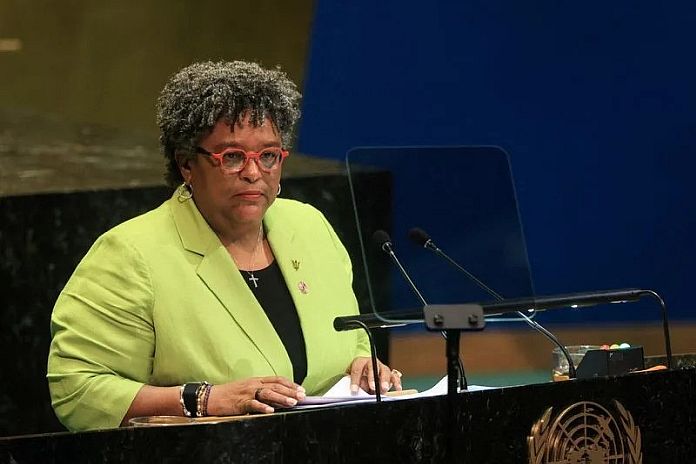
From her earliest addresses on climate justice to her interventions at the United Nations, Mottley’s voice has been unmistakable: measured yet urgent, dignified yet unyielding. She has positioned Barbados not as a supplicant small state seeking assistance, but as a principled advocate exposing structural inequities embedded in the global financial order.
The world has taken note of her clarity – whether speaking on climate finance, debt vulnerability, or development disparities. She reframes these issues not as abstract policy debates but as moral imperatives: Who bears responsibility? Who pays the price? Who writes the rules? By casting small-island concerns as universal ethical questions, she has elevated regional vulnerability into a global accountability.
This is transformational leadership in practice. Rather than operating within the confines of status quo assumptions, she has sought to shift the paradigm itself – articulating coherent alternative frameworks that have prompted intellectual and institutional reconsideration at the highest levels of international governance.
Advancing Barbados, the Caribbean, and small states
Domestically, her tenure has included Barbados’s transition to a republic, symbolically completing a post-colonial arc and reinforcing a narrative of sovereign self-definition. The move resonated well beyond the island’s shores, signalling to other Caribbean nations that constitutional evolution can be affirming rather than disruptive – forward-looking rather than destabilising.
Regionally, she has helped reposition the Caribbean’s global image – from one defined primarily by tourism dependency and climate vulnerability to one grounded in moral authority on development and environmental justice. By building coalitions that extend beyond the Caribbean to other small and developing states, she has constructed alliances that transcend geography.
Several qualities underpin her outsized influence: cognitive agility, disciplined composure, and moral conviction tempered by pragmatism. A trained lawyer with formidable rhetorical skill, she moves fluidly between legal reasoning, economic architecture, and historical narrative. These strengths have enabled a country of fewer than 300,000 people to shape discussions on climate finance and sovereign debt restructuring – demonstrating that within multilateral systems, intellectual coherence and moral authority can, at times, offset limited material power.
Challenges ahead
A third term, however, does not arrive without formidable tests.
Domestic pressures remain paramount. Economic resilience in a climate-vulnerable, tourism-dependent economy demands constant adaptation. Transformational international advocacy must translate into tangible domestic gains.
Geopolitical fragmentation presents another challenge. Her leadership model relies on functional multilateralism. Should global institutions weaken further or great-power rivalry eclipse climate cooperation, the leverage of small-state coalitions may diminish.
There is also the question of durability. Transformational leadership can be intensely leader-dependent. For her reforms to endure, they must be embedded within bureaucratic practice, regional institutions, and international norms. Succession planning and the cultivation of new leadership will determine whether her agenda becomes a durable doctrine or remains closely associated with her personal authority.
A voice larger than the state
History occasionally produces leaders whose influence transcends the scale of their nations. What distinguishes Mottley is not charisma alone, nor rhetoric alone, nor policy fluency alone – but the integration of all three into a coherent moral and strategic framework.
She has demonstrated that small states need not possess small voices. Through clarity of message, institutional ambition, and disciplined advocacy, she has reshaped how the Caribbean is heard in global forums. Her third electoral mandate suggests that her domestic constituency recognises both the symbolism and the substance of that role.
In a century defined by climate disruption and deepening inequality, her voice – clear, Caribbean, and unapologetically global – remains one to be reckoned with.
- Ron Cheong, born in Guyana, is a community activist and dedicated volunteer with an extensive international background in banking. Now residing in Toronto, Canada, he is a fellow of the Institute of Canadian Bankers and holds a Bachelor of Science degree from the University of Toronto.