

By Kristoffer Welsien, Mariappa Kullappa and Sumila Gulyani
“Wake up—the water has come.” At four o’clock in the morning, Swetha rouses her children. The last bucket of water, collected three days earlier when the village taps briefly flowed, is emptied onto the street. Half-awake, the family walks several hundred meters to the community water point in Bekkalale village of Karnataka. Seeing the lengthy line already formed, they realise that the children will miss school and Swetha will miss work.
The burden of poor access to water supply cannot be overstated. Its impacts extend far beyond inconvenience, shaping household decisions, and undermining education and health. It directly hurts the ability of rural women to work—they need to be home to collect water at the unscheduled hour that it might come.
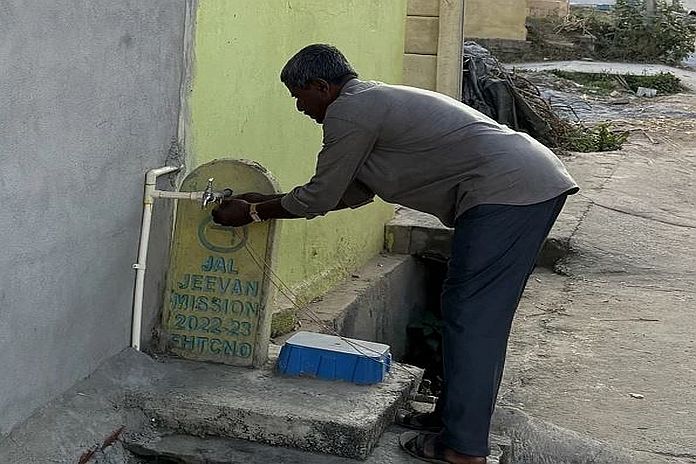
To tackle this issue, the government of India launched the Jal Jeevan Mission (JJM) in 2019, with the ambitious goal of providing piped drinking water to every rural household in the country—reaching over 900 million people in more than 600,000 villages. Coverage has increased rapidly, but so too have the challenges associated with keeping the water flowing.
Recognising these challenges, India launched JJM 2.0 on March 10, 2026, extending the mission through December 2028, and emphasising structural reforms to move the focus from infrastructure creation to delivery of reliable and safe drinking water to communities over an extended period.
Two Moon Shots from Karnataka
In August 2023, the Indian Space Research Organization, headquartered in Bengaluru, Karnataka, landed a rover on the Moon, marking a new era in India’s technological achievement.
The same month, the Government of Karnataka launched its own Moon Shot – the Karnataka Sustainable Rural Water Supply Program – in partnership with the World Bank to deliver piped water reliably to its 44.5 million rural residents. The program recognises that water supply systems are uniquely sensitive: a single malfunction – whether a pump failure, leak, or power disruption – can halt service completely. Operating one or ten water schemes is manageable; running thousands of rural systems for decades, while ensuring consistent service, is hard. Arguably, as hard as landing on the moon and requiring far more than technical prowess.
Doing things differently: Under its new Program, Karnataka decided to combine the ambition of JJM – connecting its 10 million rural households to piped water – with reforms to build systems, practices, and behaviors across the state’s 5,946 Gram Panchayats. The central premise of the Program is clear: infrastructure alone does not deliver water—strong institutions and systems are needed to ensure water flows reliably for decades and generations to come.
Four features of the Karnataka Program are worth highlighting:
- Measure everything. Karnataka is developing an all-encompassing monitoring and benchmarking system for operating and maintaining rural water schemes. As an example, the system has a full record of water quality tests for every village, with QR code access for interested citizens. An asset management system tracks everything, including the periodic cleaning of overhead water tanks in all villages of Karnataka – all 32,415 of them. The state now knows that 29,225 of these are functional and is repairing the 3,190 old tanks that are not working.
- Build community ownership:Citizens play a critical role in the Karnataka program. They need to take ownership of the infrastructure, turn off water taps to prevent waste, prevent damage to meters, and pay their modest water bill. This is a key feature of the state’s operations and maintenance policy which has already been formally adopted by 5,628 of 5,946 Gram Panchayats (94 percent).
- Community-led budgeting and user fees to support operations and maintenance. Rural water schemes often fail because of insufficient financing for maintenance and repairs. Karnataka is starting to demonstrate how to roll out community-led budgeting for water and revenue collection, at scale. Dedicated water bank accounts have been opened in all Gram Panchayats, and more than half (3,431) of them have prepared their annual water budget, which includes expenses for electricity and preventative maintenance. Many communities have started collecting user fees for operation and maintenance, because government grants are not always sufficient. District and block level staff are now monitoring village budgets for operations and maintenance as well as revenue collection rates.
- Fix energy-inefficient water pumps to lower costs: Thousands of old energy-guzzling water pumps run every day, using far more energy than necessary. The Karnataka Program is improving energy efficiency to reduce the price of water.
Raising the bar while advancing on its Moon Shot. Beyond the ambition of JJM 2.0, the Program decided to test the feasibility of delivering water 24 hours a day, 7 days a week (24×7) in 500 villages as a 5-year target. Surprisingly, the Program has already upgraded 233 villages to 24×7 water supply, and contrary to common belief, early results show that providing water 24×7 can save water, energy, and money. In the upgraded 24×7 villages, water consumption declined by one-third on average and lowered energy consumption, delivering financial savings to Gram Panchayats. Before transitioning to continuous supply, pipes were systematically inspected, and water leakages were fixed, reducing losses.
In August 2025, Swetha’s village started receiving water 24×7. When we visited in February 2026, Swetha said:
“I came to this village as a bride ten years ago, and life was hard. The new water system has transformed our lives. I now go to work regularly and have time to help the children with their studies. The children no longer miss school either.”
Even as Karnataka works on its Moon Shot of building a system that reliably delivers water in all rural taps, it has doubled one of its targets – it now plans to upgrade 1,000 villages to 24×7 water supply within the next 12 months.
Hopefully, other states will also raise their ambition as they implement JJM 2.0. The central challenge is no longer delivering pipes—but ensuring that water continues to flow. If India succeeds in landing 24×7 water supply in every village, it may be the country’s most important mission yet.