

- Embedding inclusion in the fast-evolving architecture of the global energy transition.
GENEVA, Switzerland – As governments accelerate efforts to secure supplies of cobalt, nickel and other strategic minerals essential to electric vehicles, batteries and renewable energy systems, the global race for critical energy transition minerals is reshaping industrial policy and trade alliances.
Dozens of new mines and processing facilities may be required by 2030 to meet rising demand linked to net-zero commitments and new manufacturing strategies.
For mineral-rich developing economies, this surge presents a rare opportunity: to move beyond raw extraction into higher value-added activities such as processing and refining, strengthening domestic capabilities and economic resilience.
But a new report by UN Trade and Development warns that the benefits of this transition will not be automatic.
Strategic minerals and the new industrial push
The report examines women’s roles in cobalt mining in the Democratic Republic of the Congo and nickel mining in Indonesia – two pivotal suppliers in global mineral supply chains.
As countries pursue downstream industrialization – exemplified by Indonesia’s expansion of nickel processing – mining is becoming increasingly technology-intensive.
Automation, digital monitoring and advanced refining processes are raising demand for technical and vocational skills. This transformation is redefining who captures value within mineral value chains.
Persistent gender gaps in a growing sector
Women account for just 10 percent to 13 percent of the global industrial mining workforce.
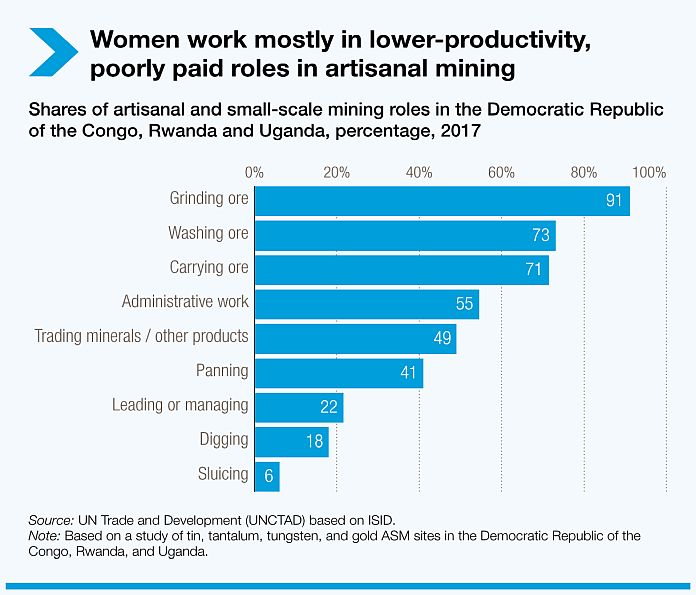
In some cobalt-producing areas of the Democratic Republic of Congo, they represent up to 40 percent of artisanal and small-scale miners. Yet they are often concentrated in lower-paid, more hazardous activities such as washing and sorting ore, frequently without protective equipment.
In one survey, 90 percent reported never receiving formal mining or safety training.
Without deliberate inclusion policies, technological upgrading risks reinforcing existing gender gaps and confining women to informal or low-productivity roles – even as investment and export revenues expand.
Governance choices will shape outcomes
The report argues that the race for strategic minerals is also a governance test.
Trade and investment frameworks, mining legislation, local content rules and skills policies collectively determine how opportunities are distributed along the value chain.
If gender considerations are not embedded in these frameworks from the outset, disparities may become entrenched as capital flows into the sector.
Emerging practices show a different path is possible.
In Lualaba Province in the Democratic Republic of Congo, a copper mining company linked local hiring targets to investments in girls’ education and skills development.
Through cadetship and career preparation programmes, 114 of 228 community recruits were women, while half of secondary school bursaries went to girls in 2023.
Some 30 percent of entry-level local hires were filled by women.
UNCTAD calls for a dual strategy: integrating gender considerations into mining laws and value-chain policies, while improving working conditions and social protection for women already active in artisanal mining.
As the geopolitics of critical minerals intensify, decisions taken today will shape labour markets and industrial structures for decades.
Ensuring that women can access skills, jobs and leadership roles is not an add-on to the energy transition – it is part of the economic architecture that will determine who benefits from it.