


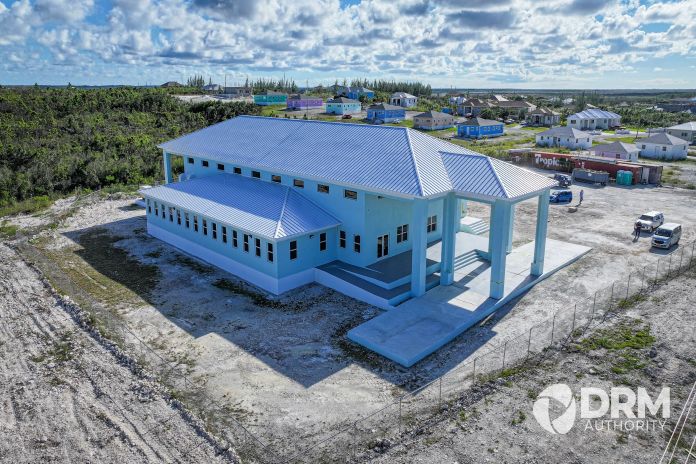
KINGSTON, Jamaica, (UNDP) – A climate resilient hurricane shelter, able to withstand category five-level disasters and flagged as a global best practice, is now open and activated on Abaco, the culmination of a tri-lateral partnership between the governments of The Bahamas and India and the United Nations Development Programme (UNDP).
Built to withstand 200 mile per hour winds and host up to 800 persons, the newly operationalised hurricane shelter and community center is built as a multi-purpose facility for year-round community activities and a safe space during disasters for the people of Abaco. It includes solar power and water harvesting systems, disability inclusive features at access points and bathrooms, an industrial kitchen, an office space for emergency personnel and communications and outdoor space for sporting activities during the year.
The UNDP-managed project was funded by the government of India with a USD 1 million grant from the India-UN Development Fund as a show of solidarity and friendship to the government and people of The Bahamas. The Disaster Risk Management Authority (DRA) of The Bahamas served as national implementing partner for the initiative, overseeing construction activities and mobilising 3.5 million USD parallel co-financing from the government of The Bahamas.
High Commissioner of India to The Bahamas (resident in Kingston, Jamaica), His Excellency Shri Mayank Joshi disclosed that the Abaco Shelter has been chosen as a global best practice under the India-led Coalition of Disaster Resilience Infrastructure (CDRI) – a global partnership inspired by India’s experiences with natural disasters, in which UNDP also serves as a strategic partner.
“As we hand over this facility, we celebrate not just a building but a partnership of shared values, shared challenges, and share aspirations for a safer and more prosperous future,” Joshi said.

The permanent representative of India to the United Nations and director on the management board of the India–UN Development Partnership Fund commended the outcome, embodying the spirit of “Vasudhaiva Kutumbakam” – the world is one family, reflecting India’s solidarity with Small Island Developing States (SIDS) and its steadfast support for climate resilience and disaster preparedness.
The facility now stands as a new beacon of hope in the face of more frequent and severe disasters, said Leon Lundy, minister of state with responsibility for Disaster Risk Management in the office of the prime minister.
“In ordinary days, it will serve as a place of training, community meetings, skills building, and youth development. In extraordinary hours, it will become a sanctuary, a command post, a beacon of order when the winds rise, and the waters push,” minister Lundy stated.
Building on this success, DRA plans to further expand shelter coverage into the future across The Bahamas’ family islands, most at risk from hurricanes.
Dr Kishan Khoday, UNDP Resident Representative in The Bahamas, Belize, Bermuda, Cayman Islands, Jamaica and the Turks & Caicos Islands, likewise lauded the South-South cooperation model between The Bahamas and India, with UNDP and the UN Office for South-South Cooperation, which UNDP hosts, prioritising this model as a way forward to scale up action on the climate emergency.
“Category 5 shelters can have big impact for community resilience goals in places like The Bahamas, with scope to replicate the Abaco Shelter model in other Caribbean Small Island Developing States (SIDS). Today, SIDS are on the frontlines of the climate crisis, with 2025 seeing new records broken in the Caribbean for intensity of storms and degree of impacts. Ensuring a resilient recovery from disasters must include scaled-up investments to expand climate-resilient infrastructure and shelters. We commend The Bahamas and India for this outcome,” he stated.
The hurricane-resilient shelter in Abaco concludes UNDP’s post-hurricane Dorian resilient recovery support to The Bahamas. The UNDP Multi-Country Office in Jamaica is scaling up climate resilience and disaster recovery support to the Caribbean as climate change impacts generate more intense and frequent storm systems.
Last year was one of the most powerful hurricane seasons on record, with hurricane Melissa being one of three category five-level storms to hit the Caribbean in 2025.
With record ocean temperatures and more frequent and severe climate disasters becoming the new normal, a priority is to rapidly enhance levels of climate resilience and disaster preparedness.