


By Judana Murphy
KINGSTON, Jamaica, (JIS) – The Bank of Jamaica (BOJ) Monetary Policy Committee (MPC) has unanimously agreed to maintain the policy rate on overnight placements by deposit-taking institutions at 5.75 percent per annum.
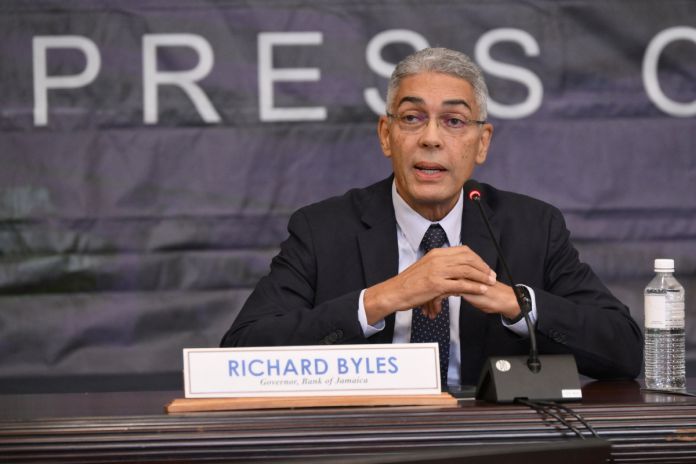
Speaking during the Quarterly Monetary Policy Report press conference at the BOJ auditorium in downtown Kingston on December 22, Governor Richard Byles, said the decision to maintain the policy rate at this time is based on four main factors. He outlined that annual headline inflation is projected to rise sharply in the coming months – from 4.4 percent in November – and is expected to exceed the bank’s four to six per cent target range by early 2026.
The Central Bank Governor explained that the forecast primarily reflects hurricane Melissa’s impact on major food-producing parishes, as well as disruptions to supply chains, particularly in energy and agriculture.
“These supply-side shocks lie outside the direct influence of monetary policy and, therefore, cannot be addressed through interest rate actions but will have a knock-on effect on other prices,” Byles advised that core inflation is projected to rise over the next 12 months, breaching the target range in early 2026.
“This will reflect another wave of price increases for other goods and services, such as home repairs, meals sold at restaurants, and personal-care items. The Central Bank is, therefore, positioning monetary policy to minimise such second-round effects and to constrain the inflation expectations of businesses and consumers.”
Governor Byles explained that another key factor in the MPC’s decision was the government’s suspension of the fiscal rules for an initial one-year period, allowing increased spending on recovery and relief efforts. He noted that this will lead to larger fiscal deficits over the next three years.
“While additional government spending is absolutely essential to rebuild the foundations of the economy following such a catastrophic event as hurricane Melissa, the bank has to position its policy to temper any possible inflationary impulses from this increased spending,” he said.
Governor Byles shared that the MPC also considered inflationary risks, noting a greater likelihood of inflation exceeding projections.
“Higher inflation could result from higher-than-expected demand to support the reconstruction efforts. Inflation expectations could also rise as households and firms anticipate higher prices and adjust their behaviour in ways that make higher inflation self-fulfilling,” he stated.
Governor Byles also noted that a slower-than-expected recovery in the agriculture sector, coupled with prolonged supply chain disruptions, could further exacerbate food price increases.
“There could also be long-term damage to specific industries, which could slow the improvement in production and availability of supplies,” the Governor further stated.