

By BDC
MONTREAL, Canada – In the last edition of the Monthly Economic Letter, we shared our economic outlook for the coming year. This time, we zero in on three key trends that will affect Canadian businesses and make for an eventful 2026.
These long-standing forces are shaping the economy now more than ever: geopolitical uncertainty, demographic change and the rapid rise of AI. They will have a tangible impact on businesses over the next 12 months. With our outlook for 2026 being for positive but modest growth, businesses should take these trends into account in their strategy to better position themselves for long-term growth.
Geopolitical uncertainty
Tariffs and trade took centre stage in 2025—and they will be right there again in 2026.
As part of the mandatory review of the Canada-United States-Mexico Agreement (CUSMA), preliminary discussions between Canada and the United States will begin in mid-January. Although many US tariffs were introduced in 2025 and the average level of tariffs increased significantly, to date, it remains at a manageable 5.9 percent. That’s because nearly 90 percent of exports are still protected by the CUSMA.
Some tariff increases that were scheduled to take effect in January have been postponed until January 2027. This is the case for certain wood products, including upholstered furniture, kitchen cabinets and vanity units. That’s providing a welcome respite for the affected industries, of course, but also a measure of optimism for the trade talks ahead.
Still, recent international geopolitical upheavals are reigniting uncertainty around the world and could complicate the CUSMA review that is scheduled to formally start in July.
Despite trade tensions and geopolitical uncertainty, some recent developments offer reason for optimism for entrepreneurs. Internationally, communication channels between Canada and China have reopened. At home, businesses operating nationally will benefit from simplified interprovincial trade. These developments don’t eliminate the risk of future setbacks, but they could provide help for businesses seeking to stabilise their operations and plan for growth.
Demographic change
It’s no secret that Canada is aging—and fast. What does this mean in concrete terms? First, a declining employment rate, despite ongoing job creation. In the 1970s, there were eight Canadians of working age for every person aged 65 and over. Today, that figure is closer to three, despite strong population growth in recent years, which has tempered the effect.
Ultimately, this means that there will be fewer potential workers (relative to retirees) to stimulate economic activity and fund social programs.
These demographic changes are already having a tangible impact on Canadian businesses, and the pressure will intensify in the long (and short) term.
- Labour shortages: While uncertainty has slowed economic growth, many businesses are still struggling to find staff, whether due to regional worker shortages or the type of skills required. Businesses grappling with this problem are more likely to experience slower growth, be less competitive and see a deterioration in the quality of their products and services. Even if your business is not directly affected by a labour shortage, the issue is driving up overall wage costs. Businesses can reduce their dependence on labour by adopting new technologies and by automating tasks.
- Business transitions: It’s not only employees who are aging but also business owners. That represents a major challenge for the viability of many small and medium-sized businesses and Canada’s economic vitality. Business transfers are critical for maintaining jobs and expertise in the country. But they also represent opportunities for growth through acquisitions. Buying a company gives a business access to a pool of new talent, client lists and service offerings that enhance and complement its current activities.
- Consumer demographics: As a general rule, spending slows after individuals reach a certain age. The aging of the Canadian population will, therefore, lead to a slowdown in demand for goods and services. Some sectors will fare better than others. Among the obvious winners are sectors such as healthcare, pharmaceuticals and accessibility solutions for aging at home. New retirees, ages 65-74, are big consumers of tourism but demand drops after age 75.
The advent of AI technology
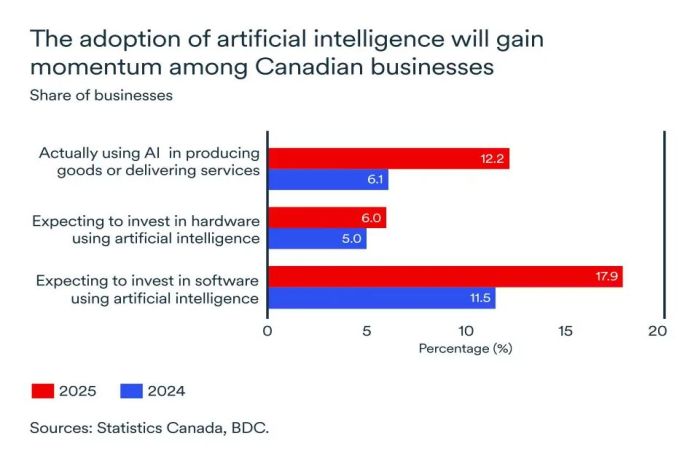
The adoption of artificial intelligence (AI) is progressing in Canada and around the world, but the gap between its use by large companies and SMEs remains wide. Larger companies, particularly in finance, logistics and manufacturing are already deploying advanced AI to automate their processes and optimise decision-making. Conversely, many smaller businesses are hesitating, held back by the cost of the tools, a lack of internal skills and the complexity of integration. However, smaller-scale AI solutions will continue to come to market.
At the same time, the issue of digital sovereignty is gaining increased attention. At both the national and provincial levels, investments in AI infrastructure to reduce dependence on foreign platforms and protect sensitive data will grow this year. This trend opens opportunities for providers of this type of service.
The rise of AI is being accompanied by increased demand for talent: engineers, cybersecurity specialists and software developers. Companies, including many SMEs, will have to compete to attract these employees. On the other hand, the resources previous devoted to performing certain repetitive, analytical or administrative tasks can be reallocated to higher value activities.
As this technology evolves, the associated risks for businesses will increase, and once again, smaller businesses will be more vulnerable. Sophisticated cyberattacks, automated disinformation and deepfakes are threats to the reputation and security of businesses. SMEs will need to invest in robust detection and protection systems to maintain the trust of customers and partners.
The impact on your business
Canadian businesses can manage these trends by learning from what larger organisations are doing, investing in their infrastructure and training their teams.
- Once again this year, businesses would be wise to prepare financial projections, especially if you export. Take advantage of interprovincial trade simplifications to diversify your markets and partners.
- Plan strategies today to prepare your business for the changes brought about by an aging population and slower immigration. This is a good time to adapt your offerings and business strategy, such as adjusting your sales cycle or seizing merger and acquisition opportunities. Technologies can help.
- The race for AI is accelerating among SMEs. New tailored solutions are arriving, so be ready to test and position yourself to quickly reap the benefits. Be curious, well-planned and financially prudent in your approach.