

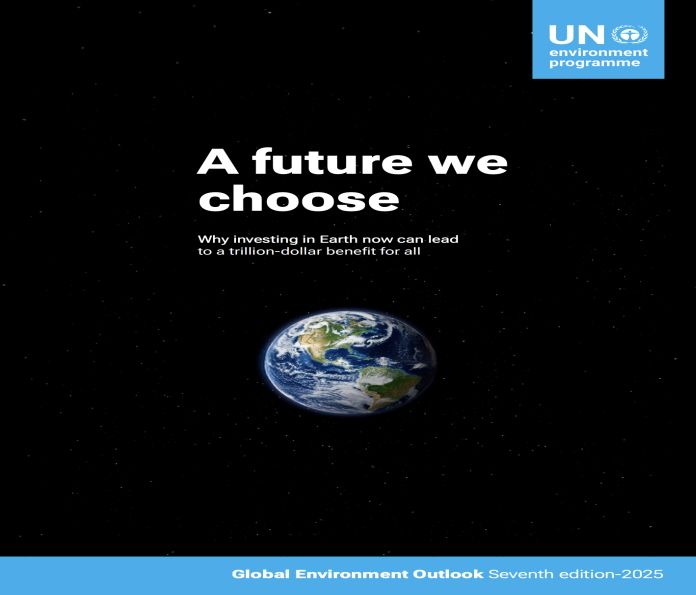
 WASHINGTON, USA – Adopting a fresh approach to protecting planetary health would deliver stronger economies, fewer deaths and less poverty, the UN Environment Programme (UNEP) insisted on Tuesday, as it released its most comprehensive assessment of environmental pressures facing the world.
“The Global Environment Outlook lays out a simple choice for humanity: continue down the road to a future devastated by climate change, dwindling nature, degraded land and polluted air, or change direction to secure a healthy planet, healthy people and healthy economies,” said UNEP executive director Inger Andersen.
The report has input from 287 multi-disciplinary scientists from 82 countries and stretches to well over 1,000 pages.
Looking beyond GDP
The report makes a case for interconnected ‘whole-of-society’ and ‘whole-of-government’ approaches to transform economy and finance, materials and waste, energy, food and the environment.
Taking this path starts with moving beyond gross domestic product (GDP) as a measure of economic wellbeing and instead using inclusive indicators that also track the health of human and natural capital.
It continues with a transition to circular economy models; a rapid decarbonisation of the energy system; a shift towards sustainable diets, reduced waste and improved agricultural practices; and expanding protected areas and restoring degraded ecosystems – all backed by behavioural, social and cultural shifts that include Indigenous and local knowledge.
Two pathways to change
The report lays out a social and a technological pathway to transformation.
- Behaviour-focused transformation pathway: lifestyle, behavioural and value changes. Social awareness of the environmental crises drives a shift in worldview.
- Technology-focused transformation pathway: innovation and technological solutions. An urbanized world with significant global trade and technological spill-over.
Why it matters
According to UNEP:
- The state of the environment will dramatically worsen if the world continues to power economies under a business-as-usual pathway.
- Without action, global mean temperature rise is likely to exceed 1.5°C above pre-industrial levels in the early 2030s, exceed 2.0°C by the 2040s and keep climbing.
- Climate change would cut 4 percent off annual global GDP by 2050 and 20 percent by the end of the century.
- If made, the changes have the potential to avoid nine million pollution-related premature deaths, lift 200 million people out of undernourishment, and move 150 million people out of extreme poverty by 2050.
The agency called on countries to follow the whole-of-society and whole-of-government approaches laid out in the report to achieve a sustainable future.
“This sounds like, and indeed is, a massive undertaking. But there is no technical reason why it cannot be done,” Andersen said.