



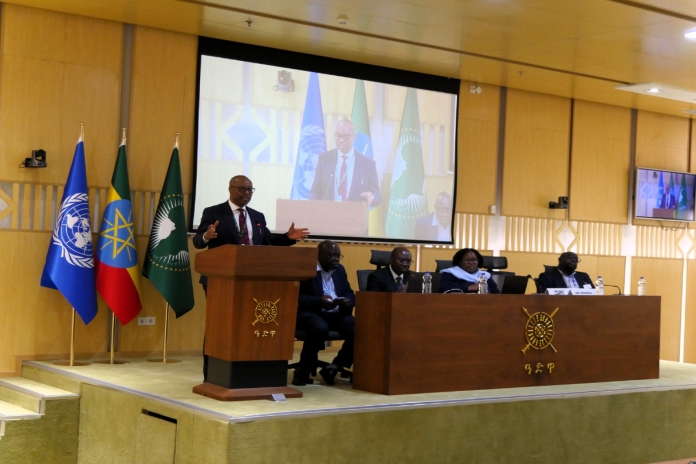
AFRICA – The 13th Conference on Climate Change and Development in Africa (CCDA-XIII) has concluded with a resounding call for a coherent, evidence-based, and investment-ready African climate agenda.
Held from 5-7 September, the conference brought together more than 250 policymakers, negotiators, scientists, civil society representatives and youth leaders. Delegates reaffirmed CCDA’s role as Africa’s leading technical platform linking climate science, policy and action. The conference outcomes will inform the Second Africa Climate Summit (ACS2) and shape the continent’s common position at COP30 in Belém, Brazil.
Opening the gathering, Mithika Mwenda, executive director of the Pan African Climate Justice Alliance, stressed urgency: “Africa cannot afford to be trapped in endless pledges while our people suffer. We need urgent action, with adaptation and resilience placed at the center of global climate action. Justice means financing Africa’s solutions, not charity handouts.”
Anthony Nyong, director of Climate Change and Green Growth at the African Development Bank, underscored the scale of the financing gap: “Africa is at a crossroads. Despite contributing less than 4 percent of global emissions, our continent receives only 3 percent of international climate finance, even as nine of the ten most climate-vulnerable countries are here. This gap is unacceptable.”
He highlighted the proactive response by the African Development Bank Group to scale climate-smart investments, institutional reforms, and results-oriented finance, including the mobilization of $4 billion through the Climate Action Window by 2025 to support vulnerable and fragile states.
“Climate resilience must be built where it is needed most—on the frontlines of vulnerability. That means connecting adaptation to peace, empowering every African country to lead its own climate transition, and equipping them with the intelligence to act decisively,” Nyong said.
James Kinyangi, Coordinator of the ClimDev-Africa Special Fund at the Bank, emphasized science as Africa’s first line of defense: “Without closing knowledge gaps, our people remain exposed to risks we cannot anticipate or manage. Investing in climate data and early warning is not optional – it is essential for saving lives and building resilience.”
The conference delivered a set of technical recommendations that will shape the Addis Ababa Declaration and Africa’s common voice for COP30:
- Science, Data & Climate Intelligence – Invest in integrated climate monitoring systems, early warning, and indigenous knowledge to close Africa’s data gaps and guide policymaking.
- Adaptation, Resilience & Loss and Damage – Address Africa’s $160 billion annual adaptation gap; operationalize the new Disaster Tracking System; and ensure equitable access to the Loss and Damage Fund.
- Transforming Climate Finance – Shift from aid dependence to strategic investment, mobilizing $2.5–$3 trillion annually by 2030; expand tools like green bonds and blended finance; and ensure at least 10% of flows create Africa’s green workforce.
- Just Transition & Energy Access – Universal energy access must be placed at the heart of Africa’s transition, while developing value chains for critical minerals and positioning the continent as a global hub for green hydrogen and renewable-powered industrialization.
- Ecosystems & Nature-Based Solutions – Scale up stewardship of forests, wetlands, and peatlands, embed circular economy principles in NDCs, and recognize Africa’s ecosystems as global public goods.
- Governance & Institutional Coherence – Rationalize Africa’s climate governance architecture under AU leadership; embed climate into national plans; and strengthen negotiating capacity.
- Global Community Responsibilities – Deliver the $300 billion annual climate finance commitment by 2035; agree on a measurable Global Goal on Adaptation; and establish fair carbon taxation regimes to support Africa’s resilience.
Closing the conference, Claver Gatete, United Nations under-secretary-general and executive secretary of ECA, emphasized Africa’s leadership: “This conference was not an end in itself. It is a bridge that links evidence with ambition, technical depth with political momentum, and Africa’s aspirations with actions. Africa is not waiting to be acted upon. We are shaping our destiny, leveraging our resources, and bringing solutions to the world.”
Click here for more information on the African Development Bank’s role in CCDA XIII and the Second Africa Climate Summit.