



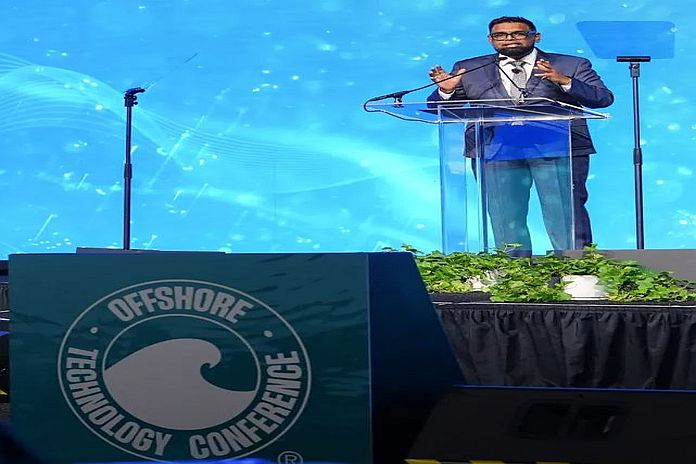
 GEORGETOWN, Guyana, (DPI) – President Dr Irfaan Ali said that the world must adopt a balanced approach to global energy need and highlighted critical realities for the energy sector, including a widening energy gap and the scale and distribution of investment required to address it.
During his feature address at the opening of the Offshore Technology Conference (OTC) 2026, in Houston, Texas, the president underscored that the transformation of the global energy system is not simply a technological challenge but a fundamentally financial one that goes beyond substituting fossil fuels with renewable energy.
Renewables are expanding, they are not sufficient to meet demand, and that fossil fuels continue to play a central role in meeting baseload demand and supporting industrial development, the president highlighted that of the total investment globally in 2025, approximately 65.2 percent was directed towards clean energy, while 34.8 percent was invested in fossil fuels, says president Ali.
The head of state explained that although global investment has substantially increased, it remains insufficient to meet the scale of the challenge of aligning with global climate targets, especially the goal of limiting global warming to 1.5 degrees. To achieve this, the president noted that, large economies will have to increase annual investment significantly.
“This imbalance has profound implications. The regions with the fastest-growing energy demand are not the regions receiving the largest share of investment. The Global South, where demand is rising most rapidly, remains highly underfunded.”
Guyana’s model
President Ali reminded that Guyana’s role in the global energy and climate landscape is distinctive, underscoring that while the country is one of the fastest-growing oil producers in the world, it is also one of the most significant net carbon sinks globally. Guyana has maintained one of the lowest deforestation rates in the world and has a forest cover of approximately 85 percent of its landmass that sequesters more than 150m tonnes of carbon annually.
“We care about the world, and we are demonstrating it,” the president said. Developments in Guyana are underlined by a Low Carbon Development Strategy (LCDS) 2030 that provides a framework for integrating environmental stewardship with national development.
“Guyana demonstrates that energy production, Climate Leadership and biodiversity protection are not mutually exclusive. They are mutually reinforcing. We are showing that a country can, at the same time, produce oil, maintain a net carbon sink, expand renewable energy and protect its natural environment. We take pride in that—it is the responsible thing to do. We urge others to join us in this endeavour for all mankind and for our own homeland and this planet Earth.”
The president added that it is within the context of global challenges and opportunities that Guyana has defined its energy strategy.
“We approach this moment with clarity and with discipline. We have rejected the false choice between economic development and environmental stewardship. We’ve also rejected the notion that the energy transition can be pursued through a single pathway. Instead, we have adopted a deliberate and integrated, dual-track approach,” and these objectives are not mutually exclusive and, with careful management, reinforce each other.
“Guyana’s energy strategy is not a single project or a single sector. It is a system-wide transformation. Over the past five years, we have moved from policy to execution. Our gas-to-energy project is a cornerstone of this effort.”
President Ali noted the expansive investment in the national grid, affordable electricity, improved generation, improved reliability and a significantly lowered carbon-intensive system are cornerstones of Guyana’s energy plans.
In addition to developing its own infrastructure and energy mix, the president also noted that Guyana is actively engaging bilateral partners such as Brazil, Suriname and French Guiana to explore the development of mega-scale regional power infrastructure and interconnection systems.
This, he said, “would lead to regional energy integration that offers improved energy security, greater efficiency, expanded opportunities for economic cooperation, redundancy and an energy system of the future that is not isolated, but interconnected.”
Guyana’s strategy is clear, explained President Ali:
“We’re using our hydrocarbon resources to finance the future. We are building isolated projects. We are building a diversified, resilient and modern energy ecosystem. We are not delaying transition. We are investing in the balance of the future,” adding, “ the global energy balance, is not a simple shift from one system to another, but a complex transformation shaped by rising demand, constraints, supply, uneven investment, emerging dependency, incentives and technology, geopolitical realities and rising new frontiers. The world requires reliable and affordable energy that is produced with the least impact on the environment and the greatest return on the dollar.”
“ And, I say most humbly that Guyana fits the bill in all of these criteria, any investment in energy in Guyana is an investment in a sustainable future and a balanced framework that the world needs,” said president Ali.
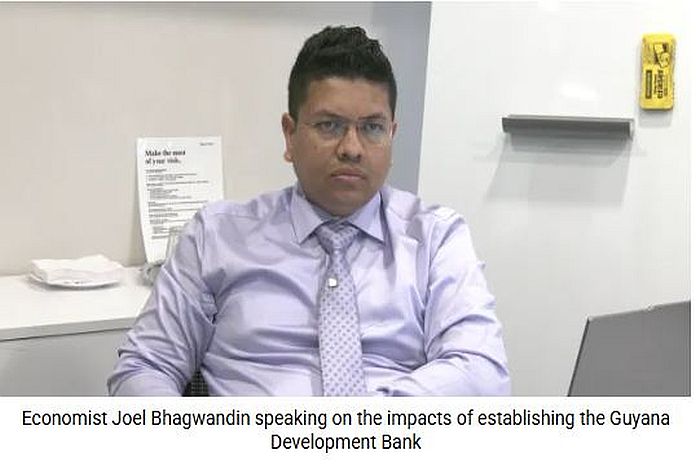
Meanwhile, the establishment of the Guyana Development Bank (GDB) marks a critical step in transforming the country’s economic landscape, with a strong focus on inclusion, entrepreneurship and sustainable growth.
Speaking in an interview with the Department of Public Information (DPI), economist Joel Bhagwandin explained that, unlike traditional banks, the GDB is designed to support individuals who have been unable to access financing – particularly small entrepreneurs and those operating in the informal economy. He noted that the initiative will provide interest-free and collateral-free loans.
Bhagwandin also said the bank will offer business training, mentorship and financial guidance, giving citizens the tools needed not just to start businesses, but to sustain and scale them.
The economist highlighted that over 80,000 new businesses have been registered in recent years, signalling strong entrepreneurial interest.
However, many remain limited by a lack of access to financing and formal systems, gaps that the development bank aims to close by transitioning small operators into the formal economy.
“Nobody must be left behind, and this is why the Development Bank is so important. It is to create new industries, not to compete with the commercial banks,” Bhagwandin stated.
The economist also underscored the bank’s role in strengthening key sectors such as agriculture, where expanded financing and support services will help unlock Guyana’s vast underutilised lands and boost food production.
“With those investments and the policy framework, it is important to get more young people in agriculture. By learning innovative ways of conducting agriculture and by seeing agriculture not as a laborious profession, but as a viable, sustainable business,” said Bhagwandin, pointing to opportunities in tourism and new industries, explaining that the bank will help drive diversification as Guyana prepares for a future where oil production stabilises.
Bhagwandin emphasised that the Development Bank is not intended to compete with commercial banks, but to fill a critical financing gap in creating new business opportunities for Guyanese.
This initiative, he underscored, forms part of a strategic mechanism to reduce poverty, expand opportunity, and empower citizens, ensuring that more Guyanese can actively participate in and benefit from the country’s rapid economic transformation.