



- NDP-supported solar energy centres to rise to minimum five this year, with more in the works
KINGSTON, Jamaica – The United Nations Development Programme (UNDP) has announced a new JMD 9.2 million partnership with the Government of Australia to establish three additional solar-powered community centres in fishing communities hit by Hurricane Melissa, building on the two delivered to Parottee and Galleon Beach in St Elizabeth, last week.
When complete, the number of solar energy centres supported by UNDP will rise to five, with more in the works for other fishing villages impacted by hurricane Melissa.
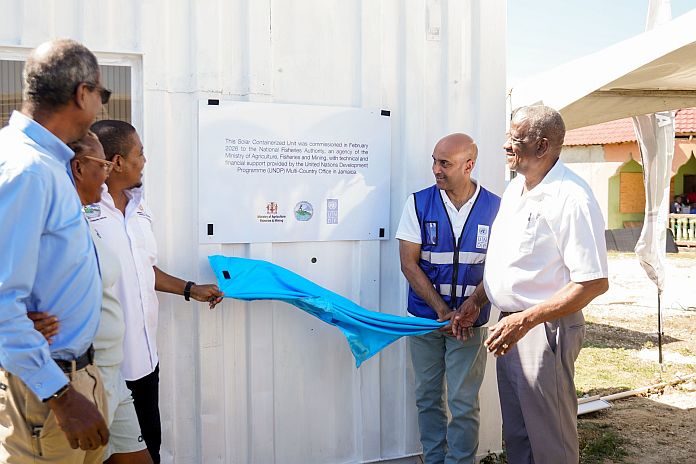
UNDP resident representative Dr Kishan Khoday also signalled UNDP’s intention to replicate and scale similar solutions across other vulnerable communities at the handing over ceremonies for two solar centres on Friday in Parottee and Galleon Beach.
With the delivery of the two solutions last week, more than 300 fishers who lost their livelihoods to hurricane Melissa can now secure cold storage to preserve their post-harvest catch, along with Starlink internet and charging stations – all powered by the sun. Serving 250 fishers in Parottee and 50 in Galleon, St Elizabeth, the two fully air-conditioned solar energy community centres are each powered by eight photovoltaic panels generating 5600 watts of energy, lithium battery storage, a Starlink unit and chest freezers. Two boat engines were also handed over to the community of Galleon for shared use among its fishing community.
Donated by UNDP in partnership with the National Fisheries Authority and the Jamaica 4H Foundation under UNDP’s Jamaica Resilient Recovery Initiative (JARRI), the centres supply clean affordable energy at zero cost to the fishing communities.
“Though modest in scale, these systems send a strong message: clean energy can support livelihoods, strengthen food security, and help communities recover stronger than before,” Dr Khoday stated. He said the initiative reflects UNDP’s approach to recovery: rebuilding in ways that reduce future risk while supporting long-term sustainable development. “As climate change continues to intensify risks for Small Island Developing States like Jamaica, solutions such as these, show what climate-smart recovery can look like in practice,” he pointed out.
Minister of agriculture, fisheries and mining, Floyd Green, called for the installation of model mobile solar-powered centres in fishing villages across Jamaica to support fisher livelihoods in and out of season and to strengthen food security. In welcoming the donation, he said the centres tick all the boxes related to sustainability, climate resilience and building back better. Rebuilding livelihoods is key to rebuilding communities impacted by the hurricane and requires strong partnerships, Minister Green stated. He lauded the fishing community for their resilience, acknowledging their self-reliance and drive when given opportunities.
Minister of state in the ministry, Franklin Witter, lauded the solar centres as key to reducing post-harvest losses at a time when the power grid was still out of service in the community. He said with the advance of climate change the solar facilities will go a far way in building the resilience of the fishing community.
In reiterating the National Fisheries Authority’s (NFA) commitment to supporting impacted fishing communities, its chief executive officer Dr Gavin Bellamy said the solar facilities marked another significant step forward on the path to recovery and long-term resilience. He further reported that the NFA has been providing immediate relief to fishing communities, including wire supplies to replace lost and damaged fish pots, facilitating license replacements, renewals, and registrations.”
A direct response to reports of post-harvest losses among fishers in the aftermath of hurricane Melissa, the solar energy community centres solve the challenge of prolonged disruptions in power supply while providing a cost-effective alternative to grid-tied energy costs. The solar-powered solutions form part of UNDP’s Jamaica Resilient Recovery Initiative, which includes livelihoods recovery, home repair, technical advisory services and resilient planning.