



 PORT-AU-PRINCE, Haiti, (PAHO) — The security and humanitarian crisis that has persisted for several years continues to disrupt the lives of thousands of families in Haiti. Armed violence and ongoing insecurity have forced entire populations to leave their neighbourhoods and seek refuge in makeshift displacement sites or with host families, often in extremely precarious conditions.
Today, more than 1.4 million people are internally displaced, primarily in the Ouest, Centre, and Artibonite departments. Many of them, particularly children and pregnant women, lack regular access to essential social and health services, including vaccination, key pilar in the fight against vaccine-preventable diseases.
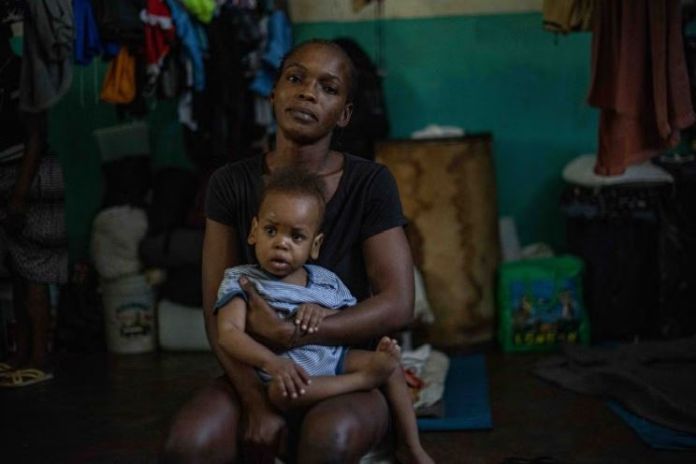
Fara, 40, is one of these displaced mothers. Originally from the Solino neighbourhood of Port-au-Prince, she fled her home a year ago after it was burned down. After a temporary stay in a church, she now lives in a displacement site with her four sons. “I live here with my children in very difficult conditions: overcrowding, poor sanitation, foul odours, dirty water, and waste. The health situation is concerning,” she explains.
To protect displaced children and pregnant women from vaccine-preventable diseases, the Expanded Program on Immunisation (EPI) of the Ministry of Public Health and Population (MSPP), with support from the Pan American Health Organization / World Health Organization (PAHO/WHO) and Gavi, the Vaccine Alliance, has carried out a targeted vaccination campaign in displacement sites and host communities.
Mobile vaccination and active case finding
Over the course of one week, 736 mobile teams visited host communities and displacement sites in Port-au-Prince and its metropolitan area, as well as in the Artibonite and Centre departments, to vaccinate children aged 0–5 years and pregnant women against diseases such as measles, diphtheria, polio, and tetanus. At the same time, teams conducted active community surveillance to identify any suspected cases of acute flaccid paralysis, measles, or other vaccine-preventable diseases.
Fara has always ensured her children are vaccinated, both in her original neighbourhood and since her displacement. For her, vaccination is an essential protection. “Vaccination changes children’s lives: it helps prevent fever, diarrhea, and tetanus, and keeps them healthy,” she says. “As soon as the vaccination teams arrived, I immediately took my child to be vaccinated.”
Community mobilisation that delivers results
Thanks to strong community mobilisation, the campaign vaccinated 4,879 children with zero doses, 4,217 under-vaccinated children, 11,163 children against measles, 3,845 against polio, 6,836 against diphtheria, and 2,627 pregnant women against tetanus. These efforts strengthen protection for displaced populations most exposed to epidemic risks while improving early detection of suspected cases.
For Fara, the presence of vaccination teams in the camp is a real relief. “When vaccination is available here, free of charge, it is very important for me and my children,” she shares.
In a context of prolonged displacement and extreme vulnerability, vaccination remains a critical tool to protect the health and future of Haitian children.