
For decades, visa-free travel was treated as a settled privilege for certain nationalities. For nationals of countries benefiting from visa-free travel arrangements, holding the right passport was enough: you booked the flight and travelled. There was no application, no prior permission, and no advance engagement with a foreign authority before departure. That understanding is now quietly, but fundamentally, changing.
It is important to be clear that this experience was never universal. Many nationalities have always been required to apply for visas, often for each trip, and to submit repeatedly to background checks, documentation requirements, and reassessments of their personal and professional circumstances. Their access was conditional, limited in duration, and frequently restricted to single or short-term entries. For these travellers, advance scrutiny and administrative discretion were longstanding features of international mobility, and states retained the ability to reassess risk before every journey.
What is changing now is not the treatment of visa-required nationals, but the extension of permission-based travel to those who historically moved without prior authorisation.
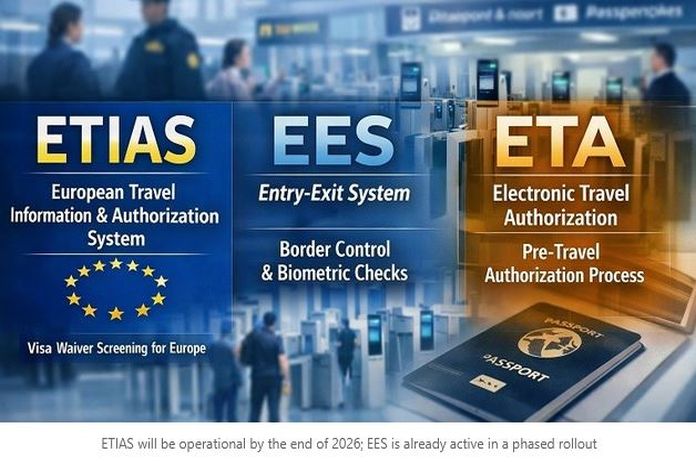
The European Union’s introduction of the European Travel Information and Authorisation System (ETIAS) marks a decisive shift in this direction. When it becomes operational, currently expected in the last quarter of 2026, with a transition period into 2027, most visa-exempt travellers to the Schengen Area will be required to submit an online application before travelling. The process will involve providing personal data, passport details, and answers to security-related questions. Once approved, the authorisation will be electronically linked to the traveller’s passport and may remain valid for up to three years or until passport expiry.
Many policymakers describe ETIAS as a light pre-check. That description misses the point. What matters is not how long the form is today, but the fact that the form exists at all. An electronic travel authorisation is functionally closer to a visa than most governments are prepared to acknowledge. Entry is no longer presumed; permission must come first. Once that threshold is crossed, the nature of travel changes permanently. The seal is broken.
History suggests that prior-authorisation systems do not remain static. They begin modestly, often justified as efficiency tools, and expand over time. Questions are added. Screening criteria deepen. Fees rise. Processing times lengthen. Approval rates shift. None of this requires treaty amendments or diplomatic crises. It requires only political will, and political winds change.
ETIAS must also be understood alongside the EU’s Entry/Exit System (EES). Once EES is fully operational, every entry and exit into the Schengen Area will be logged biometrically. Travel history will no longer be inferred; it will be recorded. Frequency of travel, duration of stays, compliance patterns, and overstays will become immediately visible. Border decisions will increasingly rely on data profiles rather than isolated judgments made at the point of entry. EES is already active in a phased rollout. It officially went live on 12 October 2025 and is being progressively introduced at external Schengen borders.
This matters because ETIAS does not operate in isolation. It creates a permanent digital travel record. Information provided today does not disappear after a single journey. It is stored, compared, and revisited over time. Inconsistencies, whether intentional or innocent, can resurface years later. Screening becomes cumulative. Risk is no longer assessed once; it is inferred continuously.
This shift is particularly relevant for holders of Citizenship by Investment (CBI) passports, especially from the Caribbean. Not because these individuals are inherently higher risk, but because CBI programmes sit at the intersection of mobility, capital, and geopolitics. From a regulator’s perspective, they are visible, measurable, and administratively convenient to scrutinise.
Industry data already reflects this reality. A 2025 survey by IMI Daily found that one-third of senior investment migration executives expect ETIAS to be used as a selective enforcement tool, not through headline-grabbing bans or mass suspensions, but quietly and individually. Case by case. Applicant by applicant. This is precisely why ETIAS appeals to regulators. It allows control without confrontation and differentiation without public declarations.
Visa-free travel once implied spontaneity: the ability to move on short notice without prior engagement with a foreign authority. ETIAS replaces that presumption with a process. It does not matter that the process is digital. It is still an application, reviewed by a foreign system, and it is deniable. Even with approval, entry remains discretionary at the border.
The uncertainty this introduces is not accidental. It is the feature. Two citizens of the same country, holding identical passports, may face different outcomes based solely on their profiles or answers. Over time, this creates a two-tier reality without an official two-tier policy.
It is also important to recognise that authorities are not limited to the information an applicant chooses to disclose. Modern border management increasingly incorporates open-source intelligence, public digital footprints, and cross-agency data sharing. As systems mature, the distinction between travel screening and broader security assessment continues to blur. The final list of ETIAS questions is not fixed, and neither are the datasets that may inform decisions behind the scenes.
This evolution is not unique to Europe. Similar systems exist in the United States, Canada, Australia, and soon the United Kingdom. Each began as a convenience. Each became a filter. Over time, each developed its own enforcement logic. ETIAS follows a well-established global pattern.
For investors, this changes the calculus. Citizenship by investment has long been marketed on speed and certainty: apply, qualify, obtain a passport with defined mobility rights. Prior-authorisation systems introduce conditionality. An investor may complete the citizenship process, commit capital, and only later discover that access to certain regions is delayed, restricted, or unpredictable. This is not speculation; it is the foreseeable outcome of permission-based mobility.
An often-overlooked consequence of this shift is how it is reshaping the role of immigration and global mobility advisers. The era in which a single passport or a single programme could be presented as a complete solution is coming to an end. Advisers are increasingly required to design layered strategies, combining citizenship, residency, long-term presence rights, and jurisdictional flexibility, to manage risk and preserve mobility.
Rather than offering access to one country or region, the task now is to help clients diversify their options, reduce dependency on any single mobility regime, and build resilience against regulatory change. In a permission-based travel environment, mobility is no longer a product; it is a portfolio.
The broader lesson is clear. Mobility is no longer guaranteed by a single passport. Access today does not ensure access tomorrow. Travel rights are increasingly mediated by administrative systems that evolve quietly and apply selectively. In this environment, relying on continuity is not a strategy; it is a gamble.
ETIAS does not end mobility. But it ends the assumption that mobility is automatic. The first authorisation, no matter how simple, changes the relationship between the traveller and the destination state. From that point onward, additional controls become easier to justify and harder to reverse.
Those who plan their freedom of movement as if today’s rules will last indefinitely are relying on hope, not strategy. In a world of biometric exits, centralised databases, and expandable screening systems, protecting mobility requires deliberate planning. The uncomfortable truth is this: quick access and a single passport are no longer enough.
About the Author