
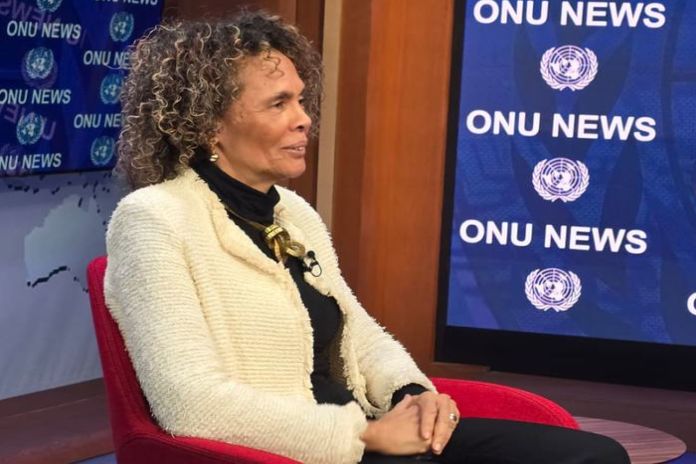
Under-Secretary-General Cristina Duarte, Special Adviser on Africa to the UN Secretary-General, sits down for an interview with UN News [UN News/Ben Malor]
- Africa does not have a million problems, it only has one – a mindset problem, says UN Special Adviser on Africa Cristina Duarte.
AFRICA – The 2025 Academic Conference on Africa at UN headquarters earlier this month, brought together leading African scholars, ministers, and activists to examine why many on the continent feel their countries are on the wrong path – and what must change for Africa to claim its rightful place in a shifting global order.
In an interview with UN News’s Ben Dotsei Malor, Duarte shared her top three takeaways from the thought-provoking gathering.
She emphasised that transforming mindsets, reclaiming the continent’s deep reservoir of knowledge, and strengthening institutions, are essential steps toward true transformation.
This interview has been edited for clarity and length
UN News: What are the three main takeaways from this year’s Academic Conference on Africa?
Cristina Duarte: First takeaway, we need to acknowledge that Africa doesn’t have “a million problems.” In my view, Africa has one problem, a mindset problem. Once we shift this mindset and value African knowledge as a foundation for development, everything else will follow a new direction.
Second takeaway, we need to recognise that Africa, despite almost 60 years of independence, is unfortunately facing a nation-building challenge, a State-building challenge.
Third takeaway, Africa must control its own resources. While Africa is in debt distress, we are not an over-indebted country. The reason behind Africa’s debt distress is that Africa does not control its own economic and financial flows.
UN News: What is it about the mindset that needs to be transformed?
Duarte: Too often, African policymakers look outward – for loans, aid, or investment – before looking inward. Every day, Africa loses about $1.4 billion, or $500 billion annually, due to inefficiencies and capital flight.
Yet we continue to prioritise official development assistance (ODA), which represents barely 10 per cent of that amount.
Our development model must shift from a reliance on external aid to one based on domestic resource mobilisation, not by raising taxes but by using existing resources more efficiently.
UN News: What is the place of remittances from Africans in the diaspora? Sometimes remittances exceed foreign direct investment and ODA [Official Development Assistance].
Duarte: The question of remittances is a question of mindset.
Remittances exceed $100 billion annually, more than ODA and foreign direct investment combined. Yet they’re treated as external flows, but they’re not; they come from Cape Verdeans, from Ghanaians, from Nigerians.
From a policy-making standpoint, you need to approach remittances as a domestic flow, and you need to factor in the best way to use it to be injected into your financing development strategy.
UN News: The majority of the African population, more than 60 per cent, are young people below the age of 25. How can this be harnessed?
Duarte: Right now, it’s not a dividend – it’s a nightmare. Over 85 percent of young Africans work in the informal sector.
To change that, we must invest the wealth we already generate – that $500 billion – into building strong economic ecosystems and productive sectors.
STEM [Science, Technology, Engineering and Maths] needs to be rolled out on a massive scale, so each young African has the tools to secure a decent job. I like to say, ‘If you have a baobab tree with Wi-Fi, just put STEM there.’
From a policymaking standpoint, we need to recognise that the State has a responsibility to create the ecosystems, and that young Africans have the responsibility to leverage and create their own employment.
UN News: You’ve spoken about weak States and governance challenges. What gives you hope for the future of Africa?
Duarte: The future is on our side. By 2050, four out of five young people globally will be African, so demographics speak for themselves.
We also need to stop importing narrow models of Western democracy. Africa has deep-rooted democratic traditions – consensus, participation, and social responsibility – that should inform a Made-in-Africa democracy. The current governance crisis is an opportunity to rebuild political systems that better fit African realities.
UN News: What message would you like to leave with participants of the 2025 Academic Conference on Africa?
Duarte: We must all acknowledge the mindset challenge. Policymakers and academics need a ‘knowledge contract’.
Policymakers must embrace African knowledge to redesign policy, and academics must make their work more relevant to African realities.
Both have been looking outward – policymakers for resources, academics for recognition. It’s time we both look inward and work together to chart Africa’s path for the next 25 to 50 years.
About the Author