



When floods destroy crops, or drought wipes out a harvest, the human impact is clear. Farmers lose income. Communities lose food security. Governments face rising fiscal pressure.
But there’s a quieter crisis unfolding at the same time: what happens to the loans that financed those farms? This question matters more than it seems. Without shock-responsive credit systems, farmers cannot recover, and future investment dries up just when it is needed most.
In many countries, agriculture employs more than half the workforce but receives just 2–3.5 percent of total bank lending. This discrepancy between the critical role of agriculture in job creation and economic growth and its limited access to finance is due in part to reliance on financial systems that lack the capacity to handle high levels of risk.
The scale of the loss is significant, but not insurmountable
Globally, 4–5 percent of agricultural production is lost each year to natural disasters, rising to 7–8 percent across Africa. Agriculture losses account for nearly one-quarter of all disaster-related economic losses in developing countries.
But these aren’t just crop losses. They are credit losses.
Natural disasters are now the leading cause of agricultural loan defaults — outpacing price shocks, pests, and disease. When disasters hit entire regions, they trigger simultaneous loan defaults that leave lenders without the liquidity they need to continue to operate. A new World Bank Group report explores these challenges and what financial institutions, regulators and policymakers can do to address them. Nearly half of the institutions surveyed face a disaster event every one to two years. On average, these institutions wrote off 10.7 percent of their agricultural loan portfolios after a disaster — equivalent to 2.4 percent of their total portfolios.
Nevertheless, even after disasters, most farmers remain creditworthy. 73 percent of borrowers who miss payments are still viable, and 81 percent of these borrowers ultimately repay. This means that the damage is not irreversible — if lenders have the tools and resources needed to sustain them through periods of volatility.
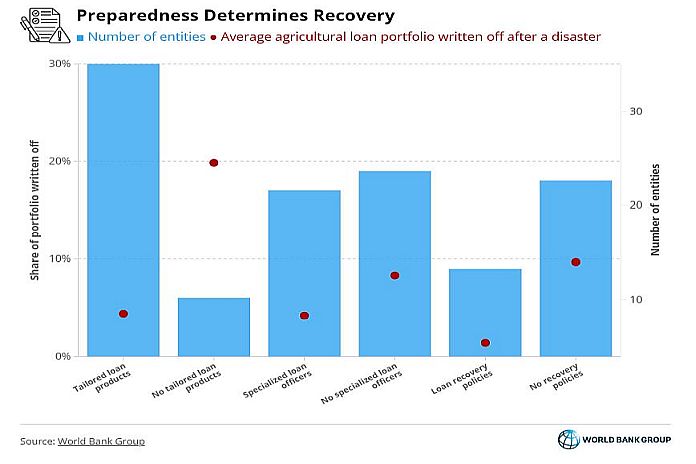
Preparedness is a measurable differentiator between recovery and ruin
Institutions with tailored agricultural loan products wrote off just 8.5 percent, compared to 24.5 percent for those without. Those with dedicated loan recovery policies wrote off 5.4 percent, versus 14 percent — nearly three times more — for those without. And institutions that combined forbearance, additional credit, and technical assistance wrote off just 5 percent, compared to 14 percent for those relying on forbearance alone.
So why isn’t this happening at scale?
Regulators in most countries still lack the instruments needed to respond to agricultural disasters. Pre-arranged liquidity is rare. Insurance is underused. And the institutions closest to farmers — Savings and Credit Cooperative Societies (SACCOs) and Microfinance Institutions (MFIs) — are often the most exposed and the least equipped.
Addressing disaster-driven credit risk requires coordinated preparedness
- Financial institutions need to move from reactive to proactive approaches— designing loan products that account for climate risks, building reserves, and partnering with insurers to expand affordable, credit-linked insurance.
- Regulators must integrate disaster risk into supervisory frameworks.Allowing temporary, well-targeted flexibility — such as time-bound forbearance and adjusted loan classifications — enables recovery by ensuring that viable borrowers are not permanently cut off from finance.
- Policymakers must build stronger risk ecosystems.This means facilitating data-sharing between meteorological agencies, insurers, and lenders through digital public infrastructure, like AgriStacks; promoting geospatial tools for credit risk assessment; and establishing financial safety nets for nonbank lenders — the SACCOs and MFIs that serve the most vulnerable rural clients.
- Critically, governments must resist the temptation of ad hoc debt relief.The global evidence is clear: poorly designed forgiveness programs can reduce borrowers’ willingness to repay, distort lenders’ ability to assess creditworthiness, and in the long-term result in the withdrawal of credit to farmers.
A chance to rethink resilience
Disasters are becoming more frequent and severe. In addition to resilient farming practices, strengthening agricultural credit systems, especially tailored agricultural loan products, loan recovery processes and embedded insurance and is essential to preserving and creating jobs, stabilising food systems, and supporting sustainable recovery.
This new report identifies the constraint, documents it with evidence, and charts a way forward. International experience shows that financial preparedness and measured government intervention can play an important role, including regulatory frameworks that take into account the impact of natural disasters. Public policy should be predictable and promote financial sector development through improved data, credit infrastructure and carefully designed subsidies to address market failure where necessary. The data shows that preparedness works. The question now is whether we’ll invest in it — before the next disaster, not after.