



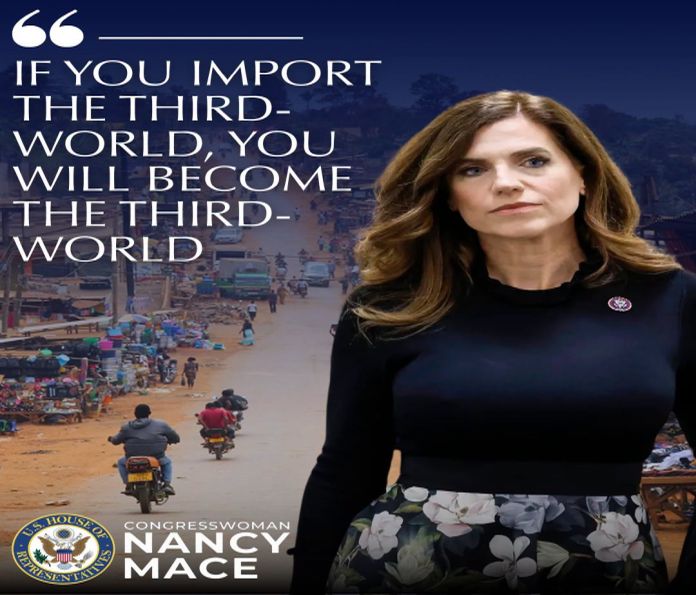
 US House Representative Nancy Mace of South Carolina has every right to introduce legislation reflecting her views on immigration and national security. But she has no licence to misrepresent Caribbean countries or demean their peoples. Caribbean governments and the region’s press should answer her with facts, unity and confidence.
No Caribbean nation or media questions the sovereign right of the United States to determine who may enter its territory. Every nation possesses that right. What Representative Mace does not have is the right to expect Caribbean people to remain silent when she publicly misrepresents their countries and demeans their achievements.
Her recently introduced Third World Immigration Moratorium Act places Antigua and Barbuda and Dominica on a list with countries experiencing civil war, state collapse, international terrorism and chronic instability. Her accompanying press release goes further, declaring that many listed countries are “state sponsors of terror, hostile regimes, and failed states with a proven track record of exporting violence and instability to American soil.”
No objective observer could place Antigua and Barbuda or Dominica in such a category. More troubling was Representative Mace’s post on X: “If you import the third world, expect your country to turn into the third world.” She added: “We are not a dumping ground for the third world’s problems.”
These were deliberate political statements accompanying legislation that would bar nationals of 40 countries, including Antigua and Barbuda and Dominica, from entering the United States. They invite Americans to regard citizens of those countries not as individuals, but as representatives of “the third world’s problems.”
That deserves an answer. The expression “Third World” has long ceased to be a useful description. Today it is largely a pejorative term suggesting backwardness and failure. Representative Mace chose that language. The Caribbean is equally entitled to reject it.
Ambassador Sir Ronald Sanders, Antigua and Barbuda’s Ambassador to the United States, immediately challenged those assertions in a letter following the introduction of her Bill. He reminded her that Antigua and Barbuda bears no resemblance to the picture conveyed by her legislation or statements.
As the Ambassador pointed out, Antigua and Barbuda is not a failed state, a sponsor of terrorism, or a country exporting instability. It is recognised by the World Bank as an upper-middle-income economy and enjoys one of the highest per capita incomes in Latin America and the Caribbean. It is a stable parliamentary democracy governed by the rule of law, with an independent judiciary, regular elections, a free press and institutions that have earned the confidence of its citizens and international partners alike.
Ambassador Sanders also reminded Representative Mace that Antigua and Barbuda has long been a steadfast partner of the United States. American citizens enter without visas, invest, and contribute to the economy. The two countries cooperate closely in security, law enforcement, disaster response, education, tourism, trade and investment. Movement between them has long been orderly and lawful.
He further noted that no citizen of Antigua and Barbuda has sought refugee status in the United States, that visa overstay rates remain very low, and that the country has consistently cooperated with US immigration authorities, including accepting promptly the return of its nationals who are lawfully removed.
These are facts!
Equally troubling is the quality of the proposed legislation itself. Representative Mace’s Bill refers separately to “Antigua” and “Barbuda” as though they were two sovereign states. They are not! Such a fundamental error raises questions about the care with which the legislation was prepared and the accuracy of the information on which it relies.
If inaccurate information can become the basis of executive action and is then repeated in proposed legislation, every democratic nation should be concerned. Ambassador Sanders was right to respond immediately—measured, respectful and grounded in evidence. He challenged not US sovereignty, but the accuracy of the information used. That distinction matters!
But this issue no longer concerns Antigua and Barbuda, and Dominica. Representative Mace’s sweeping characterisation of “the third world” demeans the wider Caribbean and disregards decades of progress by CARICOM countries in strengthening institutions, improving governance, and becoming trusted international partners.
This is a matter of national dignity and regional self-respect. Nations have an obligation to defend their reputations. Representatives of other Caribbean governments should now join in speaking clearly against false and pejorative characterisations of their societies. This is not ideology or partisan politics. It is about truth, reputation and dignity.
CARICOM was created so its members could speak with a stronger collective voice. If one member state is unfairly portrayed, the Community should not remain silent.
Respectfully but unequivocally, Caribbean governments should insist that policies be based on accurate information rather than generalisations or stereotypes.
The Caribbean press also has a responsibility.
Governments speak through diplomacy. A free press speaks through scrutiny and informed opinion. Silence in the face of misrepresentation is not diplomacy. It is acquiescence.
This is not simply Antigua and Barbuda, and Dominica issue. It is the Caribbean’s issue! The people of the Caribbean have worked too hard and contributed too much to be dismissed as part of “the third world’s problems.” Representative Mace is entitled to advocate her immigration policies. She is not entitled to expect silence when those policies are advanced through factual error and language that demeans an entire region.
The Caribbean has earned better! It should answer Representative Mace together, clearly, confidently and without apology. Caribbean News Global (CNG) is proud to do so.