


By Marie-Claire Sodergren, Vipasana Karkee, Dora Sari, Avichal Mahajan, and
Valeria Nesterenko
When the world adopted the Sustainable Development Goals a decade ago, it pledged to achieve each one of them by 2030. With less than five years left, ILO data shows that much more is needed if we are to fulfil that promise.
The world adopted the Sustainable Development Goals a decade ago with an ambitious promise: by 2030, no one would be left behind. With less than five years remaining, the ILO’s latest data present a mixed picture. On several fronts, progress has been slow, uneven, or has stalled altogether. Here is what the numbers say.
Jobs are not enough to escape poverty
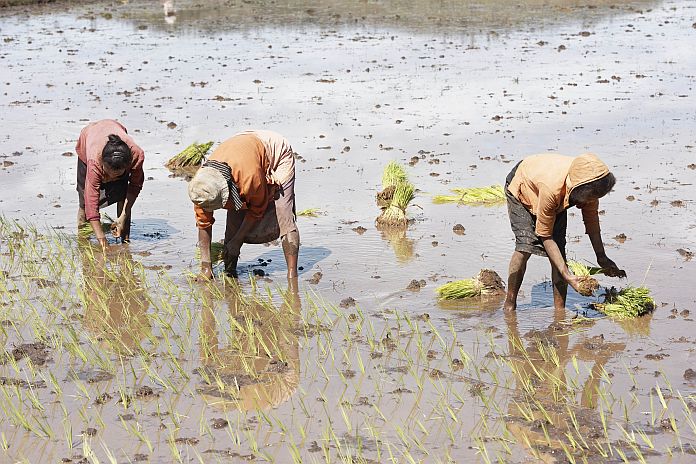
284 million workers — 7.9 percent of the global employed population — were living in extreme poverty in 2025, earning less than $3 (PPP) per day. The persistence of working poverty underlines that employment alone is no guarantee of economic security.
The global rate has fallen by 3.1 percentage points since 2015, but regional disparities remain wide. In Sub-Saharan Africa and the Least Developed Countries (LDCs), around 40 per cent of workers are still working poor, barely 2 percentage points below their 2015 levels. In Landlocked Developing Countries (LLDCs) and Oceania, nearly one in three employed people lives in extreme poverty.
The youth dimension is particularly acute. Young people aged 15 to 24 are more than twice as likely as adults to be working poor. In Sub-Saharan Africa, nearly half of all employed youth fall into this category, highlighting that access to employment is a necessary but insufficient condition for escaping poverty.
More than half the world’s workers remain informal
In 2025, 57.9 percent of the global employed population was in informal employment, virtually unchanged from 57.4 percent in 2015. In LDCs, informality stands at 88.6 percent, down only marginally from 90.0 percent a decade ago. Sub-Saharan Africa stands at 87.6 percent; Central Asia and Southern Asia at 83.9 percent.
Informal employment typically means an absence of social protection, legal safeguards, sick leave, and other standard employment protections. The limited change in these figures over the decade points to the structural nature of informality in many labour markets.
Women earn less, lead less and the gaps persist
Two indicators, read together, paint a consistent picture of where women stand in the world of work.
Women earned 52.4 percent of men’s total labour income globally in 2025, up from 49.4 percent in 2015. This gap reflects differences in pay rates, but also lower employment-to-population ratios among women and their concentration in lower-paid sectors and roles. Among employees specifically, women earned on average 78 cents for every dollar earned by male employees annually.
Meanwhile, while comprising 40.1 percent of employment, women held 30.5 percent of managerial positions globally in 2025, up from 26.9 percent in 2015. At the current rate of change, gender parity in management remains a distant prospect. In Central and Southern Asia, women’s share of management fell over the decade, from 15.1 percent in 2015 to 11.6 percent in 2025. In Western Asia and Northern Africa, women hold fewer than one in five managerial roles.
Contributing factors include unequal access to education and training, the disproportionate burden of unpaid care work, pay opacity, and weak enforcement of non-discrimination frameworks.
One in five young people is NEET and the share is rising again
The global share of young people not in employment, education or training (NEET) rose slightly from 19.9 percent in 2024 to 20.0 percent in 2025, and is projected to reach 20.2 percent by 2027. This follows a recent low of 19.7 percent in 2023, with the trend now moving in the wrong direction.
Behind the global figure, four million additional young people fell into NEET status in 2025 alone. In Western Asia and Northern Africa, more than one in four young people is NEET overall. Early and prolonged exclusion from employment and education is associated with longer-term scarring effects on career trajectories.
Young women are disproportionately affected. Globally, they are twice as likely as young men to be NEET. In Central and Southern Asia, that ratio rises to four to one.
Half the world is not covered by social protection, leaving behind billions
For the first time, more than half of the world’s population (52.4 percent) are covered by at least one social protection benefit, up from 42.8 percent in 2015. Despite this progress, 3.8 billion people remain without any protection at all.
Coverage varies sharply by income level. High-income countries are approaching universal coverage at 85.9 percent, and upper-middle-income countries stand at 71.2 per cent. Low-income countries, however, reach only 9.7 percent, barely changed since 2015, and lower-middle-income countries cover 32.4 percent of their populations.
Gaps are pronounced for specific groups. Only 28.2 percent of children globally receive a family or child benefit. Just 16.7 percent of unemployed people receive unemployment cash benefits. Women’s effective coverage lags behind men’s (50.1 versus 54.6 percent). Low-income countries spend just 2.0 percent of GDP on social protection, compared with 24.9 percent in high-income countries.
Labour’s share of the economy is shrinking
A less visible but deeply consequential trend: the share of GDP going to workers — rather than to capital — has declined. The global labour income share fell from 53.0 percent in 2015 to 52.6 percent in 2025, equivalent to roughly US$196 (PPP) less per worker per year.
Labour income is the primary source of livelihood for most households. When productivity gains flow disproportionately to capital rather than to wages, the distribution of growth becomes more unequal. The decline was sharpest in 2023, during the post-pandemic inflationary period. More recent data suggest a partial recovery as real wages have begun to catch up in some regions, though the decade-long trend remains one of modest erosion.
Labour rights compliance has deteriorated
SDG indicator 8.8.2 measures national compliance with freedom of association and collective bargaining rights on a scale from 0 (full compliance) to 10 (no compliance). The global weighted average stood at 4.83 in 2024, a slight improvement from 4.88 in 2023, driven largely by gains in a small number of large-workforce countries including Bangladesh, Indonesia and the Philippines. The decade-long picture is less encouraging, however: the weighted average has worsened by 6.4 percent since 2015, and on the non-weighted measure, which better captures the breadth and severity of violations, the deterioration reaches 12.9 percent.
Between 2023 and 2024, conditions improved in 11 percent of countries and worsened in 9 percent, but remained unchanged in 80 per cent. Across regions, Eastern Asia and South-eastern Asia continues to record the worst scores overall, while Latin America and the Caribbean has seen the largest deterioration since 2015, followed by Europe and Northern America. LDCs experienced the steepest erosion of any income group over the decade, though they recorded a small improvement between 2023 and 2024. Where these rights are weakened, so too is the social dialogue that supports inclusive policymaking, wage equality and broader economic stability.
SDGs and the ILO’s role
The 2030 Agenda and the 17 Sustainable Development Goals were adopted by the United Nations General Assembly in 2015 as a universal call to action to end poverty, protect the planet, and ensure peace and prosperity for all, with a commitment that no one would be left behind.
As a custodian agency, the ILO reports annually to the UN on 14 SDG indicators across 5 Goals. Many fall under Goal 8, which aims to promote sustained, inclusive and sustainable economic growth, full and productive employment and decent work for all.
What the data tell us collectively
Taken together, these indicators reflect interconnected challenges across labour markets. Working poverty, informality, gender gaps in pay and leadership, youth exclusion, inadequate social protection, the declining labour income share, and weakening labour rights protections do not operate in isolation. A young woman in an informal job in Sub-Saharan Africa is captured by several of these statistics simultaneously.
With less than five years remaining, for several indicators the trajectory over the past decade points away from the 2030 targets rather than toward them. How the final years of the SDG era unfold remains to be seen.