


2026-2027 Budget Proposal – XCD 2.189 Billion
By Caribbean News Global 
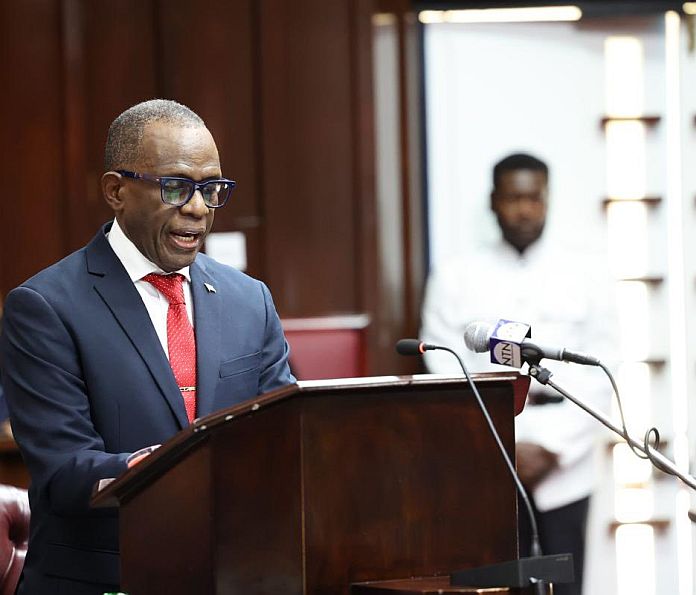
CASTRIES, St Lucia – The following are extracts from Prime Minister and Minister for Finance, Philip J Pierre, laying the estimates of revenue and expenditure 2026/2027, March 24, 2026.
Mr Speaker, notwithstanding the uncertainty of the geopolitical environment, I am optimistic that this year will be one of growth. This year’s budget estimates are based on projections for continued economic growth, supported by improvements in performance in the tourism sector, increased public and private sector construction activity, particularly in tourism, given the high level of investment projects and the expansion in domestic economic activity through growth in the orange and youth economy.
In these 2026-2027 budget proposals, government will endeavour to strengthen the country’s lands in preparation for the negative effects of climate change and economic shocks. Every effort we made to improve overall productivity in the efficiency and delivery of government services. The private sector will be expected to assist the government’s efforts to improve Saint Lucia’s ease of doing business ratings.
To achieve these outcomes, we will reduce unnecessary andf unplanned current expenditure by building efficiencies in government operations, reduce expenditure on energy, undertake strategic social expenditure in health and social services, in citizen security, in education, in sports and youth development to improve the quality of life of our citizens and the process, make them more productive and active participants in the development of our country, developing resilient infrastructure to service the growth needs of our economy.
Three major pillars
For this 2026-2027 budget, we will work towards strengthening our resilience, improving productivity and efficiency in the provision of government services, will achieve these based on three major pillars.
One, reduce unnecessary expenditure and build efficiencies in government operations.
Two, consolidate the gains that we have made in health care, public assistance, education, youth development and the economy.
And as we build efficiencies, we’ll find the space to focus on medium to long-term plans that will improve the economic well-being of our people.
The 2026-2027 budget
Total expenditure, XCD 2.189 billion, 6.4% above the approved estimates for 2025-2026.
Recurrent expenditure, XCD 1.750 billion. Capital expenditure, $298.6 million. Interest payments, $251 million. Principal payments and amortisation, $140 million.
Total revenue on grants, $1.83 billion, of which tax revenue $1.58 billion. Non-tax revenue, $175.1 million. Capital revenue, $4.7 million and grants of $81.5 million.
- We are projecting a primary surplus of $48.6 million, representing 0.5% of the GDP.
Total expenditure excluding refunds and principal repayments is estimated at $2.04 billion, while total revenue and grants are projected at $1.83 billion.
- A projected overall deficit of $212.4 million, equivalent to 2.8% of GDP, is anticipated.
Recurrent expenditure for the 2026 2027 fiscal year, the government is proposing to spend $1.75 billion in recurrent expenditure, representing 9.5 percent $151.7 million increase over the amount approved in 2025-2026.
The recurrent expenditure represents 80% of total expenditure and 78% of the approved 2025-2026 budget. The increasing expenditure is due to an increase in wages and salaries, goods and services, transfers, interest charges on debts, operating expenses related to planned project activities and higher rental payments for government offices.
Wages and salaries
Wages and salaries for both government operations and projects represent 29% of total expenditure. The wage bill for the government continues to increase as we endeavour to meet our obligations to the workers.
For the upcoming budget, a 2% salary increase is included in keeping with the collective agreement for 2025 to 2028. Wages and salaries will increase by 4.9% or $29.8 million over the approved figure for 2025-2026 and by 5.2% over the year-end outlook, $638.1 million. This figure includes wages and salaries for staff on projects and contracts.
Debt service
The debt service for the country is expected to increase in the next term due to the end of moratoriums that are ending on previously contracted debts. For the fiscal year, XCD 391 million is allocated to debt service, representing an increase of $28.2 million, or 7.8%, when compared to the year-end outlook for 2025-2026.
- $251 million is allocated to interest payments and $140 million to principal repayments.
We anticipate an increase in transfer payments as dietary boards and various social groups, caring for the vulnerable and underprivileged.
- A total of $336.5 million for the year-end 2026-2027 is projected for total transfers. We have increased the allocation for organisations involved in the enhancement of the human condition in different sectors.
- Approximately $271.3 million has been provided to statutory bodies to fulfil the obligations to the public in health and other public services.
Two main hospitals
Of the $124 million allocated to two main hospitals.
- $83.7 million to the Millennium Heights Medical Complex for the payment of salaries and operational expenses.
- $36.8 million to St Jude for salaries and operational costs.
- In excess of $3 million to cover some of the commissioning expenses for the new St Jude Hospital.
Grants and contributions to hospitals are 60% of the total expenditure have been budgeted for general health services, while the remainder is scheduled to be spent on other community health facilities and general health administration.
Goods and services account for approximately 24% of the 2026-2027 estimates at approximately $514.5 million, comprising $183 million for central government operations and $131.5 million for project expense operations.
This outlay represents 10.1% over the approved estimates of 2025-2026 and a 24.5% over the year-end outlook.
Rental and lease payments for government offices
For the fiscal year, $85 million has been allocated for rental and lease payments for government offices, reflecting a 30.8% increase over the amount approved in 2025-2026.
These allocations are expected to cover rental for the new offices of the Eastern Caribbean Supreme Court at the Orange Grove Plaza, lease payments to NIPRO for the construction of government offices, including the newly completed Gros-islet Northern Police Headquarters, as well as rentals for various other government departments.
- Operations and maintenance, $75.3 million, representing a 7.3% over the amount of moving 2025-2026. This is to support funding for road maintenance, maintenance of government buildings and the payment of digital and software licenses, which support the provision of public services.
Supplies of $57.5 million represent an approximately 9.9% increase over the approved estimates of 2025-2026. The expansion of the school feeding program will be funded from the source.
Insurance, $25 million. This accounts for increased insurance coverage for specialised vehicles, ambulances, and emergency response trucks purchased for the fire service in 2025 and others expected in 2026. Vehicles for security service officers, insurance of government buildings, and some insurance for farmers.
Development capital expenditure budgets
Capital expenditure, $492.7 million for capital projects, is estimated at $103.3 million, or 21%, to fund operations at the ministry of infrastructure, including $42.5 million for design, finance, and construct payments.
This year, we intend to complete all major capital projects started some time ago:
- Millennium Highway West Coast Road Project and road construction started in the north and south of the island.
- Commence work on the Choc Bridge and the Sir Julian-Arhunt Highway.
- Work on alternative energy projects will also continue.
- The unleashing of the Blue Economy Project.
- The continuation of several private and public sector construction projects, including major repairs to schools, St Mary’s College.
- Work on the fifth finger of the OKEU hospital is expected to commence this year.
Ministry of economic development and the youth economy is allocated 84.5 million, or 17.2% of the developmental budget.
- This project includes St Jude Hospital, the Youth Economy, and St Lucia’s Urban Resilient Flood Investment Project.
Department of finance
An allocation of $101 million or 20% has been allocated to the department of finance to facilitate the implementation of the constituency development program, 20.9 million, unleashing the blue economy, 17.1 million, the home care program, 12.3 million, economic and social enhancement projects, 4.8 million, and the government financial and management system upgrade of 3.1 million.
Physical development and public utilities
Physical development and public utilities have also been allocated a sum of 41.1 million or 8.3% of the developmental budget.
- These include implementation of the Caribbean Renewable Energy Infrastructure Investment Facility, 17.1 million, the Caribbean Efficient and Green Energy Buildings, 10.1 million, Renewable Energy Sector Development Project, 7.9 million and Land Administration, 5 million.
Major investments in the water sector through WASCO to help alleviate the long-standing issues in that sector.
Department of education
- 4 million or 6.8% of the developmental budget has been remarked by the department of education.
The main projects to be implemented for that agency are the OECS Skills and Innovation Project, $8.2 million, major repairs and rehabilitations of the school plan, $6.6 million, and the programming for education realignment and transformation, $3.1 million.
Department of health
Government is also committing 17.8% or 3.6% of the environmental budget to the department of health to support the OECS Regional Health Project, 2.7 million, projects supporting post-COVID-19 response, 8.56 million, and others, including initiatives under the Universal Health Care Program of 4.3 million.
Agricultural sector
We have spoken about the need for food security and our capability to grow what we eat.
- 7 million, or 4.4% of the developmental budget, will support the agricultural sector.
This amount will support building resilience to adaptation to climate change and climate variability, 7.9 million.
- The Fish Adapt Project, $2.3 million.
- Enhancement of Food Production and Agriculture and Fisheries, $1 million.
(Ministers will speak in more detail about the allocations to the ministries, including the programs to transfer land title to qualifying long-term existing occupiers free of charge.)
How the 2026-2027 appropriation bill will be financed
We are projecting total revenue and grants of XCD 1.83 billion. This reflects an increase of 6.7%, $114.8 billion over the approved amount in 2025-2026, and a 7.1% over the projected outturn for the end of the same period.
The breakdown of revenue and grants is as follows: Recurrent revenue, $1.75 billion; Capital revenue, $4.7 million; Grant receipts, $81.5 million.
We expect economic expansion to continue in the upcoming year and remain optimistic based on proposed investment in the tourism sector. However, we will be vigilant and make the necessary adjustments, if needs be, depending on how global geopolitical events unfold.
Recurrent revenue, XCD 1.7 billion
Recurrent revenue is projected to increase by XCD 128.5 million over the approved estimates for 2025-2026. When compared to the outing for the preceding year, 2024-2025, recurrent revenue will increase by $125.1 million or 7.7%.
The total amount projected for recurrent revenue will be in the form of tax revenue, XCD 1.58 billion or 90% and $175.2 million in non-tax revenue.
- Tax revenue is forecasted to increase by 6.5% in comparison to the out-term for 2025-2026, while non-tax revenue is expected to increase by 20.2% compared to the out-term for the last fiscal year.
The increase in tax revenue will be influenced by continued projected expansion in economic activity, increased tax compliance and the use by taxpayers of the ongoing tax amnesty program.
- The increase in non-tax revenue is projected to be influenced by CIP inflows.
Taxes on income and profits
Tax on income and profits are projected to be $406.1 million, or 26.7% above the revised estimates of 2025-2026. This category is forecasted to perform well due to the continuation of the tax amnesty program and the ongoing expansion of the economy. The projection for the main items under this category, income tax of corporations.
The revenue from income tax in corporations is expected to generate $194.9 million for the financial year 2026-2027, representing a 9.6% increase above the year-end outlook for 2025-2026.
Income tax for individuals
Revenue from income tax, personal income tax, is estimated to account for $172.2 million. This represents a 1.4% increase from a 2025-2026 projected outage.
Income tax arrears
Income tax arrears are projected at $57.2 million based on responses to the tax amnesty program. Let me assure you, the government will not give up on the collection of tax arrears.
Taxes on international trade transactions
Customs duties, 244.2 million. This category includes excise taxes, cargo throughput charges, and import duties. Of the total amount to be collected, 177.6 million is expected to come from import duties, $137.2 million from excise tax and $6 million from passenger facility fees.
Taxes on domestic goods and services, XCD 812.9 million
Taxes on domestic goods and services are expected to generate $812.9 million, which is 9.2% above the projected outturn for 2025. This category includes Value-Added Tax (VAT) on domestic activity collected by the Inland Revenue.
Receipts from VAT collected by the Inland Revenue account for 50% and are projected at $237.1 million, which represents a 1.3% increase relative to 2025-2026.
VAT from international change transactions, collected by the Customs and Excise Department, is projected to yield $235.7 million in 2026-2027, which is 8.8% or $216.6 million above the 2025-2025 outcome.
Health and security levy
The health and security levy will remain at 2.5% and is projected to record an increase of $11.9 million above the 2025-2026 outcome to reach $53.3 million for the new fiscal year, 2026-2027.
- Expenses on health are estimated to be $259.3 million, and expenses on citizen security $200.4 million.
A simple calculation, arithmetic that is, will show that total expenses for health and security will be projected to be $459.7 million, while collections on health and security levy will be $53.3 million. We continue to increase spending on health and security in our country.
SWIFT Justice Program
This month, we commissioned the SWIFT Justice Program to reduce the backlog of over 1,000 pending criminal cases in the system for several years.
Other revenue – Non-tax revenue
The 2026-2027 estimates for non-tax revenue are estimated at $175.2 million, or 20.2% increase over 2025-2026.
- The main contributor to the increase during the current fiscal year is expected to be higher inflows from the contribution of the citizenship investment program.
Voluntary transfers, other grants
The Citizenship by Investment Program is expected to deposit XCD 85 million into the Consolidated Fund. Revenue from voluntary transfers is estimated to increase by $30.2 million or 54.5% over 2024-2025 fiscal year.
Income from property
Revenue collections from this category are expected to increase by $7.2 million.
Sales of goods and services, $64.6 million. Revenue collections from sales of goods and services is reflecting a decrease of 7.3% below the projected outturn for the previous financial year.
Grant revenue
Grant revenue, grant receipts attached to project expenditures is estimated at 81.5%, reflecting a 4.7 million decline over the projected outcome for the 2025-2026 fiscal year. This amount represents 27.3% of the total capital expenditure programmed to fund ongoing projects.
Some of the major contributors to the grant inflows are the Taiwanese government, XCD 41.7 million, the European Development Fund, $3.9 million, the Caribbean European Bank, and the United Nations Environmental Program, $9.3 million.
- Given the projected level for revenue and grants and the projected expenditure savings, the budget is expected to reflect an overall deficit of XCD 212 million for the fiscal year 2026-2027.
This gap will be financed from a combination of loans and bonds:
-
- XCD 9 million will be secured from developmental partners, and 49.5 million will be secured from bonds, treasury bills and loans; (some of the external borrowing already identified and sourced.)
-
- Republic of China and Taiwan, Exim Bank, 160.7 million.
-
- International Development Association, the IDA, 77.4 million.
-
- The Caribbean Development Bank, 63.43 million.
-
- The Government of Saudi Arabia, 16.5 million.
-
- The African Export-Import Bank, 2.2 million.
-
- The Caribbean Development Fund, 2.4 million.
-
- The European Investment Bank, 6.1 million.
-
- The Kuwait Fund for Arab Economic Development (KFAED) 4 million.
The 2026/2027 budget seeks to undertake approximately 31 measures: The Government of Saint Lucia 2026-2027 budget undertakings.
Geopolitical events
“This budget of XCD 2,188,765,900 was compiled before the war in Iran and the subsequent increase in oil prices. Our small open economy will be more negatively affected by geopolitical events than larger countries, making a disproportionate call on our limited resources. I will continue to trust the people of Saint Lucia and keep them informed when and if changes in the budget forecast are necessary,” Prime Minister and Minister for Finance, Pierre, continued. “The externalities of geopolitical events, our open borders and small size, and our dependence on tourism make small island states like ours extremely valuable. Notwithstanding these challenges, I remain confident that through sound policies, strong fiscal management and decisive action, this government will competently navigate the hostile waters ahead.“
The political
“We have demonstrated, and the people have agreed with our ability to respond to external shocks through sound fiscal management. Our approach will continue to be guided by prudent economic management, while supporting key sectors of the economy, strengthening our fiscal position, and safeguarding the well-being of our citizens, particularly the vulnerable.”
Prime Minister and Minister for Finance, Pierre, added:
“The citizens of Saint Lucia have for the past five years agreed with our policies, and that is why they have returned us to government with an increased majority (16-1) on December 1, 2025.”
Related: Part 1 and Part 2 – transcribed and produced by CNG.