



By Johnny Coomansingh
At the onset of the carnival season in Trinidad, an event known as the ‘Stink and Dutty’ fete is staged. The Stink and Dutty fete is characterised by ribald, raucous revelry; a literal exposé of lewdness and debauchery to the max! In this fete, participants seem to lose their image of humanity and degenerate into animalistic behaviours, which truly represents the ‘freedom of flesh;’ carnevalarium. Several hours of ‘misbehaviour’ and inebriation are spent, but eventually, the partying comes to a stop. The feting atmosphere and wanton exhibitions of what it is to be stink and dutty are, for all wants and purposes, ephemeral.
Because the Trinidad Carnival engenders such behaviour, I could understand that there is a definite need for such a fete. My book titled An Understanding of the Trinidad Carnival (2019) cited aspects of Francesca Sautman’s 1982 paper, The Quick and the Dead in the Communal Feast of Aschura and Carnival:
“Identified by Sautman were certain aspects of carnival as practised in parts of Europe. The carnival described involved groups of men during the 14th century in Southern France, smeared with darkening substances from head to toe. These blackened individuals paraded sometimes entirely naked and would sometimes chase women with a long stick held like a phallus while singing, “We want to fornicate.” Another of their disguises would be a coat full of holes with an enormous fake phallus.
If they entered a house, they would break everything in sight, attack women and even defile them with urine. It is also probable that, during the twelfth dynasty, the Egyptians, who were the first recorded culture that celebrated carnival, could have passed on this type of lewd activity over the centuries. Five of the 365 days of the year were set aside to recreate or restore harmony to their relationship with the deities of the cosmos. This period, in which the Egyptians would chant ribald songs, drink brew and carouse, was known as a time outside of time. Torch parades would include women revellers who would hold aloft giant erect phalluses. This theatrical spectacle was actually a reenactment of the passion that existed between Isis and her husband/brother Osiris, who, incidentally, was the Egyptian’s god of rebirth.
Also very important during the 14th century in the French village of Cournonterral, near Montpellier, was the aggressive display or flaunting of putrefaction, which signified the bridging of the gap between life and death. Cournonterral had a song for the occasion: “We are of blood and wine, the more it rains, the thicker the mud—we are happy in our filth.” The use of putrefying, rotten and foul- smelling materials representative of the grave was most present at the celebration. Besides the wine sediment normally used for the occasion, manure, compost heaps, blood, tripe, decomposed animal corpses and the content of stables and lavatories were at one time employed in the celebration.
According to Sautman, one had to be somewhat of a nasty animal, or display animalistic behaviours on this day. As a comparison to, or as a derivative of, the Cournonterral carnival, another researcher refers to the subject of ‘Ol’ Mas’ (Dirty Mas) or ‘Mud Mas’ as practised in Trinidad during J’ouvert, otherwise known as Jouvay.”
Although I highlighted some aspects of the Trinidad Carnival, this article is not about the Trinidad Carnival and its Stink and Dutty fete. Moreover, I have no issue with those who want to attend the Stink and Dutty fete during carnival time. However, I take umbrage with citizens of Trinidad and Tobago, who, for some god-forsaken reason, want to continue their stink and dutty (dirty) habits for the rest of their lives. It appears to me that such people possess genes riding on a chromosome for nastiness. In other words, some people in Trinidad and Tobago are just stink and dutty because they do not care about any kind of environment, including the natural, physical, political and/or economic environments.
I am not here to bash or destructively criticise any government because all parliamentarians in Trinidad and Tobago drink tea together in the Red House tea room. They may even indulge in having some crumpets. As I have seen, they may argue with one another in the parliamentary chamber as elephants in a fight. During and after such fights, who are the ones that are trampled? None other but the grass. As I have said before, “In the best of us are the worst of us and in the worst of us are the best of us.” I am not a psychiatrist, but I could offer some counsel here: “Beware of Greeks bearing gifts;” the proverb warns that an enemy’s apparent kindness or generous offer often hides a trap. A political party could make all sorts of promises that they will do this and that they will do that during the hustings. Nevertheless, the people must come to the realisation that they are the ones with the power at the tip of their right index finger. They are the ones who could create change!
On Ian Alleyne’s Crime Watch television program, I saw that Trinidad and Tobago, even though there is a State of Emergency (SOE) in effect, the country has already chalked up 171 murders. People are being killed as though Trinidad is a dammed killing field. One of the more gruesome murders that took place a couple of days ago was that of a 12-year-old female who was a student of the Erin Roman Catholic Primary School. Apart from the murders, home invasions and robberies continue. Grand theft auto is part and parcel of the stink and dutty activities that permeate society. No one and nowhere is safe, SOE or no SOE! The present government is now seeking another three-month extension of the SOE.
On top of all the terrible ills in the country, there are now almost daily protests from all quadrants. The protesters want to be heard. They want more money! The blame game continues to fester. The former government, the People’s National Movement (PNM) is using anything in its attempt to destabilise the present United National Congress (UNC) government. Let’s be fair: the UNC government won the election with the use of the slogan: “When the UNC wins, everybody wins.” However, some people are feeling that they are not winning. Why? A long time ago, there was once a statement: “Money is not a problem.” Right now, money is the problem. According to a post on 01/04/2023 about calypsonian Dr Leroy Calliste (Black Stalin) and his 1985 calypso, Wait Dorothy wait, Lance Dowrich in WordPress declared:
“Social inequalities resulting from the unequal distribution of resources in Trinidad and Tobago are poignantly captured in the lines “That oil money come, and oil money go, and poor people remain on the pavement and ghetto, aah when Divider start to divide the bread equally, I go finish the whole damn calypso about Dorothy!”
Inadvertently, the political stink and dutty mentality started somewhere in our history, and what we are seeing today is the cumulative result of certain political decisions. Note carefully that I am still waiting to see the protests for such happenings. In essence, who was it that decided to scrap the railway system to introduce a malfunctioning, inefficient bus system? Who was it that shut down the sugar industry? Who was it that stymied the agricultural production of citrus, cocoa, coffee, bananas, coconuts and rice?
Last but not least, who was it that closed the Pointe-a-Pierre oil refinery? The refinery was still providing the country with a measure of foreign exchange (FOREX). Last year, I couldn’t even get USD 200 from the Republic Bank to travel. It has been alleged that the stink and dutty decision to close the refinery was to cover up some big stink and dutty bobol (financial corruption, fraud, or embezzlement) that was discovered. Bobol has been our legacy since time immemorial, and I expect Bobol to continue. Greed is one of our big problems. Mahatma Gandhi once said: “The world has enough for every man’s need but not enough for every man’s greed.” There is hope on the horizon that the refinery will be reopened. Who knows?
Are there any protests against the stink and dutty ones that litter every empty allotment, drain, nook and cranny with plastic containers, bottles and chicken and chips boxes?
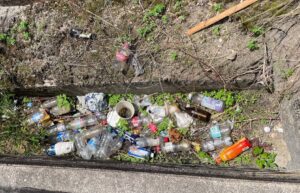
I saw truckloads of plastic ‘bottles,’ black stinking mud and garbage removed from drains under the sidewalks in El Socorro…and then the residents complain about flooding when the rains come. Who are the stink and dutty ones and businesses, without conscience, dump all manner of refuse along the byways and backroads? Many moons ago, my eight-year-old son sang his calypso titled: Clean and Tidy. Here are a couple of verses:
“If yuh can’t afford ah dustbin
Yuh could use an old oil tin
And when yuh go to the beach
Have ah garbage bag in reach.
Please put yuh plastic bottle
In the bin available
Doh leave yuh garbage all over the place
Tuh become for all ah big, stink disgrace.
Chorus
Keep yuh surroundings clean and tidy
Nobody must call yuh “Stink and Dutty”
Ah clean place is ah healthy place
My message tuh every class, creed, and race
My message, O my message
My message tuh every class, creed, and race.”
We all know that the protestations, good or bad will continue. Who will protest against the stink and dutty occurrences right before their eyes? We all need to win. Win-Win is the best scenario; you win, I win. We all need to be heard. We all need to support each other. We all need to remember that this country is a multiracial and multi-religious state. “Here every creed and race find an equal place.” If we do not change our stink and dutty attitude, the road will be long, rough and tiring. Sometimes there are activities that go awry, even with the protective services of the country. In today’s world of social media and artificial intelligence (AI) nothing is hidden under the Sun! However, truth depends on how things are interpreted. I always go back to what Anais Nin stated: “We do not see things as they are. We see things as we are.”
As every other Caribbean country, Trinidad and Tobago has had numerous protests. The 1970 Black Power Movement had its say, then came the 1990 attempted coup. In my view, that one was intense. The Jamaat al Muslimeen under the leadership of Yasin Abu Bakar (deceased) is now a part of our history. The present government, for whatever the reason(s) has cordoned off at least fifteen areas in Port of Spain (see map) as ‘No Protest Zones’ enacted under Legal Notice No. 40 of the Emergency Powers (Prohibition of Public Protests and Demonstrations) Order 2026 maybe to prevent any kind of protest activity proximal to these places.
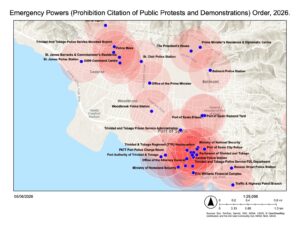
These places in Port of Spain include The Parliament (Parliamentary Complex), Office of the President, Office of the Prime Minister, The Diplomatic Centre, Office of the Attorney General, Ministry of Finance, Ministry of Defense, Ministry of Homeland Security, Headquarters of the Trinidad and Tobago Police Service (TTPS), Headquarters of the Trinidad and Tobago Prison Service, Headquarters of the Defense Force, Office of the Director of Public Prosecutions (DPP), Piarco International Airport (Trinidad), Port Authority of Trinidad and Tobago, and in Tobago, A.N.R. Robinson International Airport.
With the way things are going in the country these days, it’s quite possible that the government is apprehensive that there could be anti-governmental reprisals.