

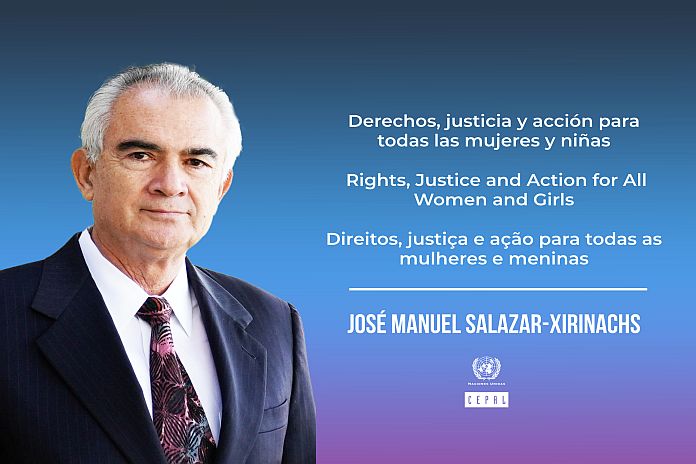
By José Manuel Salazar-Xirinachs, Executive Secretary of ECLAC
This International Women’s Day is different from before. Although important progress has been made and challenges remain, the events of recent months and the deep ruptures in the international order create an especially delicate scenario. We must not only focus on continuing to advance the full realisation of women’s and girls’ rights and the pursuit of substantive equality, which are essential tasks. Now we must also confront resistance and work to avert setbacks in an environment characterised by policies based on force and unilateralism.
We have entered an era marked by unpredictability and the impositions of “tough men” who see collaboration and cooperation as a sign of weakness. In this new context of armed conflicts, geopolitical rivalries, economic deceleration and profound structural inequalities, women and girls bear a disproportionate burden. That is why this year’s theme – “Rights. Justice. Action. For ALL Women and Girls” – is a call to collective action.
Transforming rights into reality requires that we tackle the structures limiting the autonomy of women and girls. According to official statistics, gathered by ECLAC’s Gender Equality Observatory, one out of every four women in Latin America and the Caribbean has no income of her own. Although women in the region have more years of education than men, this is not yet reflected in their full participation in the economy, politics, the sciences or other fields.
For example, half of all women are outside the labor market, in contrast to a men’s participation rate of around 75 percent. This gap is closely linked to the unjust organisation of care. Women spend nearly triple the time that men do on unpaid domestic and care work, which limits their labor market participation, reduces their income and restricts their autonomy. This work contributes between 19 percent and 27 percent of GDP in the 10 countries where it has been measured, and more than two-thirds of that work is done by women.
In addition, while poverty has declined in the region, it continues to have a bigger impact on women: for every 100 men living in poverty, there are around 123 women in the same situation.
Violence also continues to be a pandemic. In 2024, at least 3,828 women were victims of femicide (or feminicide) in Latin America and the Caribbean, and one in five girls was party to a marriage or union before the age of 18. Impunity and barriers to accessing justice perpetuate these cycles and undermine trust in institutions.
With regard to political representation, women hold on average 36 percent of parliamentary seats and just 17 percent of mayor’s offices. Their presence in these spheres, where strategic decisions are made, does not yet reflect the importance they have in public and social life.
Faced with this reality, Latin America and the Caribbean today, has more robust regulatory frameworks, institutions and mechanisms for women’s advancement. However, equality under the law does not automatically translate into equality on the ground. Effective access to justice and rights guarantees is a precondition for transforming laws into reality, breaking the cycles of violence, discrimination and poverty, and ensuring that women’s autonomy can come to fruition in all its dimensions and across all countries.
At the recent meeting in Mexico of the Regional Conference on Women in Latin America and the Caribbean, States approved the Tlatelolco Commitment, which establishes a Decade of Action to accelerate the achievement of substantive equality and the care society. This proposal by the region is a contribution to the world and poses a new paradigm for sustainable development, equality and peace. This achievement was reinforced by the Inter-American Court of Human Rights’ Advisory Opinion 31 of 2025, which recognises care as an autonomous human right.
Today, the call to action is clear. The rights of women and girls can only become effective if there is justice, and justice demands action. There is no doubt we can do more. Supporting women’s leadership and increasing men’s commitment, investment and political will is the foundation of a better society, with equality, development and peace. Today’s world is in need of urgent transformations, and few transformations will be as profound and universally beneficial as putting an end to the historical exclusion of women and girls in all areas of society.