

By Dr Claudius Preville
After pursuing Saint Lucia 14 times against the French during the Colonial period, having won us, then lost us after our political independence, has Britain now declared war against us? Well, at least not militarily, thankfully, but certainly an economic war against Saint Lucia. We are, after all, the coveted “Helen of the West” after the 14th Colonial battle, we were French, then became British through the Treaty of Paris in 1814, following the Napoleonic Wars. Does Britain now despise us, or the history of our relationship? Are we now, having just turned 47 years old, only a despised stepchild?
A little over one month ago, on 3 February 2026, to be precise, the British Government (through its High Commission) co-sponsored and co-hosted a special national consultation on leveraging the UK-CARIFORUM EPA, the prevailing trade and investment agreement between the UK and Saint Lucia, to show Saint Lucian businesses how to exploit opportunities for trade and investment under the Agreement.
The consultations, which took place at high-level, involving Saint Lucia’s minister with responsibility for investment and tourism, Dr Ernest Hilaire, who keynoted the event, senior diplomats, including the Resident British Commissioner and senior officials of the Government of Saint Lucia, took place in the context of the current dynamic global geopolitical setting. The event was ostensibly geared at showing Saint Lucian businesses how to exploit opportunities under the UK EPA. Among other issues, it highlighted the opportunities open to Saint Lucians in the services sector in the UK. It also highlighted the fact that Saint Lucia enjoyed a services trade surplus in excess of £150 million pounds sterling with the UK in 2023.
Unlike goods, services are traded primarily through human beings, through what is commonly known as four modes of supply under the WTO GATS Agreement. Three of those four modes of supplying services require the movement of natural persons, or human beings. Seamless trade in services requires the removal of impediments to the movement of natural persons. One of the biggest impediments to the movement of natural persons is a visa.
That is why countries that are seriously committed to improving the business, trade and investment relationships between themselves, always explore ways of eliminating visa restrictions between them. I just saw the UAE concluding a visa waiver agreement with Papua New Guinea as a precursor to comprehensive economic partnership agreement. Movement is the basis for services trade. No movement, or highly restricted and costly movement, implies no or little trade and investment flows between the countries in question.
The British decision to impose a visa on all Saint Lucian passports, for all purposes of travel whatsoever, including transit to third countries (esp. Europe, Asia and Africa), seems very extreme a measure, in response to a claim that a significant number of Saint Lucian passport holders are seeking asylum in the United Kingdom. An issue which is completely new to me. It is not clear how they have arrived at this as their intelligence has not been shared with Saint Lucia.
But the cited number of Saint Lucian asylum seekers in the UK over a 4-year period (2022-2025) is 360 applications. That equates to approximately 90 applications per year. Putting this in context, it represents about 0.05 percent of our population (180,000). Accurate statistics on the number of Saint Lucian departures to the UK per year are not readily available, in part because a significant number might depart via third countries, like the US or Canada. But some experts estimate it ranges between 5,000 and 10,000.
It might be even higher. So, as a percentage of the travelling population to the UK annually, that works out to somewhere between 0.9 percent and 1.8 percent, on the average. Let’s be clear. I do not condone any Saint Lucians seeking asylum in any country. To the best of my knowledge, we do not have situations of adversity in Saint Lucia so extreme, that warrant individuals petitioning foreign governments for asylum.
Therefore, it behoves all logic and understanding why the British government decided to take such a radical and extreme action against one of its most beloved former colonies. Saint Lucia is the choice of destination by about 90,000 Britons annually, and statistics suggest there is a demand for about another 30,000 to 40,000 Britons, who are unable to visit because of limited flights to Saint Lucia. In fact, Saint Lucia is currently in the process of negotiating additional capacity (airlift) with another major airline in the hope to meet the unrealised demand by later this year. British Airways currently dominates the Saint Lucia-London route.
While it is the prerogative of all sovereign countries to implement laws, regulations, policies and measures to safeguard their national interests, it is very difficult, if not confounding, to understand why Britain is proverbially “using a sledgehammer to kill an ant”. The percentages of Saint Lucians that potentially pose a risk of seeking asylum in the UK is statistically insignificant by any measure and, therefore, does not constitute a sound argument for imposing a visa on all Saint Lucian passports for all reasons whatsoever, including transit to third countries. This is extreme. Very extreme. The nominal cost of the visa is already significant, and the administrative cost could be three or four times higher, if the visa is to be obtained from a third country, like Barbados.
As a small, open economy relying heavily on the exports of services for our growth, with more than 85 percent of our economy composed of services, a visa measure against us from a major trading partner and ally, is effectively a declaration of war against our economy.
Moreover, this measure is inconsistent with the most recent public engagement of the Resident British Commissioner in Saint Lucia with our private sector, where we were assured that Britain ‘has our back’, in the current global geopolitical dynamics. Personally, after my presentation on the geopolitical dynamics, during the Q&A, I explicitly sought and received the assurance of the Resident British Commissioner on this issue. Yes, we were encouraged to pivot to Britain as a safe and reliable trade and investment partner in the context of the ongoing global geopolitical dynamics.
In the circumstances, it would be desirable that the British government engages Saint Lucia constructively, with the view to safeguarding its borders whilst supporting our economic growth agenda, which is heavily dependent on our ability to export services. A visa imposed unilaterally on us is not the solution. We need intelligence sharing, technical assistance, and support to address the issues that have been cited by the British Government, not to be isolated from global trade and investment.
We are the same Saint Lucia which Britain coveted for centuries and eventually won against the French, not on the battlefield, but through the Treaty of Versailles. We are the same Saint Lucia who stood shoulder to shoulder with Britain in World War II when Hitler sought to control the world. The scars from Hitler’s U-boats, when they attacked and sank the RMS Lady Nelson on 9 March 1942, remnants of the war, are still in the bottom of port Castries. Our soldiers assisted in the fight for and paid the ultimate price for the freedom enjoyed in the Western World today. Our country was used to accommodate two military bases of the alliance. We served in the armed forces both in Britain and Canada.
We are the same Saint Lucia that helped build the Panama Canal and provided the base from which it was monitored for trade in the Americas. We have stood with Britain throughout our existence. I wish, in closing, to appeal to the British government to revisit this decision to impose a visa on Saint Lucia and instead, constructively engage the Government of Saint Lucia, including intelligence sharing and technical assistance, to move our countries forward together on a solid and sustainable path.
-
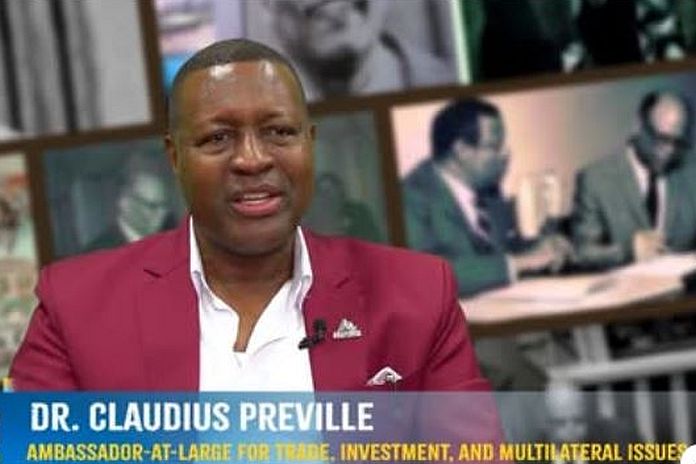
- Dr Claudius Preville, Ambassador-at-Large for trade, investment and multilateral issues, Dr Claudius Preville, Saint Lucia.
- The views expressed are those of the author and do not necessarily represent the views of the Government of Saint Lucia.