


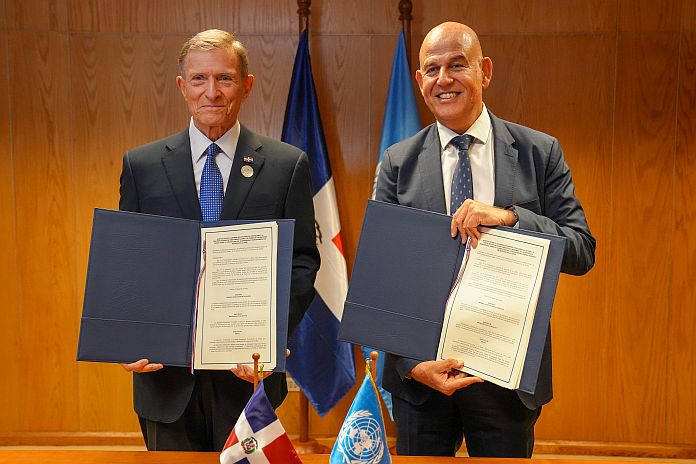
- At the organization’s headquarters in Santiago, Chile, the Dominican Foreign Minister, Roberto Álvarez, and the Secretary of the Commission, Luis Fidel Yáñez, signed an agreement establishing that the meeting will be held on October 7-9, 2026.
SANTIAGO, Chile – The Forty-first Session of the Economic Commission for Latin America and the Caribbean (ECLAC), which is its most important biennial meeting, will take place on October 7-9, 2026, in Santiago de los Caballeros, Dominican Republic, according to an agreement signed by that country’s minister of foreign affairs, Roberto Álvarez, and ECLAC’s secretary of the commission, Luis Fidel Yáñez, who was acting on behalf of the United Nations regional organisation’s executive secretary, José Manuel Salazar-Xirinachs.
The accord, penned on Tuesday, March 10 at ECLAC’s central offices in Santiago, Chile details the commitments assumed by both parties for organising this international gathering, in which authorities from ECLAC’s 46 member states and 14 associate members will participate, along with representatives of the United Nations system and of non-governmental organisations.
At the event, countries will have the opportunity to debate about the region’s economic, social and environmental development, to review the activities carried out by the Commission during the prior two-year period, and to set the priorities for its programme of work for the next two years.
In addition, the meeting will mark the start of the Dominican Republic’s term as chair of ECLAC – which will last until the Commission’s next session (in 2028) – as well as the end of the period presided by the current chair, the Government of Peru (for having hosted the 40th Session, held in Lima in 2024).
As established practice would have it for each session, ECLAC’s Executive Secretariat is preparing a position document that will be presented as an input for the meeting next October, and that will help prompt an analysis of the main development challenges faced by the region’s countries at this very particular time in our history and in the world.
ECLAC’s executive secretary, José Manuel Salazar-Xirinachs, stated in reference to the accord:
“We are very pleased that this agreement has been signed, marking a formal start to the entire preparatory process for the Commission’s 41st Session in the Dominican Republic. Traditionally, our Session is a time for strategic reflection, an opportunity for ECLAC to present its main analyses and top proposals for the region to countries. In an international context characterised by deep ruptures and reconfigurations, this gathering in Santiago de los Caballeros will be an exceptional opportunity to provide Member States with tools for navigating the current situation, harnessing their assets in order to achieve development goals.”
Meanwhile, the foreign minister of the Dominican Republic stressed that this agreement reflects the close and constructive relationship that his country has maintained with ECLAC historically, along with its commitment to multilateralism, regional dialogue and cooperation for Latin America and the Caribbean’s sustainable development.
“The Dominican Republic is currently serving as one of ECLAC’s vice-chairs and once this session is held, it will take over as chair of the organisation for the 2026-2028 period. We assume this responsibility with a deep sense of commitment and with the conviction that regional cooperation continues to be essential for tackling the challenges of our times. It will be an honor for our country to host this gathering and contribute to exchanging ideas regarding the economic, social and environmental challenges facing our region,” said Foreign minister Roberto Álvarez, who was accompanied by the Dominican Republic’s ambassador to Chile, Juan Cohen Sander.