

 AFRICA – The African Development Bank has underscored the circular economy as both an environmental necessity and a major industrial opportunity at the seventh session of the United Nations Environment Assembly (UNEA-7), held under the theme “Advancing sustainable solutions for a resilient planet.”
Speaking during high-level engagements on the margins of the Assembly, the bank’s vice president for power, energy, climate and green growth, Dr Kevin Kariuki, said circularity can strengthen global value chains while supporting the clean energy and digital transitions.
“UNEA-7 comes at a decisive moment for our planet, and indeed for Africa,” Kariuki said.”The Assembly offers an important opportunity to align science, policy, and finance to build a more resilient and sustainable future.”
The bank’s position featured prominently during Leadership Dialogue 2, “Round and Round: Why circularity and sustainability are critical to the future of global industry.” Discussions highlighted Africa’s circular economy as an estimated $546 billion annual opportunity, with the potential to create more than 11 million jobs by 2030. Key sectors include construction, food systems, plastics, textiles, electronics, and mining-related value chains.
With nearly 50 percent of global greenhouse gas emissions linked to materials and resource use, the dialogue examined how more sustainable material management can support the clean energy and digital transitions, while building resilience across critical industries.
Participants also stressed the importance of scalable practices, sound policy frameworks and social safeguards to ensure that circular transitions protect livelihoods while addressing environmental challenges.
For African economies facing intensifying climate shocks, volatile supply chains and rising input costs, circular approaches offer practical benefits. These include reduced reliance on imported materials, greater value addition within domestic and regional markets, and new investment opportunities in industries focused on durability, recycling and local production.
“Circularity reduces exposure to global supply shocks by keeping materials in use locally,” Kariuki said. He added that scaling up requires coherent, whole-of-economy policy frameworks, supported by predictable regulation, aligned incentives and standards that promote durability, safe design, and resource efficiency.
Dr Kariuki also held bilateral meetings to advance collaboration. Talks with Finland’s minister of climate and the environment, Sari Multala, focused on initiatives supported by the Africa Circular Economy Facility (ACEF), including the National Circular Economy Roadmap (NCER) programme and the AfriCircular Programme. Finland, alongside the Nordic Development Fund and the Coca-Cola Foundation, has been a founding partner of ACEF.
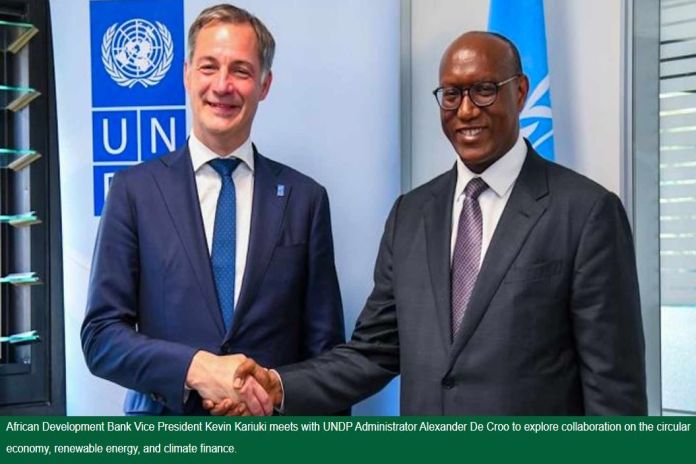
In a separate meeting with the new UNDP administrator, Alexander De Croo, discussions explored closer alignment on shared priorities, including renewable energy under Mission 300, technical assistance through the NDC Hub and NDC Partnership, and joint work on the circular economy to deliver measurable development impact.