



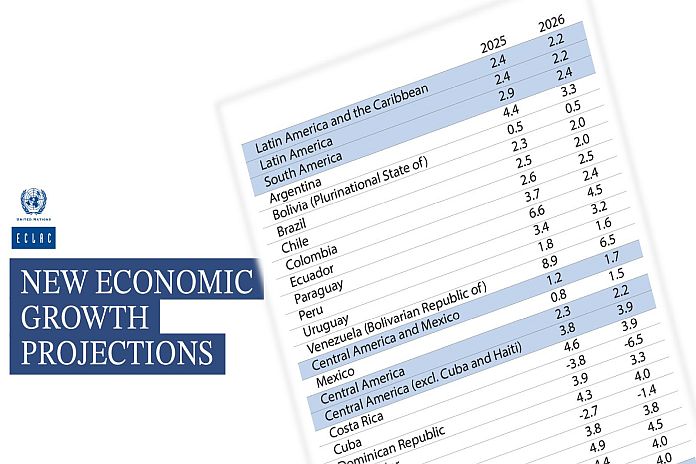
SANTIAGO, Chile – The economies of Latin America and the Caribbean are seen growing by 2.2 percent on average in 2026, according to the updated projections released today by the Economic Commission for Latin America and the Caribbean (ECLAC), which represents a slight downward revision from the 2.3 percent estimated in December 2025. This result reflects a more complex external environment than what was foreseen at the end of last year, characterised by greater geopolitical tensions, restrictive financial conditions and the resurgence of inflationary pressures at a global level.
According to the United Nations regional economic commission, this reduced dynamism is expected to be widespread. Growth is seen decelerating in 2026 in 24 of the region’s 33 countries, and accelerating in just seven of them. If this projection is borne out, the region as a whole will have had four straight years of growth rates around 2.3 percent, revealing a pattern of low capacity for growth.
A more restrictive international context
The deterioration in the external scenario is one of the main factors behind the downward revision of the regional growth projections, ECLAC indicates. During the first four months of this year, the increase in geopolitical tensions and war in the Middle East have exacerbated global uncertainty and volatility in financial and commodities markets.
In particular, the average price of oil in the first three weeks of April was 74 percent higher than the average value in December 2025, creating global inflationary pressures and increasing production and transportation costs. This was compounded by a rise in food prices globally and a deceleration of growth in some of the region’s main trading partners – such as the euro area, China and India – along with less dynamic international trade. The World Trade Organization (WTO) forecasts 2.7 percent growth in the volume of global goods and services trade in 2026, after a 4.7 percent expansion in 2025.
In this context of higher inflation and diminished trade prospects, the world’s main central banks have adopted more cautious stances, maintaining less favourable financial conditions than what was expected at the end of last year.
Contained domestic aggregate demand
At the regional level, growth is seen being constrained mainly by less dynamic private consumption. While investment shows signs of recovering, it continues to be moderate in the majority of countries.
During the second half of 2025, a deceleration in economic activity was already observed, especially in the region’s main economies, and this trend has continued into 2026.
In line with the reduced dynamism of economic activity, employment in Latin American and Caribbean economies is also seen expanding moderately, with growth estimated at around 1.1percent in 2026 versus 1.5 percent in 2025. Meanwhile, the effects of inflation pressures at a global level are seen fueling increased inflation in the region, with the median forecast topping 3 percent in 2026, compared with 2.4 percent in 2025. This situation is especially relevant in South American economies, where there continue to be pressures associated with exchange rate volatility and the impact of more costly imported inputs and transportation.
Heterogeneous economic activity performance between countries and subregions
In total, nine countries are seen growing by 4 percent or more, eight countries are seen growing between 3 percent and 4 percent, 13 will expand below that level, and three will undergo contractions.
Subregionally, it is estimated that:
- South America will grow by 2.4 percent in 2026, below the 2.9 percent recorded in 2025, reflecting a deceleration in the majority of the subregion’s economies.
- In Central America growth is seen easing in comparison with 2025, totaling 2.2 percent in 2026 versus 2.3 percent last year. This result is affected by the contractions forecast for Cuba and Haiti. If those two economies were excluded, the average would be 3.9 percent in 2026, which represents a slight increase from the 3.8 percent seen in 2025.
- In the English- and Dutch-speaking Caribbean 5.6 percent growth is expected for 2026, which is just above the 5.5 percent notched in 2025. This result reflects forecasted high growth in Guyana. If that country were excluded, the estimated regional average would be 1.2 percent, versus 2.0 percent in 2025.
Relevant risks remain
The region’s risk balance contemplates factors that, if they were to come about, could lead to further downward adjustments to this year’s growth projections. These risks include the continuation of restrictive financial conditions, inflationary pressures associated with increased energy and food prices, volatility in international markets, countries’ vulnerability to external shocks, and the weakness of domestic demand in several of the region’s economies.
In addition, in some countries, structural factors such as external restrictions, limited policy space and institutional weaknesses could affect economic performance.
Structural challenges
The current scenario reveals the structural challenges faced by the region, particularly low trend growth, high exposure to external shocks and the need to strengthen domestic growth drivers.
In this context, expanding domestic and external resource mobilisation and bolstering governance are fundamental to fostering policies that would energise investment, increase productivity and strengthen macroeconomic resilience in an increasingly uncertain global environment.