



- Investment in clean energy can create opportunities for local jobs, skills or industrial capacity, but these benefits are not automatic.
- Many older investment treaties were designed before climate transition became a policy priority.
- Some treaty provisions may limit governments’ flexibility to support domestic capabilities linked to renewable industries.
- The next global divide may be between countries that attract investment and those that turn it into technology and know-how.
GENEVA, Switzerland – New UN Trade and Development (UNCTAD) analysis notes that attracting clean energy investment is an important step, but additional measures are needed to deliver an inclusive energy transition. The world needs more than $1 trillion a year in renewable energy investment by 2030, much of it from private and foreign sources, but without access to technology, skills and enough policy flexibility to build local industries, many developing countries risk remaining buyers rather than builders in the green economy.
The report examines international investment agreements, many negotiated in the 1980s, 1990s and early 2000s, before climate action became a central global priority. It argues that a significant share of these treaties may restrict governments’ ability to adopt policies that encourage local training, supplier development or technology diffusion, even as countries try to build domestic clean energy industries.
The report says newer investment treaties can better support the energy transition by preserving governments’ policy flexibility, encouraging clean-energy investment and helping countries build the skills, institutions and supplier networks needed to benefit from it.
The hidden inequality in the green transition
For developing countries, foreign investment is often essential. More than 80 percent of renewable energy investment already comes from private sources, and domestic financing alone may not meet future needs.
But the report warns that hosting renewable projects without domestic technological capacity does not guarantee broader economic gains.
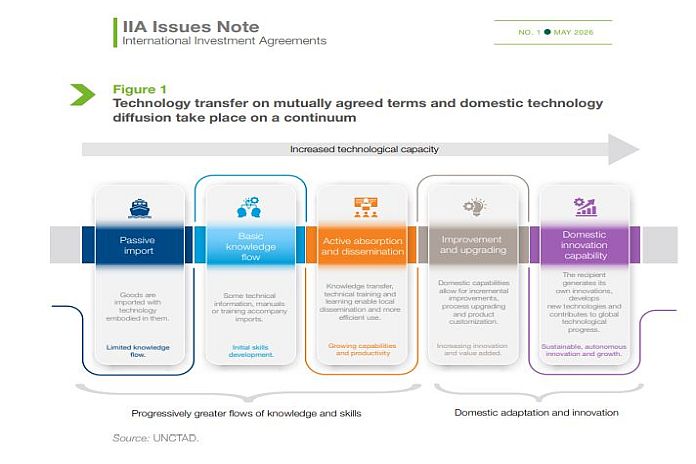
Countries may import solar panels, battery technologies or clean energy equipment without developing the expertise needed to produce, adapt or improve them. Over time, this risks creating a new form of dependency, where countries participate in the green transition mainly as consumers rather than producers.
UNCTAD argues that access to technology, technical knowledge and skilled labour increasingly determines whether investment leads to long-term development.
Rules written for another era
The report points to provisions in older investment treaties that may limit the use of policies intended to strengthen domestic industries. These may include encouraging investors to use local suppliers, support workforce training or help build technological capabilities. More than one-third of existing treaty relationships include restrictions on some of these measures.
The report does not advocate broad intervention or mandatory technology transfer. It stresses that poorly designed requirements can raise costs, discourage investment or fail to create lasting benefits. Evidence on what works remains mixed. Instead, it underlines that the energy transition takes place in a rapidly evolving policy environment, which requires a certain degree of freedom to adjust policies over time and preserve carefully designed tools that can support technology diffusion and skills development.
Beyond investment: building the capacity to benefit
Investment is only part of the equation, according to the analysis. Countries also need skilled workers, infrastructure, supplier networks and institutions able to absorb and adapt new technologies. Without those foundations, even large inflows of capital may have limited impact. Modern investment agreements increasingly try to support developing countries in strengthening these foundations.
As governments race to scale up renewable energy, the report suggests a broader question is emerging: not only who receives green investment, but who gains the knowledge, industries and capabilities that come with it.
For UNCTAD, the policy challenge is clear: the green transition must not only move capital across borders, but also spread the knowledge and capabilities countries need to develop.