



This blog post is part of a special series based on the April 2026 Commodity Markets Outlook, a flagship report published by the World Bank Group. This series features concise summaries of commodity-specific sections extracted from the report.
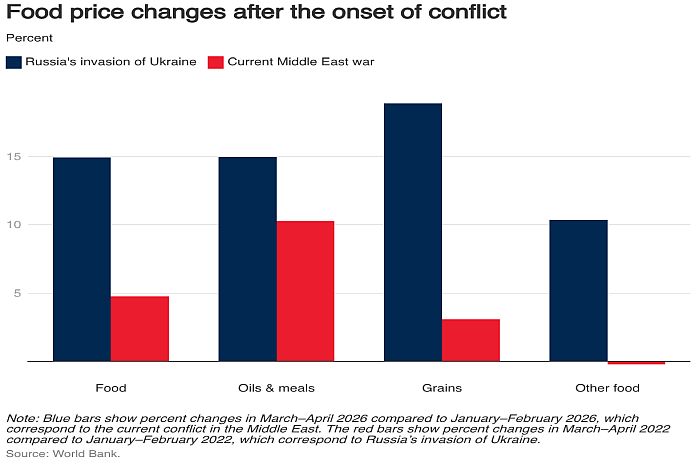
Global food prices rose to their highest level since January 2024 in April 2026, following the near-total closure of the Strait of Hormuz after the Middle East conflict erupted in late February. Over the two months after the conflict began, food prices rose 5 percent compared to the prior two months, driven primarily by oils and meals, which surged 10 percent due to higher crude oil prices and expanded biofuel mandates. Grain prices rose more modestly by 3 percent. Year-to-date through April, food prices are 2 percent above their level a year earlier.
By Dawit MekonnenKaltrina Temaj
Food price indexes
Even so, the food price response has been far more contained than in early 2022: food prices rose 15 percent in the comparable two-month window after Russia’s invasion of Ukraine — about three times the increase so far. This is striking given larger spikes in energy and fertilizer prices in the current conflict. The more muted food price response reflects ample grain and oilseed supplies, the fact that Northern Hemisphere farmers had largely secured fertilizer for spring planting before hostilities began, and the nature of the current shock, which transmits mainly through higher input costs rather than through an immediate disruption of major food exports.
Food price changes after the onset of conflict
Grains: Ample supplies cushion the blow. A key reason food prices have not surged more sharply is that global grain and oilseed supplies are robust. In 2025–26, global grain supply is forecast to reach a record high. Despite this buffer, grain prices rose by 5 percent in the first quarter of 2026 compared to the previous quarter, led by a 9 percent jump in wheat and a 4 percent rise in maize. The increase reflected drought concerns, expectations of reduced spring planting amid higher fertilizer costs, and logistical disruptions. In 2026–27, grain production is projected to be lower than in the current season but remain the second-highest on record.
Oils and meals are the food group most affected by the current conflict, rising 10 percent in the two months following its onset and reaching a two-year high in April. The increase reflects elevated crude oil prices that boosted the attractiveness of biofuels, alongside higher blending mandates in Indonesia, Thailand, and the United States. Year-to-date through April, the oils and meals index is up 10 percent (y/y). Soybean oil surged 16 percent in 2026Q1 (q/q) and 25 percent (y/y) following ambitious US renewable diesel targets announced in late March, while soybean prices rose 5 percent on strong vegetable oil demand and renewed Chinese buying. Palm oil prices also firmed on strong biodiesel demand. However, ample edible oil supplies helped limit further gains.
Global edible oil supply
Food security in the crosshairs. The conflict’s ripple effects on food security are already visible. Before hostilities began in February 2026, food price inflation in the Middle East, North Africa, Afghanistan, and Pakistan (MENAAP) region was relatively contained. The closure of the Strait of Hormuz changed that quickly, with food inflation rising sharply in March in Gulf economies that are heavily import-dependent. The Islamic Republic of Iran, where food inflation was already running at 98 percent in February, faces particularly acute risks.
Food consumer price inflation, by EMDE region
The acceleration in food inflation was not confined to MENAAP. Prices also picked up in Europe and Central Asia, Latin America and the Caribbean, and South Asia — a pattern broadly similar to the one observed a month after Russia’s invasion of Ukraine. If acute supply disruptions persist beyond mid-year and oil prices remain above $100 per barrel for an extended period, the UN World Food Programme estimates that 45 million additional people could face acute hunger in 2026, more than half of them in Sub-Saharan Africa and MENAAP.
Acute food insecurity
Outlook: Modest food price increases, with risks tilted firmly upward. Under the baseline assumption that Middle East supply disruptions ease around mid-year, food commodity prices are projected to rise modestly—grains by 2 percent in 2026, oils and meals by 4 percent, and the overall food index by around 2.5 percent. Risks, however, are tilted firmly to the upside. If the conflict persists beyond mid-year, keeping energy and fertiliser prices elevated for longer, or if a stronger-than-expected El Niño emerges, food prices could exceed current projections. Whether supply disruptions ease as assumed will be the central question for global food markets in the months ahead.