



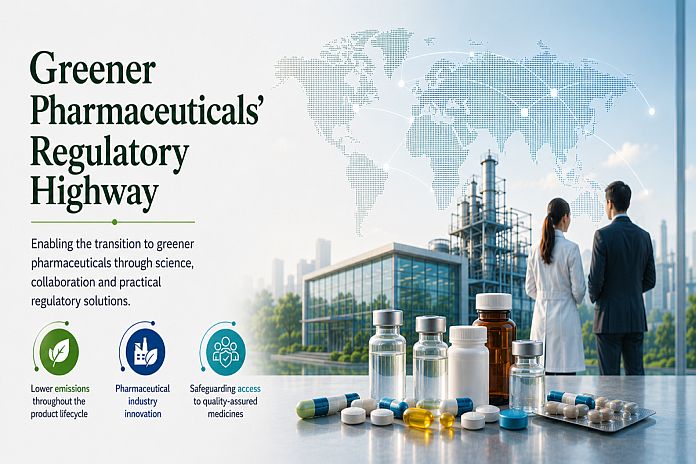
 GENEVA, Switzerland – How can regulators enable the transition towards more environmentally sustainable medicines without slowing innovation, compromising safety and efficacy or limiting access for those who need them?
That question brought regulators from around the world to WHO headquarters on 19 June 2026 for the Global Regulators Summit on Greener Pharmaceuticals’ Regulatory Highway, a meeting designed to help shape the next phase of international collaboration to reduce the environmental footprint of pharmaceutical products.
The Summit marked an important milestone in a broader WHO-led initiative launched in 2024 to explore how regulatory systems can support sustainability-driven innovation while continuing to safeguard the quality, safety and equitable access to affordable health products. Bringing together medicines regulatory authorities from diverse geographical regions and income settings, together with WHO technical experts, the meeting focused on practical opportunities for action, collaboration and shared learning.
The discussions will inform a forthcoming WHO White Paper that sets out a global framework for regulatory action and international collaboration.
Regulation as an enabler of sustainable innovation
Opening the Summit, Dr Rogério Gaspar, director of WHO’s department of regulation and prequalification, emphasised that environmental sustainability and innovation must advance together.
“Climate change is already affecting health systems around the world,” he said. “Regulators have an important responsibility, not only to ensure that medicines remain safe, effective and of assured quality, but also to enable innovations that can reduce the environmental footprint of pharmaceutical products throughout their lifecycle.”
He stressed that the initiative is not about lowering regulatory standards or creating additional barriers for manufacturers. Rather, it seeks to modernise regulatory approaches so that environmentally beneficial innovations can reach patients more efficiently.
“The challenge is not choosing between sustainability and access,” he noted. “It is ensuring that regulatory systems enable both.”
Throughout the Summit, participants emphasised that regulatory systems are uniquely positioned to help accelerate innovation by shaping standards, guidance, reliance mechanisms and regulatory pathways that enable new technologies to reach people in need.
Many lower-carbon technologies and manufacturing solutions already exist. What is often missing are regulatory pathways that allow companies to adopt these innovations efficiently, consistently and across multiple jurisdictions.
The opportunity is already within reach
Delivering the keynote address, Vincent Bretin, director for results and climate at Unitaid, outlined why pharmaceutical decarbonization represents one of the health sector’s greatest opportunities to reduce emissions.
While health systems contribute around 5 percent of global greenhouse gas emissions, pharmaceuticals account for one of their largest individual sources. Yet evidence increasingly shows that many emissions reductions can be achieved without compromising patient care, and in some cases while reducing costs.
Examples presented during the Summit included more sustainable manufacturing processes, improved solvent recovery, greener active pharmaceutical ingredient production, lower-emission inhalers, optimised packaging, digital technologies and cleaner energy sources.
Participants emphasised that regulators could help accelerate these transitions through clearer scientific guidance, earlier engagement with developers and more agile approaches to lifecycle management.
Learning from regulatory experience
Regulatory authorities shared practical examples of how these principles are already being translated into action.
The European Medicines Agency (EMA) described how it has established dedicated mechanisms to support environmentally sustainable pharmaceutical innovation, including scientific advice and multidisciplinary guidance for manufacturers seeking to introduce lower-emission technologies. It also highlighted the importance of internationally harmonised guidance, risk-based regulatory approaches and early dialogue with industry to reduce uncertainty for manufacturers while maintaining rigorous scientific standards.
Representatives from the Indonesian Food and Drug Authority (BPOM) and the South African Health Products Regulatory Authority (SAHPRA) shared complementary perspectives, demonstrating how regulators across different regions are integrating environmental sustainability into regulatory thinking while strengthening capacity, digital transformation and international collaboration.
The African Medicines Agency (AMA) highlighted the importance of ensuring that the transition towards greener pharmaceuticals supports countries at all levels of regulatory maturity. It also emphasised that international collaboration and reliance mechanisms will be essential to help manufacturers across Africa adopt greener technologies while maintaining high standards of quality, safety and efficacy.
Participants emphasised that progress will require coordinated action across regulatory authorities, manufacturers, procurement agencies, standards-setting bodies, multilateral organisations and other key stakeholders. Within this broader effort, strengthened international cooperation, regulatory convergence and reliance will be essential to enable sustainable innovation at global scale while avoiding unnecessary duplication.
From dialogue to implementation
The Summit concluded with broad agreement that regulatory systems must evolve alongside scientific and technological advances if health systems are to meet both public health and climate objectives.
Rather than viewing environmental sustainability as an additional regulatory burden, participants recognised it as an opportunity to modernise regulatory systems, support innovation and strengthen the resilience of global pharmaceutical supply chains.
Insights from the Summit will inform the finalisation of a WHO White Paper on greener pharmaceuticals, expected to be published in July 2026. The White Paper will serve as a roadmap for regulators, governments, manufacturers and international partners seeking to accelerate the transition toward more sustainable pharmaceutical products while safeguarding equitable access to quality-assured medicines worldwide.
“This Summit is not the end of the conversation; it is only the beginning,” concluded Dr Gaspar. “Together, we are laying the foundations for a long-term effort to enable innovation, strengthen sustainability and preserve access to quality-assured medicines worldwide.”