
- “Silence in trade policy is not neutral. It is a decision, and it carries a price,” Dr Preville.
By Special contributor
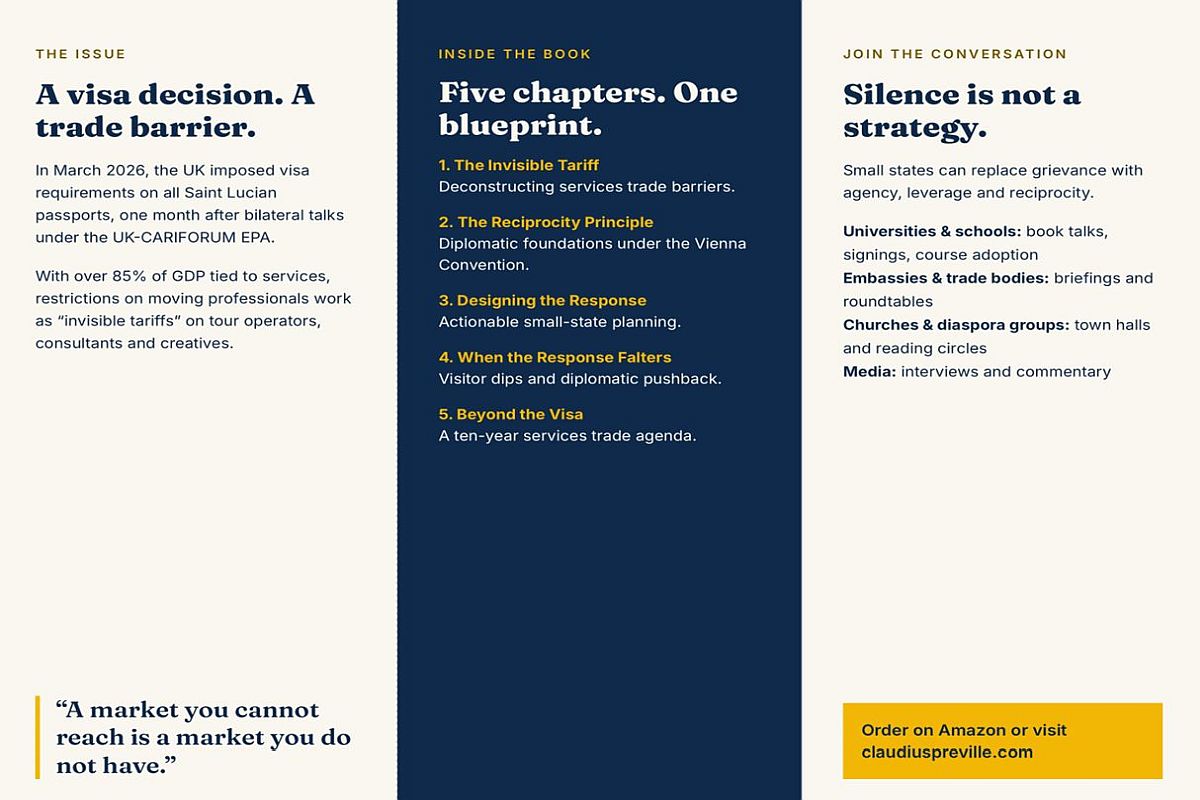
RODNEY BAY, St Lucia – In March 2026, the United Kingdom imposed a visa requirement on every holder of a Saint Lucian passport. June 15, Ireland announced the same, followed by Bermuda on September 19, 2026. These are not coincidences.
Visa restrictions by the UK hit at the heart of Saint Lucia’s most critical economic vulnerabilities – global mobility, international trade in services, and economic self-determination are but a few. Decisions also hit regional policy and services, heavily dependent on tourism, financial services, digital and professional services, imports and climate adaptation.
These policy decisions made far away hit Saint Lucian’s and the economy immediately. To break that cycle and protect active participation, streamlining cross-border data frameworks and investing heavily in digital education and infrastructure is here and now a matter of urgency for Saint Lucia.
Quite often, indecision, paralysed by options, stops the process of evaluating and starts consuming whatever path requires the least immediate cognitive load. Treating that permanent decision fuels analysis, or risk becoming active participants, in a twist of fate to someone else’s bottom line.
The termination of Citizenship-by-Investment (CBI) programs, trade and travel visa restrictions now threaten vital capital inflows. CBI, visa and global mobility issues facing Saint Lucia from the EU, US, and UK are inextricably linked to trade, international travel, service providers, financial and professional services.
Conditions such as these curtail global mobility and silence sovereign states from negotiating equitable partnerships. They function as “invisible tariffs.”
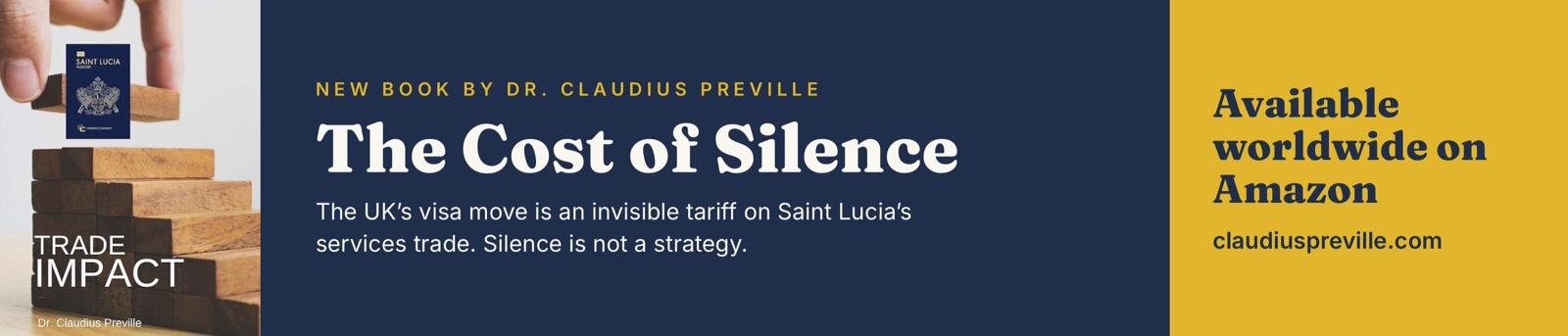
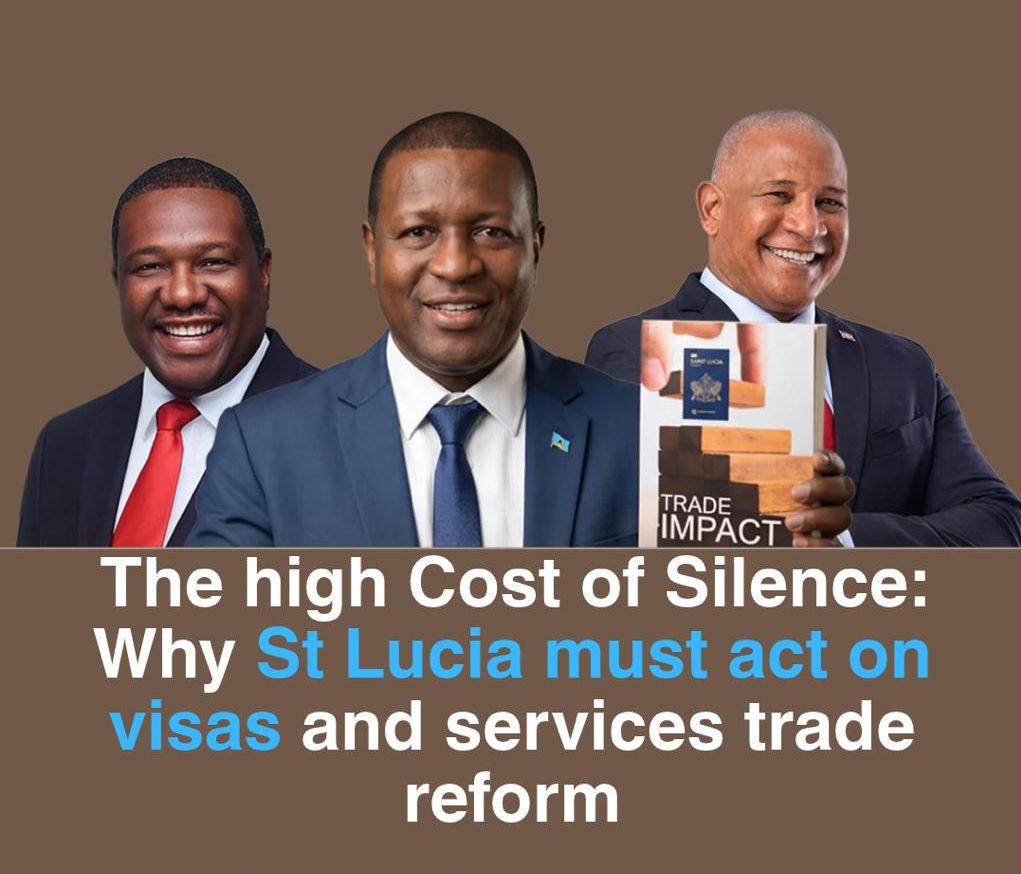
Dr Claudius Preville’s book, The Cost of Silence: What the UK’s visa move means for St Lucia’s trade in services, and why a response is urgent, is available on Amazon.
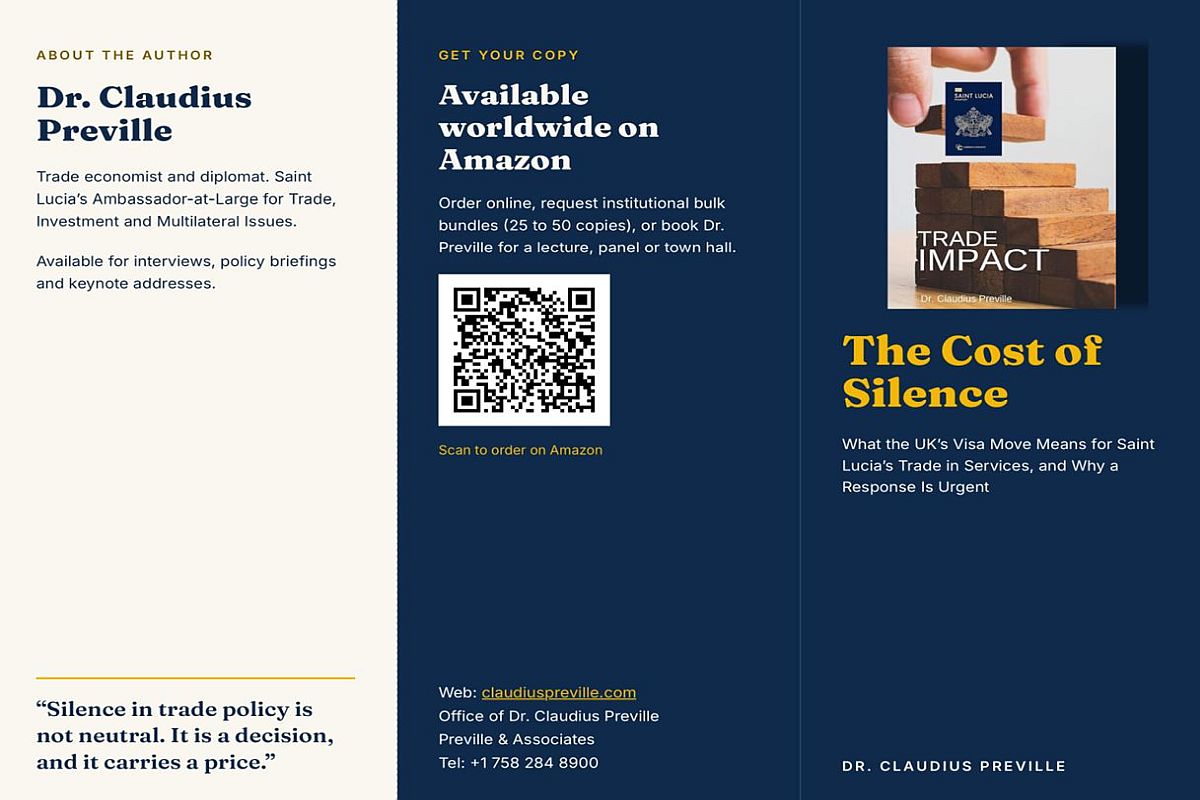
Dr Preville treats this episode with the seriousness it deserves; in an economy where services account for more than 85 percent of GDP, restrictions on the movement of people are not a secondary or administrative matter.
Small economies face macroeconomic pressures, fiscal realities, persistent inflation, high public debt, limited options for financing on better terms, and a vulnerable revenue base. Persistent challenges of scale and high unity costs, infrastructure and human capital gaps, alongside execution capacity and policy consistency, are repeatedly disrupted by climate shocks and limited options. When CARICOM and OECS cannot move or act in the Intra-Regional Blind Spot scenario, trade remains stifled by structural bottlenecks.
“A market you cannot reach is a market you do not have,” Dr Preville.
The UK decision has raised the cost of market access, shrunk the practical reach of professionals, creative, tourism-related and consultancy services, and quietly determined whose expertise is allowed to participate in international commerce. Meanwhile, Saint Lucia remains open.
Dr Preville’s book, The Cost of Silence is distinguished by its refusal to remain at the level of grievance. He argues: “Every year that Saint Lucia accepts the UK visa without comment, it establishes a precedent: that its market access can be restricted without consequence,” Dr Preville. Over time, the author outlines, precedent erodes both economic opportunity and national confidence, and hits at the heart of the island’s most critical economic vulnerabilities.
The alternatives rather than reacting impulsively: A coherent services trade agenda
The alternative, Dr Preville says, is grounded in reciprocity, institutional discipline, and the deliberate construction of a longer-term services trade strategy (Chapter 5). In this approach, the visa question becomes one instrument among several rather than the entire conversation.
The objective – from visa policy to trade strategy – is not merely to seek the restoration of visa-free access, but to build a trade posture – a coherent services trade agenda – that raises the cost of unilateral restriction and strengthens Saint Lucia’s negotiating position over time.
“The price of speaking up is therefore worth paying. It is the price of a visa, a negotiation, and a period of uncertainty. The price of silence is the slow erosion of a trading nation’s confidence. One is a cost; the other is a surrender,” Dr Preville.
There are risks in adopting a more assertive stance. Dr Preville does not deny them. Short-term friction, including possible effects on visitor flows or bilateral relations, cannot be ruled out. Yet the greater long-term cost lies in the quiet acceptance of diminished access and the gradual normalisation of asymmetry.
“A country that does not defend its people’s right to trade is a country that tells its citizens their work does not matter,” Dr Preville.
The Cost of Silence, therefore, presents Saint Lucia with a clear strategic choice – opportunity through action: visas and services trade reform.
Dr Preville presented that the visa stamp can continue to be treated as a symbol of constraint, or it can be treated as a prompt for a more deliberate and reciprocal trade strategy. One path accepts the current terms by default. However, the other requires sustained institutional focus and the willingness to negotiate from principle rather than from resignation.
“The stamp [visa] is no longer a symbol of helplessness. It is a symbol of a choice. Saint Lucia can choose to answer like with like, to negotiate from a position of principle, and to build a trade strategy that defends its access. Or it can choose silence and pay for it every year,” Dr Preville.
In an increasingly fragmented global economy—where regional integration, digital transformation, and resilient trade frameworks are dictating survival—small island developing states (SIDS) like Saint Lucia face severe risks if they remain passive.
“Silence in trade policy is not neutral. It is a decision, and it carries a price,” Dr Preville.
Inaction is a costly gamble
Dr Preville argues, absolute passivity invites further restrictions. Thus, substantively, moving beyond silence and secrecy, Saint Lucia must pivot from a posture of defensive observation to aggressive strategic alignment or be left out as mere bystanders.
Broadening the economic leverage matrix and strategic alignment enables proactive, transparent controls; currently, Saint Lucia’s economic diplomacy leaves it in a weak bargaining position with international partners and regulatory bodies.
Deepening regional integration and lower barriers for intra-regional trade in services is most important. Saint Lucia should adopt several robust diplomatic and structural strategies by leveraging institutional architecture, moving from fragmented responses to bloc-level cohesion.
The Eastern Caribbean Citizenship by Investment Regulatory Authority (ECCIRA)—aimed at standardising Caribbean CIP/CBI due diligence and compliance across member states—must be aggressively weaponised as a diplomatic tool (albeit EU visa action). Addressing the significant capital, technical infrastructure, and time required for implementation of sustainable development (3-5 years) requires a high-value priority.
Transitioning from migration revenue (CIP/CBI) to digital services
Efforts are being made to invest in human capital; however, steps in positioning the workforce—especially youth—to capture high-value opportunities in modern digital services and trade frameworks must be firm, forward-looking and policy-focused.
Against the backdrop of the high ‘Cost of Silence’ on visas, global migration, CARICOM and OECS trade structural bottlenecks, and external pressure, Saint Lucia must create opportunities through action on visa and services trade reform, and policy realignment.
“ They should be engaged, heard, and left free to disagree, because a public split in the Caribbean is a gift to the UK and a liability to everyone,” Dr Preville.
Regional economies can no longer afford to be weighed down by this liability; collectively, they must pivot toward sustainable growth models beyond CIP/CBI.
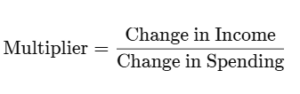
Every moment a government spends in silence or delay forfeits critical multiplier effects. Ultimately, Saint Lucians must decide if they will continue footing the bill for official passivity.
About the Author