
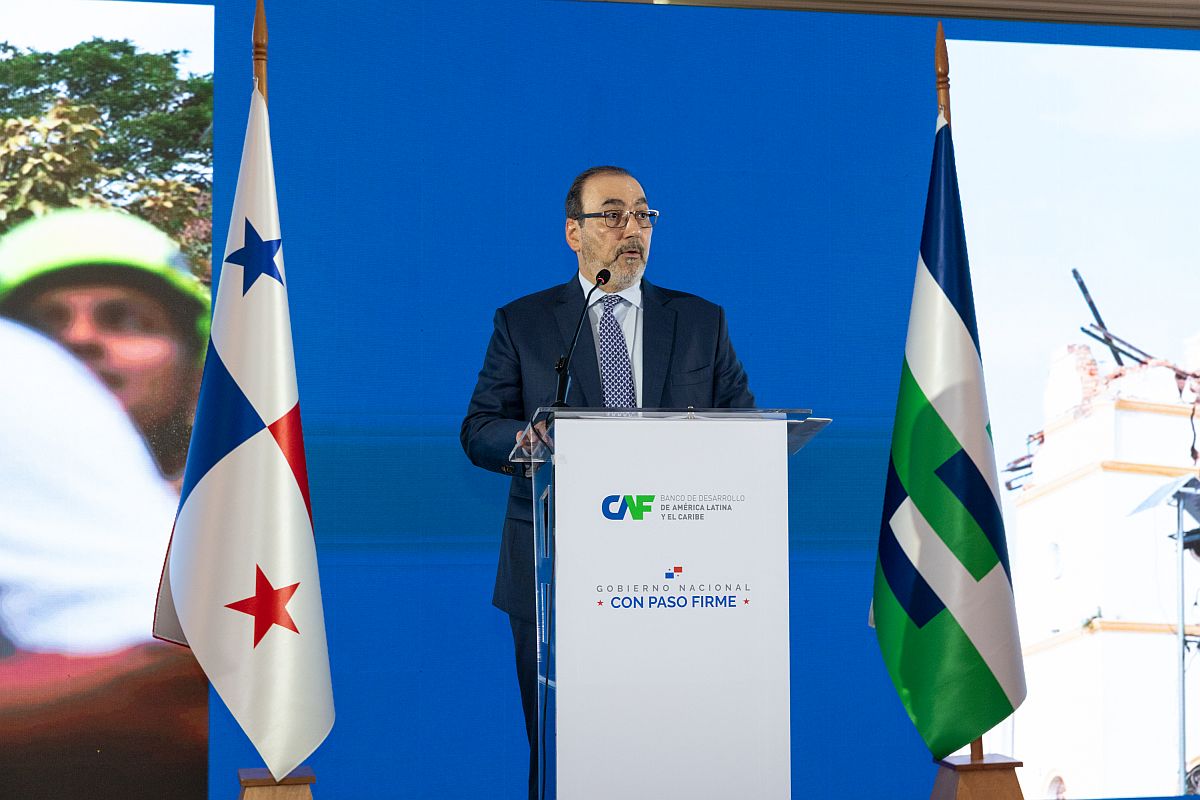
CAF Executive President, Sergio Diaz-Granados addresses the launch of the CAF International Forum 2027 in Panama City
PANAMA CITY – Panama will once again convene leading political, business, financial and multilateral representatives, as well as global thought leaders, for the third edition of the CAF International Forum 2027, to be held on January 27 and 28 at the Panama Convention Center under the theme, “Latin America and the Caribbean: A Region of Solutions for Global Challenges.”
The event, organised by CAF – Development Bank of Latin America and the Caribbean in partnership with the Government of Panama, will also include the “Voices for Our Region” Ideas Festival on January 26 and a Business Roundtable on January 28 and 29.
Ten heads of state and government from the region have confirmed their participation in the regional dialogue. They include José Raúl Mulino, president of Panama; Rodrigo Paz, president of Bolivia; Yamandú Orsi, president of Uruguay; Laura Fernández, president of Costa Rica; Pedro Alliana, president of Paraguay; His Excellency Dr Mohamed Irfaan Ali, president of the Co-operative Republic of Guyana; Nasry Asfura, president of Honduras; Daniel Noboa, president of Ecuador; Mia Amor Mottley, prime minister of Barbados; and Luis Abinader, president of the Dominican Republic.
Further confirmations of regional leaders and other international figures will be revealed in the coming weeks.
The announcement was made by CAF executive president Sergio Díaz-Granados and Panama’s minister of foreign affairs, Javier Martínez-Acha, who highlighted the importance of consolidating the Forum as a platform for dialogue, cooperation and the advancement of new opportunities for the region.
“Latin America and the Caribbean needs spaces where their leaders can debate major global changes, build consensus, and turn ideas into concrete decisions beyond ideological differences. The CAF International Forum is moving forward to establish itself as that bridge and as a regional public good serving all Latin American and Caribbean citizens,” Díaz-Granados said.
The forum’s agenda will include 21 plenary sessions, 60 parallel sessions and 50 closed-door sessions, with more than 350 panellists from the public and private sectors, academia, international organisations and civil society. It will also include business delegations from five continents, representing more than 5,000 business leaders.
Discussions will be organised around seven thematic areas: geopolitics and global governance; economy, investment and business development; regional integration and infrastructure; technology and innovation for development; environment, climate and biodiversity; energy transition and strategic minerals; and social development, talent and territories.
Panama to become permanent host of the CAF International Forum
During the event, CAF and the Government of Panama signed an agreement establishing Panama City as the permanent host of the CAF International Forum.
The agreement provides for the facilitation of venues, infrastructure, logistics and protocol support for future editions, as well as the joint promotion of the Forum as a platform for dialogue and convergence around the interests of Latin America and the Caribbean.
“Panama has welcomed previous editions of the Forum with openness and hospitality and has provided an environment conducive to dialogue, exchange and regional cooperation. For this reason, we have agreed to establish the country as the permanent host of this meeting, recognising both its commitment to Latin American integration and its strategic advantages in terms of location and connectivity,” said CAF’s executive president.
The government of Panama and CAF also announced that funds raised through sponsorships from private companies and partners for the Forum will be allocated in full to support earthquake recovery efforts in Panama, Venezuela and Colombia.
The third edition of the Forum follows a historic 2026 gathering, which brought together more than 6,500 leaders from 70 countries, including eight heads of state and four Nobel laureates. A total of 250 panellists discussed regional integration, trade, artificial intelligence, energy transition, development financing, innovation and sustainability.
About the Author