
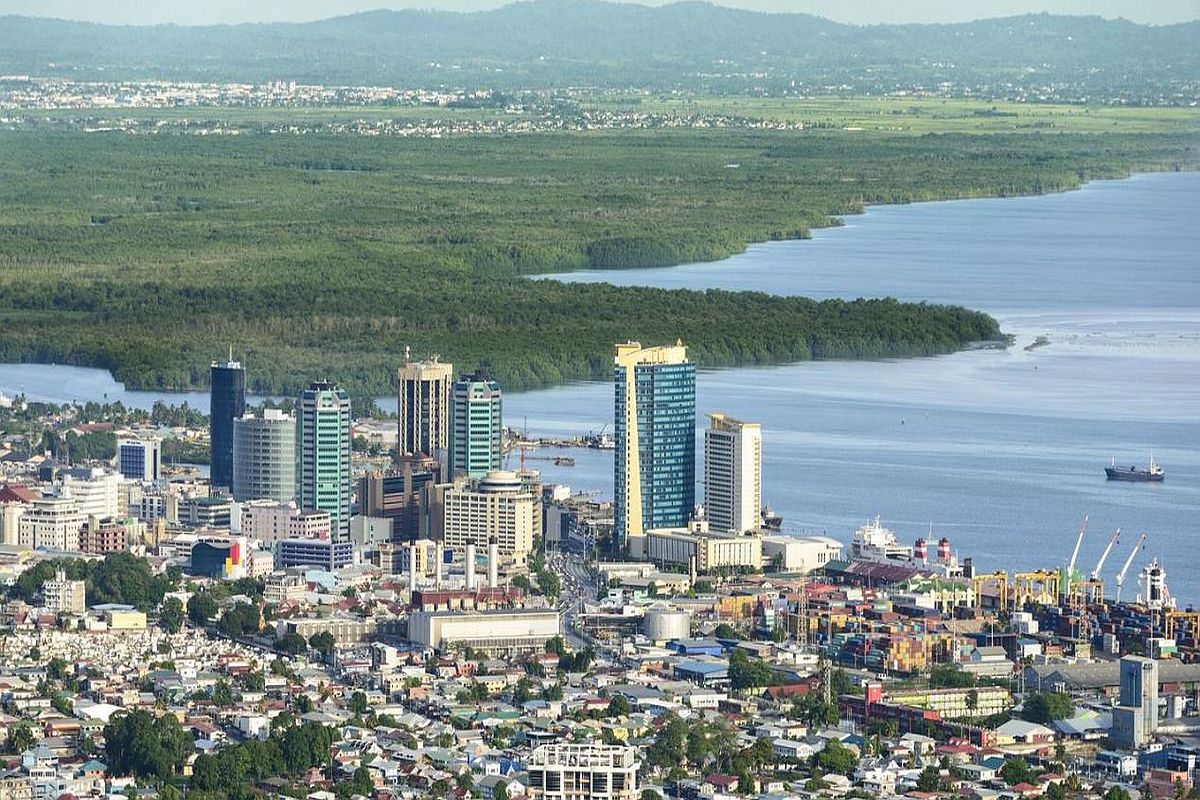
- As natural gas output declines, Trinidad and Tobago needs new sources of growth. Its skilled workforce and infrastructure offer a strong foundation.
By Nirvana Satnarine-Singh, Victor F. Gauto Gunther
Highlights
- Trinidad and Tobago has nearly doubled its real GDP per capita since 1980, alongside significant improvements in education, healthcare, and living standards.
- Yet energy dependence remains a structural vulnerability, and declining natural gas production means that higher global prices no longer deliver the benefits they once did.
- Looking ahead, the country’s industrial expertise, established infrastructure, and skilled workforce offer a foundation for developing new engines of growth.
There is an old French saying: plus ça change, plus c’est la même chose, used to describe situations in which, despite significant changes, something fundamental remains the same. This paradox seems to apply particularly well to Trinidad and Tobago, which has made great progress in recent decades but remains too dependent on the energy sector.
Over the past decades, the country has become wealthier, healthier, and more educated. Its economy has shifted from one centered on crude oil production to one built around natural gas and sophisticated downstream industries. New sectors have emerged, industries have modernised, and institutions such as the Heritage and Stabilisation Fund have strengthened the country’s ability to weather external shocks.
Yet beneath these achievements lies a persistent vulnerability: energy still dominates exports, leaving public finances exposed to fluctuations in international energy prices. At the same time, declining natural gas production has reduced the economy’s ability to benefit from rising prices, making diversification increasingly urgent, as highlighted in the study “Estimating the Effects of Energy Price Shocks for Trinidad and Tobago,” published by the Inter-American Development Bank (IDB).
Growth and Development: How far has Trinidad and Tobago come?
Trinidad and Tobago’s transformation into a global leader in natural gas processing is a remarkable achievement. The natural gas boom underpinned the country’s economic expansion.
Economic growth is often used as the scoreboard for national success. Economists, however, have long argued that growth and development are not the same. Growth tells us how much larger an economy has become. Development asks a broader question: are people’s lives actually improving?
By many measures, the answer for Trinidad and Tobago is yes. Between 1980 and 2024, real GDP per person almost doubled. Improvements in education, healthcare, and life expectancy tell a similar story, as Trinidad and Tobago has consistently maintained a Human Development Index above the global average since 1990.
But progress is always relative. Consider, for example, a marathon runner who manages to cut their finishing time in half. This would be a remarkable achievement, but if all the other runners improved just as much, the runner’s position in the race might remain unchanged.
That is largely what happened globally. Over the same period, real GDP per capita worldwide also doubled. Trinidad and Tobago remained comfortably above the world average, although the gap fluctuated considerably, highlighting the persistent volatility of the economy.
During energy booms, the country pulled further ahead, while periods of slower growth narrowed the gap. This underscores a broader lesson: maintaining an economic advantage requires not just growth but continuous adaptation.
A changing economy, persistent vulnerabilities
The economy’s transformation has brought natural gas dependence to the forefront, as natural gas is vital to sustaining a range of downstream manufacturing industries that have become internationally competitive, though they remain exposed to global price movements.
Crude oil is no longer the main driver of energy sector activity, but it remains an important source of government revenue through various corporate taxes, as highlighted in the study mentioned earlier. Moreover, economic volatility is well captured by oil price changes, given the co-movement of oil and natural gas prices.
For much of Trinidad and Tobago’s history, rising energy prices and economic activity tended to move together. Higher prices were often accompanied by expanding production, allowing the country to benefit from both higher prices and larger export volumes. Export earnings increased, foreign exchange reserves accumulated, and government revenues improved.
Today, however, the country is less able to capitalise on rising global energy prices. The reason is not that prices matter less, but that domestic production capacity has become increasingly constrained as natural gas output has declined.
Energy price shocks and fiscal vulnerability
The study finds that energy price shocks have their greatest impact on government expenditure. This underscores a critical structural challenge: the procyclical nature of fiscal policy increases dependence on the state for economic stability and crowds out productive private-sector activities.
Another structural challenge is the concentration of employment in services, which account for more than four out of every five jobs, even though Trinidad and Tobago is a net services importer and services account for only 11% of total exports. Manufacturing, agriculture, and non-gas energy employ relatively small shares of the workforce, with manufacturing recording particularly strong gains in productivity.
Preparing for a different future
If one lesson has emerged from decades of commodity cycles, it is that periods of prosperity rarely last forever. This is why long-term savings through the Heritage and Stabilisation Fund are crucial. The Fund stands out as one of the country’s greatest policy successes. International reserves have also helped preserve macroeconomic stability by supporting the country’s exchange rate regime.
Savings accumulated during previous cycles have therefore become an increasingly important source of resilience, rather than simply a precaution against temporary downturns.
Today, as the energy sector matures and natural gas production declines, the economy is less responsive to positive energy price shocks than it once was. Higher prices still matter, but they can no longer do as much of the heavy lifting. This subtle shift means that diversification is no longer merely a long-standing policy aspiration, but an economic necessity.
Fortunately, the country enters this next chapter with valuable strengths: decades of industrial expertise, established energy infrastructure, and a highly skilled workforce. Leveraging these assets can strengthen existing industries, foster the energy transition, and encourage new areas of growth.
The country’s future will depend less on waiting for the next energy boom than on developing new engines of growth capable of moving the economy forward.
About the Author