



- A new UNCTAD report finds that rising borrowing costs are leaving many developing countries with less money to invest in schools, healthcare, infrastructure and climate action.
- Between 2018 and 2024, 99 developing countries – home to 5.5 billion people – saw rising interest payments reduce the fiscal space available for development.
- Developing countries continue to pay significantly more for external financing than developed economies.
- UNCTAD calls for national reforms and stronger international action to reduce financing costs and expand the scale of, and access to, affordable, long-term finance.
GENEVA, Switzerland – Financing development is becoming increasingly difficult for much of the world.
A new UN Trade and Development (UNCTAD) report shows that while developing countries continue to attract external finance, it is insufficient, volatile and comes at a much higher cost than that paid by developed economies.
As borrowing becomes more expensive, governments are spending a growing share of public resources paying interest rather than investing in people and long-term development.
This challenge comes at a time when countries face growing demands to improve infrastructure, strengthen education and healthcare systems and create jobs.
Less room for schools, healthcare and infrastructure
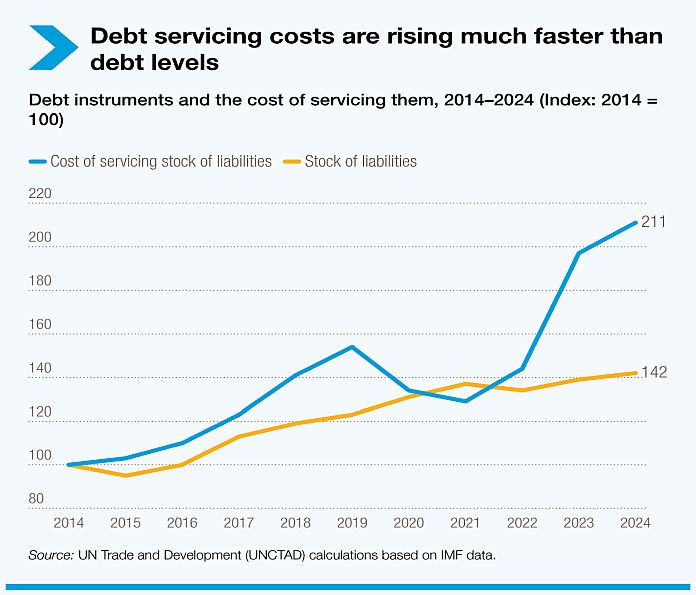
The report finds that rising debt-servicing costs are putting increasing pressure on public finances.
Between 2018 and 2024, 99 developing countries saw rising interest payments reduce the fiscal space available for development spending. Together, these countries are home to 5.5 billion people.
In 2024 alone, developing countries paid $384 billion in interest on their external debt. Over the past decade, government interest payments rose by 102 percent, while government revenues increased by only 39 percent.
As more public resources are directed towards debt service, governments have less room to invest in education, healthcare, infrastructure and other development priorities.
Developing countries still pay more for money
The report highlights a persistent imbalance in the international financial system.
Developing countries consistently pay higher costs for external financing – particularly debt financing – than developed economies, despite their significant investment needs.
It is estimated that developing countries need to invest an additional $4.3 trillion annually to achieve the Sustainable Development Goals (SDGs).
Closing this gap will require both external and domestic sources of financing to increase by at least one third.
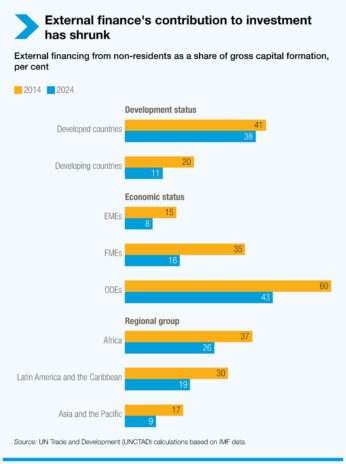
Yet new external financing has been declining and accounted for only 11 percent of total investment in developing economies in 2024, compared with 38 percent in developed countries.
Lower financing costs could unlock development
According to the report, reducing financing costs would free up significant resources for development.
UNCTAD estimates that if 94 developing country governments could borrow at the same rates as those in developed economies, they could collectively save around $500 billion each year in interest payments.
The report argues that addressing this challenge will require action at both national and international levels, including stronger debt management, increased affordable financing from multilateral development banks, improved debt restructuring mechanisms and reforms to the global financial architecture.
The message is straightforward: when financing is insufficient and too expensive, development becomes harder. Expanding access to affordable, stable and long-term finance is therefore not only a financial issue, but a development imperative.