



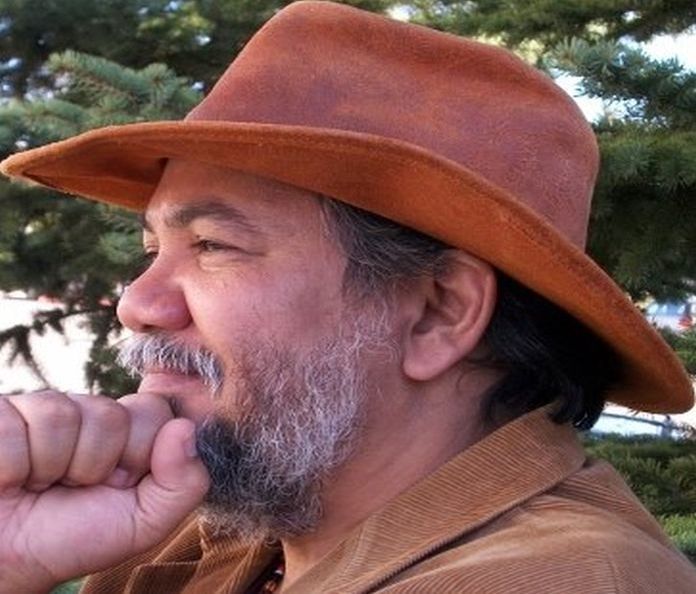
By Johnny Coomansingh
Many moons ago in our home, there was a constant battle between my father and my mother. They were like two fighting elephants. However, most of the blows fell on my mother. Both of them have passed into the great beyond, but the memories of their incessant fighting are still present in my mind; so difficult to forget. Like John Keats’ ‘Naughty Boy,’ I stood in my shoes (if I had any) and wondered when the fighting would cease.
Ascribed to the Kikuyu tribe of Kenya, the Swahili saying: “Ndovu wawili wakipigana nyasi ndio huumia,” means, ‘When elephants fight it is the grass that suffers.’ Without any doubt, we the children got ‘trampled.’ Some of us are still tired and broken from the literal flagellations and mental lacerations. Caught in the middle of the mêlée, we were like the grass on which the elephants trampled. Nevertheless, we grew bigger and went on the offensive. Eventually the male ‘elephant’ gave up and left for England; never to return. I am of the view that Brian Harris, in his blog When elephants fight the grass suffers…posted on the Internet on April 25, 2025, could not have said it better:
“A good friend recently drew my attention to a fascinating Swahili proverb, best translated as, “When the elephants fight, the grass suffers.” We had been talking about the rise in global unrest, and who the victims are. When the big players fight (or when the elephants fight), it is a host of innocent bystanders (the grass) who suffer the most. True, sometimes elephants fight to the death, especially during the “musth” period when testosterone-filled bulls can become very aggressive, but most often they simply walk away, while the grass below takes a lot longer to recover…I am always concerned when unnecessary suffering is inflicted, or when leaders forget that leadership is supposed to be “on behalf of” those impacted by their leadership.
It’s why Jesus insisted that those who wanted to be first needed to be willing to be last, the servant of all. In the Bible, true leaders (in the sense of leaders worth following) are those whose ambition is for the greater good, not their personal agenda or private concerns…
As multiple aid agencies around the world are having to shut up shop with their financial aid halted in a heartbeat; as global conflict escalates and reaches new levels of uncertainty and insecurity; as pensioners worry as they see share markets wildly duck and dive, putting their paltry savings in serious and unnecessary jeopardy; as long standing national friends turn their backs on each other; as truth is blatantly twisted and distorted, and heroes are insulted and corruption is praised – it is the grass that suffers – yes, ordinary people wanting to live peaceable lives. They don’t want artificial conflicts imposed upon them. They want security, and peace, and goodwill, and hope.”
Harris admitted that he is not an elephant. We aren’t either. So what can we do as the elephants jostle each other? He pointed out that we can take some steps while the ‘elephants’ are fighting. He said: “We can look out for each other. In an environment that escalates differences, we can spot what we hold in common…reach out in kindness, be a little bolder in including those who are not usually part of our circle…we can be people of hope.”
As I have said so many times in my deliberations, a rotten egg is a rotten egg. You could fry it, boil it, scramble it, steam it, poach it, or even make an omelette with it; it is still stinky and putrid. Try as you may, a rotten egg will not change. We must learn to call what is evil by its right name! Evil! An apple vendor once told me that his apples are not so bad. I did not mind the natural pockmarks on the fruits, but there were visible bruises and sore areas on the apples. He intimated that the apples were not-so-bad and was selling them at the same price. The ‘not-so-bad’ concept in my book is damned bad! In Trinidad, the term “lash mango” is quite popular. When buying mango, I heard people telling the mango vendor, “Me eh want no lash mango nah.”
Truthfulness is hard to come by when elephants are fighting to the death. They don’t care who gets crushed. Musth is derived from the Urdu and Persian word mast, which is roughly translated to mean ‘intoxicated.’ Many are the leaders who live in their ‘ivory palaces’ knock champagne glasses, become inebriated and eat caviar while they entertain arguments about who is right, and who is wrong, and who is indifferent, and who are insubordinate, and who should foot the bill. All this is happening when the proletariat and lumpenproletariat struggle for a morsel of bread that may fall from their tables.
During the 1990s, when I worked in the petroleum industry in the deep south of Trinidad, I witnessed people from the area asking in the ‘pluck shop’ for half of a chicken because they did not have the money to buy a whole one. Some went to the supermarket and could only afford to buy smoked bones to flavour their Sunday callaloo. Jesus the Christ once said that the poor will always be among us, but in that oil-producing area there were too many poor and struggling people. I witnessed that scenario while the elephants were politically fighting about who should get and who must not get.
For many residents in the oil belt, life was ‘hard like banga.’ In other words, they were constantly living in what we know as ‘guava season.’ This was compounded by the lack of potable water for all the villages. I once visited a relatively new home in Santa Flora with all the plumbing fixtures intact. The owner informed me that not one drop of water flowed through the faucets for fifteen years and counting! Strange as it may sound, the village of Santa Flora was the home of the Trinidad and Tobago Petroleum Company (TRINTOPEC). Right there was the juxtaposition of two liquids: the black gold, the ‘blood of the Earth’ versus the ‘blood of the people.’ Some of the residents were always struggling to make two ends meet, but someone was always moving the ends. It was quite noticeable that the wealth of the oil belt was shovelled and deposited elsewhere to enrich a few.
In a place that was pulling oil from hundreds of oil wells, residents were still fighting to survive. And there I found myself in what I would term the privileged class. My children attended the best schools in Trinidad and even had a company bus to take them to and from school. Not only that, they enjoyed the senior staff club’s swimming pool and every other sporting facility that the company offered. What struck me was how the little children from the adjacent village peered in from outside of the chain-link fence. I knew that they were wondering if they would ever get the opportunity to enjoy the swimming pool like everybody else. The famous staff club is no more, but this was an example of the inequality that existed then and in some ways still exists today in Trinidad and Tobago. Governments come, and governments go, and we hope for change, but change is hard. Sometimes things change but yet remain the same.
April 28, 2026 marked one year since the United National Congress (UNC) wrested control of Trinidad and Tobago from the People’s National Movement (PNM), who held the reins of power for the past ten years. Unwind TT, a content-driven news magazine platform on Facebook, showed that Kamla Persad-Bissesar, the new prime minister labelled as Kamla 2.0, was not going to entertain any pretenders in the UNC. Indeed, young political elephants, both male and female, are always around. The headline: ‘Kamla 2.0 pledges either peace or total war,’ was a message to her critics. The prime minister said, “If you come for my eye, I will take your whole head.” Her advice to the UNC leadership pretenders followed, “If you came for my head, make sure you don’t miss.”
Unwind TT presented a 19-question interview conducted by Anna Ramdass, senior political reporter with the Trinidad Express newspaper and the prime minister. The following is the UnWindTT preamble of the interview:
“One year into her administration, Persad-Bissessar said her leadership remains firmly anchored in the interests of the people, and that she will not be diverted from her mission to transform Trinidad and Tobago. Over the past year, the Prime Minister—dubbed “KPB 2.0” by the UNC—has spoken bluntly, adopting a no-nonsense approach on issues. The nation saw that intensity last September when she famously (or infamously) declared that narco-traffickers must be violently killed after the United States of America (USA) launched strikes on suspected drug boats in the Caribbean Sea.
From challenging regional norms within CARICOM to openly aligning Trinidad and Tobago with the administration of US president Donald Trump, Persad-Bissessar has reshaped both her political posture and the country’s external positioning. At home, she has issued repeated warnings to her ministers and to the criminal underworld, while pledging to be “ruthless” in pursuing what is right, including within CARICOM. She has also made it clear that her kindness must never be mistaken for weakness. She further said that, to date, she has received no complaints of corruption within her cabinet, as her administration moves into the second year of its five-year mandate.”
In every political party there are elephants. Some tend to hide in the political bushes and thickets until the right moment; there might be a few in the UNC and certainly in the PNM. The battle for power is ever-present; somebody is always hankering for a fight to take full control. Such people never entertain the grass beneath their feet. What I witness today in parliament is no exception. There are fighting elephants on both sides of the aisle but quite bizarre is the fact that many of them sit together and have tea in the tea room of the Red House. There have been some alleged physical incidents between elephants in that tea room. Is our parliament a puppet box with puppeteers who know about the elements of theatre?
Today in our world, elephants are fighting in the north, in the east, in the west and in the south. If it’s not Ukraine and Russia, it’s the United States and Iran. If it’s not Israel and Palestine, it’s India and Pakistan. As Bob Marley said: “Everywhere is war!” And don’t doubt me, the grass is suffering everywhere. Despite the State of Emergency (SOE), the huge elephants in the gangs in Trinidad and Tobago are constantly fighting. Last Friday (18/07/26), I saw that there were 209 murders posted on Ian Alleyne’s Crime Watch.
Do we have thoughts that all these elephants should stop fighting? Should we not consider the text contained in Isaiah 2:4? “…and they shall beat their swords into plowshares, and their spears into pruning hooks; nation shall not lift sword against nation, neither shall they learn war anymore.” Hope is all we have for the elephants to stop fighting.