
- 3.7 billion people live in countries where interest payments on public debt exceed spending on health or education.
- Developing countries paid almost $1 trillion in net interest on public debt in 2025, nearly three times the 2010 level.
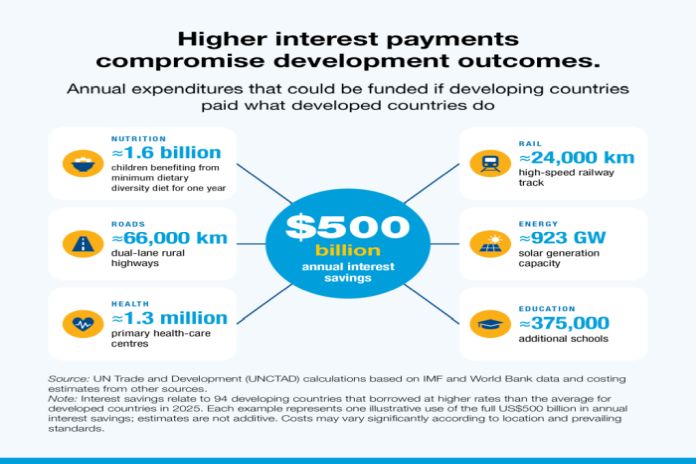
- Narrowing the borrowing-cost gap with developed economies could save developing countries $500 billion a year in interest payments.
- New UNCTAD report identifies advancing the Borrowers’ Platform as one of the global actions needed to address structurally higher borrowing costs.
GENEVA Switzerland – Rising borrowing costs are adding pressure on developing countries’ public finances, limiting the resources available for health, education and other development priorities, UN Trade and Development (UNCTAD) warns in its latest “World of debt” publication.
“Debt should help countries invest in their future. But in many developing countries, the servicing of external debt now exceeds new inflows”, says the report, highlighting a broader shift in the role of debt.
Since 2022, interest payments on external public debt have exceeded net new lending to developing countries. This means that external borrowing is not providing additional resources for development but instead leaving developing countries increasingly reliant on domestic borrowing, which comes at higher costs.
Debt burdens rising
The UNCTAD report shows that global public debt reached $111 trillion in 2025, up from $49 trillion in 2010. Though more than two-thirds of the total stock is held by developed economies, debt has increased much faster in developing countries. Borrowing costs remain persistently higher for developing countries, which paid an average interest rate of 5.2% on public debt, compared with 2.2 percent in developed countries. As a result, interest payments on public debt in developing countries rose from $363 billion in 2010 to nearly $1 trillion in 2025.
Interest costs and development constraints
The rising cost of debt is increasingly affecting governments’ ability to invest in essential public services. In 51 developing countries, home to 3.7 billion people, interest payments on public debt exceeded government spending on health or education. Narrowing the borrowing-cost gap could bring substantial gains, the UNCTAD report suggests. If developing countries could borrow at rates comparable to those paid by developed economies, they could save an estimated $500 billion a year in interest payments. That amount could finance about 1.3 million primary healthcare centres or provide a minimum-diversity diet for around 1.6 billion children annually.
What needs to change globally and nationally
At the global level, UNCTAD underscores priorities including reversing declines in official development assistance, expanding lending by multilateral and regional development banks, and increasing technical assistance to strengthen national capacities.
At the country level, UNCTAD calls for stronger macroeconomic management and public institutions, improved debt portfolio structures, and greater use of innovative financial instruments.
Borrowers’ Platform: From shared concerns to practical cooperation
The “World of debt” analysis comes ahead of a high-stakes meeting linked to the Borrowers’ Platform initiative, set to take place on 12 October in Bangkok during the IMF-World Bank Annual Meetings.
The Borrowers’ Platform, led by member states and supported by UNCTAD as secretariat, enables borrowing countries to come together, share knowledge and exchange experiences, and strengthen their collective voice on debt issues.
The Bangkok meeting will convene the Platform’s ministerial-level governing council for the first time and kickstart its full operational phase, enhancing a practical space for peer learning, knowledge sharing and capacity building.
About the Author