
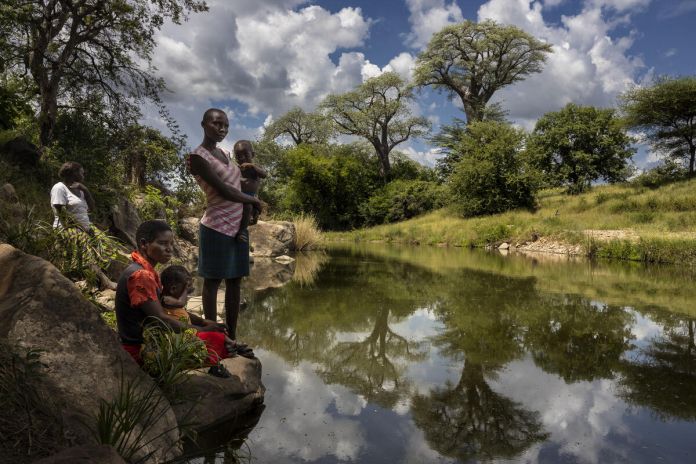
12 March 2020, Mucheni, Zimbabwe - Local women gathered at a pool where a large crocodile is known to lurk. There have been crocodile attacks on children as well as livestock. They are not compensated for these attacks and they are bitter about the fact that this is allowed to happen. There are plans connected to FAO and SWM that would like to see community conservancy come into being once there are more animals in place. The Kavango Zambezi (KAZA) Transfrontier Conservation area is home to a great diversity of ecosystems and landscapes. Each year, the area experiences large-scale migrations of megafauna. Whilst rural communities in the Mucheni (Zimbabwe) and Simalaha/ Inyasemu (Zambia) Community Conservancies have distinct cultures and local governments, they depend on hunting and fishing for both food and income. However, livelihoods are threatened by erratic rainfall, poor soils, and human wildlife conflicts. The SWM Project in KaZa is promoting a sustainable use of natural resources, including wildlife and fisheries, by the Community Conservancies. It is also developing alternative sources of proteins, such as livestock husbandry and aquaculture. The project is being implemented by CIRAD in coordination with the governments of both Zambia and Zimbabwe. Recent activities include: community Land Use Planning; Human Wildlife Conflict strategies; baseline studies (hydrology, ornithology, non-timber forest products, livestock development); data collection (food and wild meat consumption); water resource development (bore holes for people and wildlife); partnerships with local communities; and collaboration with Panthera and the Peace Parks Foundation.
- 2025 AQUASTAT Water Data indicates that pressure on freshwater resources is growing as demand increases in regions of scarcity
ROME – Renewable water availability per person has continued to decline by a further seven percent over the past decade, while pressure on already scarce freshwater resources is increasing in several regions, according to the 2025 AQUASTAT Water Data Snapshot released by the Food and Agriculture Organization of the United Nations (FAO).
The update provides a global overview of how water availability and use are evolving, presenting new data on irrigation, efficiency, and water stress reported through the 2024 AQUASTAT cycle. Renewable water refers to freshwater that is naturally replenished through the hydrologic cycle, which includes evaporation, condensation, and precipitation.
The latest figures show that some regions – particularly Northern Africa and Western Asia – continue to operate under extremely limited freshwater endowments. Countries such as Kuwait and Qatar rank among the lowest renewable water resources per person worldwide.
Freshwater withdrawals have also increased in several regions in recent years, adding pressure to already stressed river basins and aquifers. Agriculture remains the largest water-using sector globally, accounting for 72 percent of withdrawals in many regions.
A closer look at regional trends and changes in water use
The Snapshot uses clear, accessible examples to illustrate how water availability and demand are shifting across regions.
In Northern Africa, freshwater availability per person remains among the lowest globally, while withdrawals have increased by 16 percent over the past 10 years. In Western Asia – which in the Snapshot includes most Middle Eastern countries – rapid demographic growth and agricultural demand are contributing to increased pressure on limited supplies. By contrast, some regions with comparatively higher water availability still face rising competition among sectors, particularly where urbanization and irrigated agriculture are driving demand.
The data also highlights wide disparities in irrigation and water-use efficiency. In parts of Latin America and Asia, irrigation supports a large share of crop production, whereas in Sub-Saharan Africa irrigated cropland represents only a small fraction of total cultivated land, reflecting persistent gaps in access to water infrastructure. The Snapshot reports improvements in water-use efficiency in several regions, while levels of water stress remain high or very high in countries where withdrawals regularly exceed renewable supplies.
The report presents updated values for the two indicators monitored under Sustainable Development Goal (SDG) 6.4, tracking water-use efficiency and water stress. While efficiency has improved overall, high stress levels underscore the need for continued efforts to manage water sustainably and build resilience to growing demands.
About the Author