



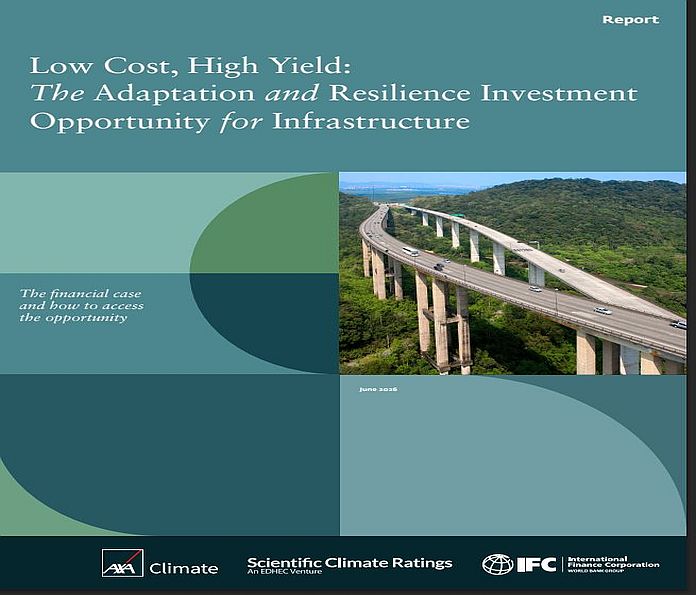
 WASHINGTON, USA – Targeted investments in resilient infrastructure can reduce financial losses, protect millions of jobs and asset value, and minimise disruptions of essential services in emerging markets, according to a new report by the World Bank Group, AXA Climate, and Scientific Climate Ratings.
“Low Cost, High Yield: The Adaptation and Resilience Investment Opportunity for Infrastructure” highlights that investing less than 10 percent of asset value in adaptation and resilience can preserve multiple times that amount.
Natural hazards cost low – and middle-income countries approximately $390 billion annually—equivalent to 1–2 percent of GDP. Without action, such climate risks could result in 43 million lost jobs across 49 countries by 2050.
By analysing assets in three Brazilian infrastructure sectors under high-emissions scenarios, the report finds that targeted resilience measures deliver up to $8.60 in protected asset value for every $1 invested. The analysis demonstrates a strong financial case that lower-cost, focused interventions—representing between 2.4 and 8 percent of asset value—deliver the highest benefit-to-cost ratios, making resilience integration financially viable even within constrained project budgets.
“This report reinforces what IFC has long believed: investing in resilient infrastructure is not a trade-off against financial returns—it is a pathway to them. It ensures continuity of essential infrastructure services, protects jobs, and unlocks long-term growth,” said Nicolas Peltier-Thiberge, World Bank Group’s Infrastructure director for strategy and operations.
The report also finds that longer financing tenors are more effective at improving investment bankability than interest rate reductions alone. The finding underscores the role of multilateral development banks and development finance institutions in providing long-term financing, combined with concessional and blended finance to crowd in private capital.
“For a modest upfront cost, infrastructure operators and investors can protect multiples of asset value and build systems that remain functional when communities need them most,” Antoine Denoix, AXA Climate’s CEO said. “We hope this report catalyses the actions urgently needed to close the adaptation and resilience financing gap.”
Building infrastructure that is resilient, fiscally sound, and built to last is smart development. This new report is part of the World Bank Group’s knowledge efforts to support countries in achieving their development goals—boosting economic growth, lifting people out of poverty, and creating jobs.
The report is available here.