

- Updated Repository of Practice provides greater insight into how INTERPOL upholds its constitutional commitments to neutrality and human rights
LYON, France – INTERPOL has published an updated Repository of Practice (RoP) on how the Organization assesses member countries’ requests for international police cooperation, including Notices and Diffusions.
The RoP outlines how the INTERPOL General Secretariat headquarters determines compliance with Articles 2(1) and 3 of the Organization’s Constitution which mandate that all activities align with the Universal Declaration of Human Rights and are not political, military, religious, or racial in nature.
While the previous RoP published in 2013 only covered Article 3, this comprehensive document shares for the first time how INTERPOL determines compliance on human rights grounds.
Using specific scenarios based on real-life cases, the updated RoP provides insights into the decision-making process for offences:
- Committed by current or former politicians and high-level civil servants or in the context of a coup d’état or situations of social/civil/political unrest;
- Concerning freedom of assembly or of association;
- Relating to terrorism or membership of a terrorist organization;
- Involving sanctions violations;
- Including religious or racial elements.
INTERPOL secretary general Jürgen Stock, said:
“As a neutral platform for international police cooperation, it is of utmost importance that our activities transcend domestic and global politics. The Repository of Practice is a valuable resource which demonstrates INTERPOL’s commitment to upholding human rights principles and the rule of law in our activities.”
The revised RoP, which will be regularly updated, reflects the evolving nature of transnational crime and INTERPOL’s continued work to ensure that its activities comply with its Constitution and rules.
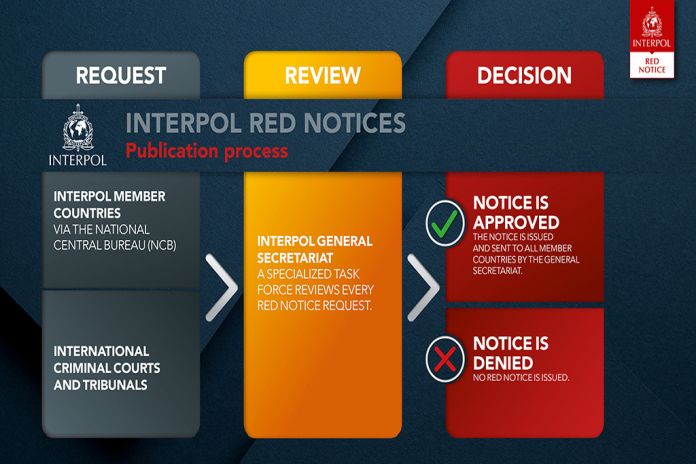
It builds on the creation in 2016 of the Notices and Diffusions Task Force (NDTF), a dedicated multidisciplinary team that conducts a robust quality and legal compliance review of incoming Notice and Diffusions requests from member countries.
Comprised of lawyers, police officers and operations specialists with a wide range of experience and language skills, the NDTF will either authorize or deny each request.
Notices approved by the NDTF are published by the General Secretariat and all INTERPOL member countries are notified.
If a Notice or Diffusion is denied because of non-compliance with Article 2(1) or 3 of the INTERPOL Constitution, no further cooperation is allowed to take place via INTERPOL.
About the Author