
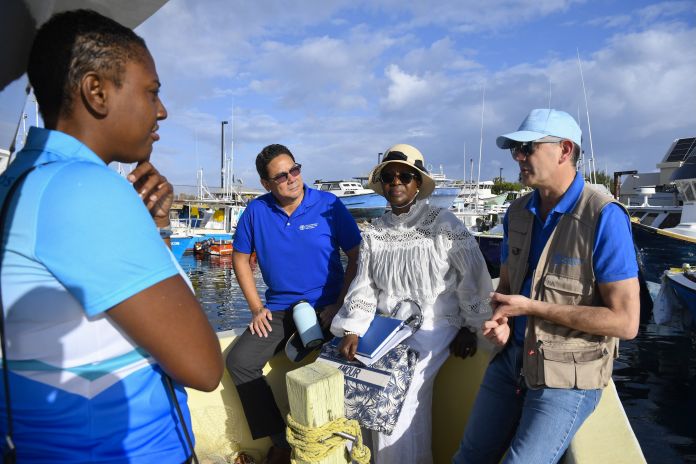
FAO Assistant Director-General Manuel Barange (R) during a March 2024 boat tour to an anchored FAD site in Barbados. [FAO/Randy Brooks]
ROME– Fishing plays a crucial role in global food security, yet it remains one of the most dangerous occupations on earth, with an estimated 100,000 fatalities each year.
As the COP29 climate change conference is underway and the UN marks World Fisheries Day on November 21, assistant director-general and director of the fisheries and aquaculture division at FAO, Manuel Barange, discusses the dangers that climate change poses to fishers, and how FAO is working to improve safety at sea.
How does climate change affect the safety of fishers, especially small-scale fisheries?
Climate change will have a significant impact on safety at sea, making it more dangerous to operate at sea and making particularly small-scale fishers more vulnerable to accidents. A warm ocean generates more storms of higher frequency and intensity, and hurricanes that we have seen recently in different parts of the world. Sometimes fishers don’t have time to go back to the harbour. Climate change is also affecting the distribution of resources, and so it is very possible that some fishers need to go further offshore to find the fish, therefore becoming more exposed. All those elements make fishing very dangerous, and it’s very important that we provide support to fishers to reduce the casualty rate.
How is FAO using technology and innovation to safeguard lives at sea?
We help countries design boats that are unsinkable, that are more resistant and long-lasting, so we reduce the vulnerability of small-scale fishers. We have vessel engineers working with us, some of the best experts from around the world, who devote their attention to this important activity that needs to be protected better.
Recently, we worked with Sri Lanka on boats made of plastic, which increases the life span of those vessels, and on designing them in a way that makes them unsinkable. You can also hide under the prow if there is a storm.
Those designs are provided free of charge to the countries and are available on our website. Sometimes we offer two or three models to begin with, for them to test, and then it is up to them to start building them, following those plans.
Are there other FAO initiatives helping fishers improve safety standards and prevent accidents?
Our work portfolio is very diverse. We run a training of trainers course that has been conducted in the Caribbean, East Africa, the Bay of Bengal, Asia, and the Near East region. In emergencies, we provide small-scale fishers with lifejackets, buoys, and voice and radio equipment to get them up to speed and back into operation.
We also work with other UN agencies, such as the International Labor Organization and the International Maritime Organization, to make sure that safety at sea is connected to working conditions of those operating at sea.
About the Author