
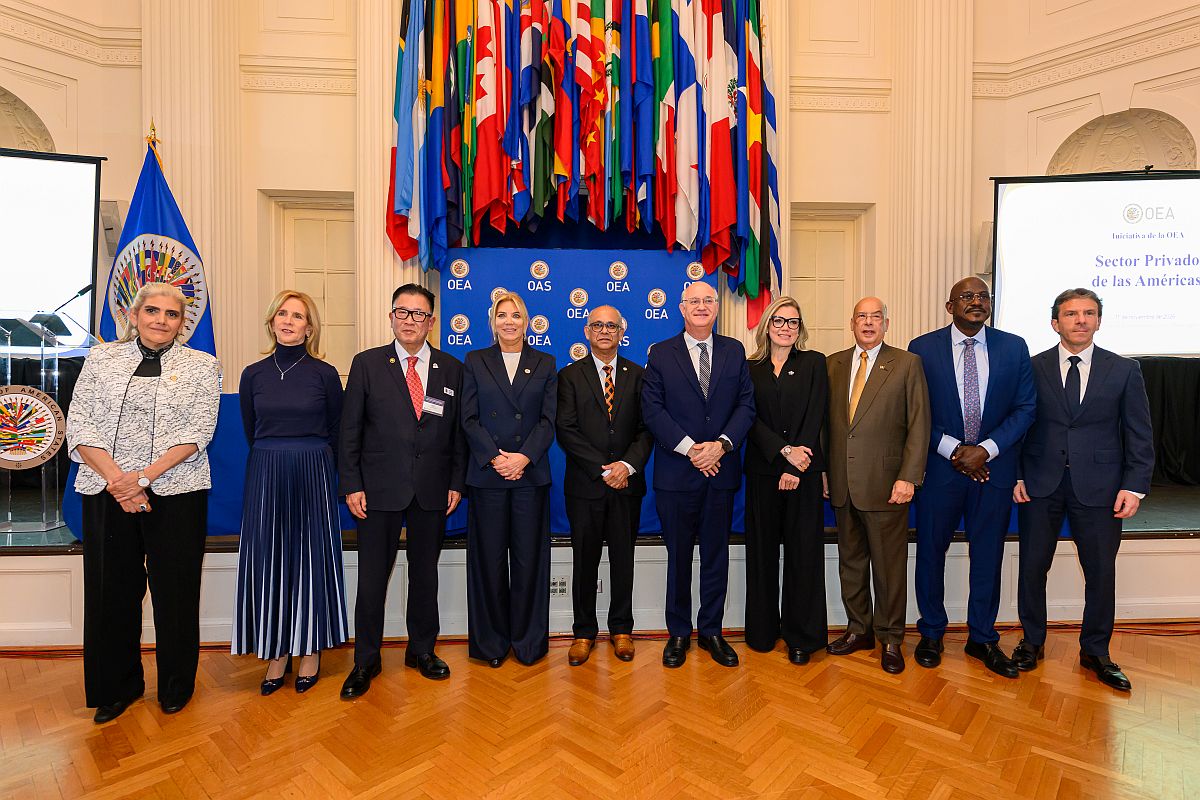
Date: November 11, 2026 Place: Washington, DC Credit: Juan Manuel Herrera/OAS

BRIDGETOWN, Barbados – The CARICOM Private Sector Organization (CPSO) has been named to the inaugural board of directors of the Organization of American States (OAS) “Private Sector of the Americas” Initiative. The seat gives the Caribbean private sector a formal voice on the hemisphere’s newest business platform.
The OAS presented the board on 11 November at its headquarters in Washington, DC, before more than 250 business leaders, government representatives and diplomats. Dr Patrick Antoine, CEO and technical director of the CPSO, takes the Caribbean seat. He sits alongside board chair Bettina Bulgheroni of Argentina and the representatives of three other business organisations: the Latin American Business Council (CEAL), the Latin American Chamber of Commerce of the United States (CAMACOL) and the Federation of Chambers and Industrial Associations of Central America and the Dominican Republic (FECAICA).
OAS secretary general Albert R. Ramdin launched the Initiative in Panama City in June. It is a business-led platform that connects chambers of commerce and industry leaders across North, Central and South America and the Caribbean with governments and development institutions. It aims to remove barriers to investment, strengthen regional trade and value chains, and open opportunities in energy and natural resources, digital transformation, infrastructure and logistics, biodiversity, tourism and food production. Its founding partners include the US Chamber of Commerce, the Americas Society/Council of the Americas (AS/COA), the Brazilian Chamber of Commerce, Industry and Services (CISBRA) and Meridian International Center.
Speaking for the more than 7,000 firms the CPSO represents, Dr Antoine told the gathering that the Region came to the table with an offer, not a request. “We are small. We are not marginal,” he said. “Fourteen CARICOM nations sit in this Organisation as sovereign equals. Governments sign the agreements. The private sector makes them real.” He added: “The Caribbean is the natural bridge of the hemisphere. The barrier is the cost of connecting: the cost of moving goods, moving money and managing risk.”
Dr Antoine said the CPSO will press three priorities on the Board: connectivity, finance for small and medium enterprises, and resilience. He urged that the Initiative be judged by “deals closed, containers moved and jobs created, not meetings held”. He closed with a direct message to his fellow board members: “The Caribbean private sector is ready to do business with the Americas. Let us get to work.”
Caribbean Voices in Washington
The Caribbean’s imprint on the event ran beyond the board. OAS secretary general Ramdin of Suriname said the OAS can provide the space for the private sector of the Americas to agree a roadmap and “present it with one voice”. He invited participants to help turn the conversation into sustained action.
Sir Ronald Sanders is Antigua and Barbuda’s ambassador to the United States, its Permanent Representative to the OAS and chair of the Inter-American Council for Integral Development (CIDI). He told the gathering that the Initiative can help turn the hemisphere’s economic potential into lasting gains for its people.
Inter-American Development Bank (IDB) president Ilan Goldfajn said that nine out of ten jobs in Latin America are created by the private sector. The development bank of Latin America and the Caribbean (CAF) described the Initiative as a permanent
channel for dialogue within the OAS.
The Initiative remains open to organisations and partners across the hemisphere that are ready to contribute proposals, expertise and tools. The CPSO will brief its members and the region’s national private sector organisations on the board’s work programme in the coming weeks.
Why it matters for the region
The board seat places the Caribbean’s business agenda in the room where hemispheric economic priorities will be set. It comes as the region’s firms face three pressures. The first is the prospect of higher shipping costs under the International Maritime Organization’s Net-Zero Framework. The second is the effect of United States’ tariffs and maritime measures on CARICOM exporters. The third is the continuing constraint on correspondent banking and trade finance. Each is, at root, a cost-of-connecting problem of the kind the Initiative was created to tackle. The CPSO’s work programme gives the region a ready set of proposals to carry to the hemispheric table. It covers de-risking intra-regional trade, deepening regional capital markets and strengthening the CARICOM Single Market and Economy (CSME).
The appointment builds on the CPSO’s part in the Initiative from the outset. The CPSO co-convened the Private Sector Dialogue in Panama City on 21 June 2026, at which the Initiative was launched. Its partners were the OAS General Secretariat, Meridian International Center, CEAL and the Chamber of Commerce, Industry and Agriculture of Panama. In a statement to the OAS on 3 September, the CPSO called for a standing seat for the private sector in the Initiative.
About the Author