



-
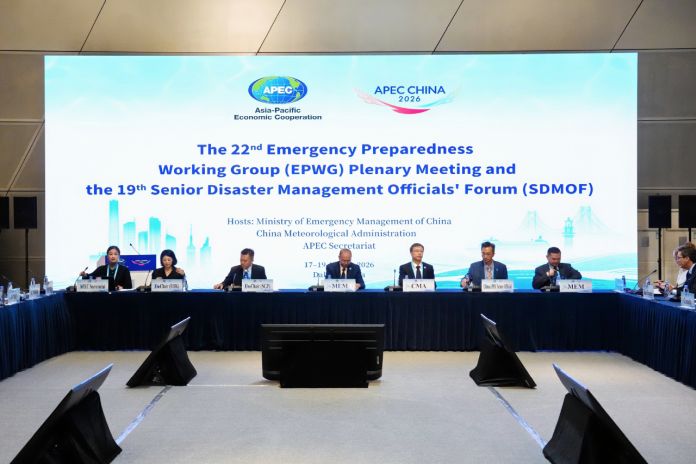
- 19th Senior Disaster Management Officials’ Forum
SINGAPORE – Weeks after Typhoon Dolphin brought record rainfall and flooding across parts of China, a powerful earthquake claimed lives and displaced thousands in Indonesia and torrential rains triggered flooding and landslides across parts of Korea, senior disaster management officials from APEC economies and leading international organisations are meeting in Dalian to strengthen regional cooperation on disaster preparedness and resilience.
The 19th APEC senior disaster management officials’ forum is putting a policy-heavy agenda at the center of that effort, spanning early warning systems, disaster risk financing, artificial intelligence, data governance, anticipatory action and community preparedness.
Experts from the United Nations Office for Disaster Risk Reduction (UNDRR), World Meteorological Organization (WMO), Asian Disaster Preparedness Center (ADPC) and International Federation of Red Cross and Red Crescent Societies (IFRC) joined officials from APEC economies earlier this week, reflecting the increasingly cross-border and multidisciplinary nature of disaster risk management.
The discussions focus not only on responding faster when emergencies occur, but on building systems capable of identifying risks earlier, converting information into action and reducing impacts before they escalate.
“Disaster management cooperation is an indispensable pillar in building a resilient Asia-Pacific community,” said Xu Jia’ai, vice minister of China’s ministry of emergency management, calling for greater investment in early warning technology and deeper integration of artificial intelligence, big data, satellite remote sensing and the Internet of Things into disaster preparedness.
The first major policy track examines how economies can strengthen multi-hazard early warning systems from end to end, from risk monitoring and forecasting to information dissemination, institutional coordination and emergency response.
UNDRR brought the wider global disaster risk reduction policy agenda into the discussion, while WMO focused on regional efforts to expand early warning coverage. Economies also examined how ex-ante investment, financing frameworks and stronger decision-support systems can help authorities act before hazards translate into major economic and human losses.
The challenge is becoming more urgent as extreme weather patterns change. Zhang Zuqiang, vice administrator of the China Meteorological Administration, noted that northern China has experienced around 50 percent more heavy rainfall events on average over the past five years compared with the 1990s.
“Only through multilateral cooperation, complementary strengths and coordinated prevention and response can we address regional and systemic climate disaster risks,” Zhang said.
A second policy track turns to how artificial intelligence and emerging technologies can strengthen risk-informed emergency management.
Discussions include the use of AI in disaster management, satellite remote sensing and geographic information systems, alongside the less visible but equally important challenges surrounding data governance, institutional capacity and the ability of economies to turn technological advances into practical emergency-management tools.
ADPC is contributing experience on anticipatory action and how risk information can support earlier decisions, reinforcing a central theme of the forum: better forecasts matter most when institutions are equipped to act on them.
The final major track shifts attention from systems and technology to the people and institutions that ultimately carry out preparedness and response.
With insights from the IFRC, economies are examining whole-of-society approaches to disaster risk reduction, including stronger coordination between governments, humanitarian organizations, communities and the private sector.
The discussions also address local capacity building, emergency supply systems and the participation of women and young people, recognising that resilience depends not only on national systems but on whether communities can prepare, respond and recover effectively.
Together, the sessions reflect a broader shift in disaster management across the region, from responding to individual emergencies toward managing risk across the full cycle of prevention, preparedness, response and recovery.
The forum builds on cooperation through APEC’s Emergency Preparedness Working Group as economies work to strengthen regional resilience and turn policy, technology and partnerships into practical protection for communities across the Asia-Pacific.