
-
- Timely access to justice and effective protection measures are essential to preventing femicidal violence and ending impunity, states the United Nations regional organisation.
SANTIAGO, Chile – In 2025, at least 24 women were victims of femicidal violence every day in Latin America and the Caribbean, including those who were murdered and those who survived attempted femicide, according to the latest official data provided to the Gender Equality Observatory of Latin America and the Caribbean (GEO) of the Economic Commission for Latin America and the Caribbean (ECLAC). In total in 2025, at least 3,386 victims of femicide, feminicide, or gender-based violent death were recorded in 27 countries and territories in Latin America and the Caribbean, and 5,327 women victims of attempted femicide or feminicide in ten countries in Latin America.
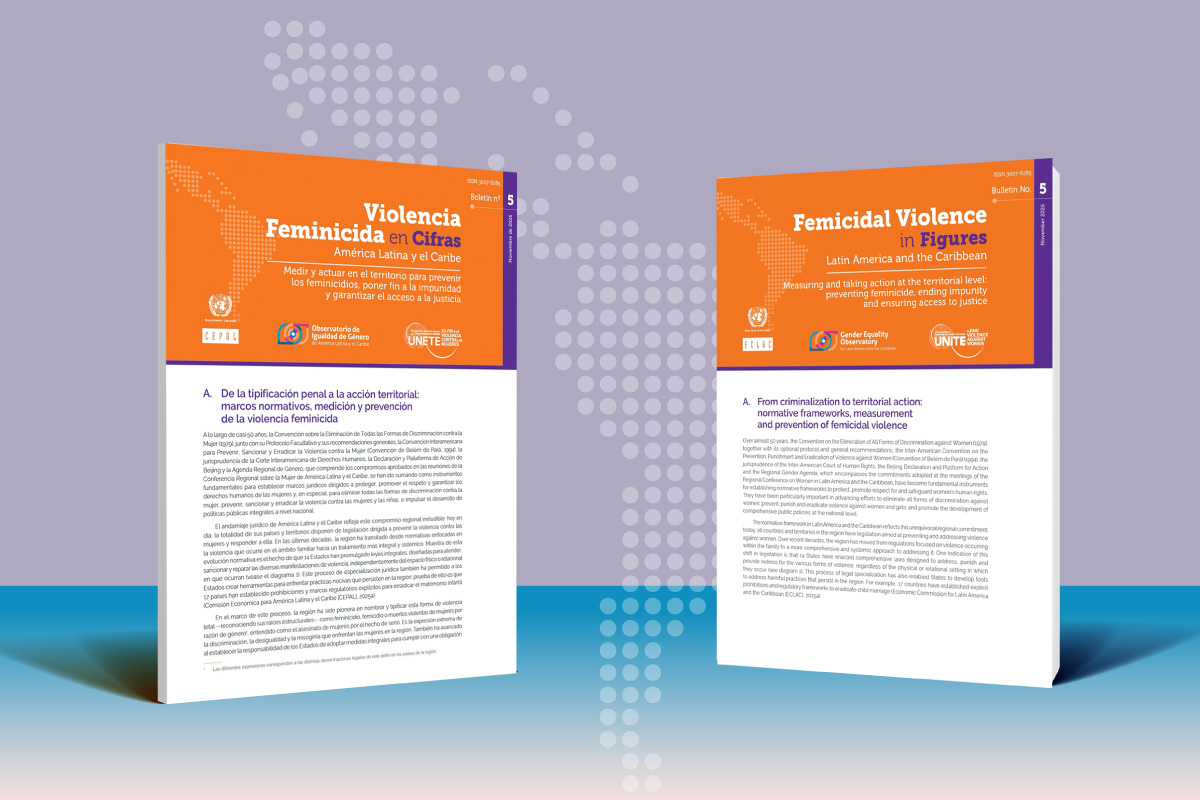
Bulletin No. 5 – Femicidal Violence in Figures. Measuring and taking action at the territorial level: preventing feminicide, ending impunity and ensuring access to justice was published by ECLAC during the UNiTE campaign of the secretary general of the United Nations to end violence against women and girls, which in 2026 called for guaranteeing access to justice, protecting survivors, and ending impunity. 25 November also marks the beginning of the 16 Days of Activism Against Gender-Based Violence, which ends on 10 December, Human Rights Day.
Of the 3,386 victims of femicide, feminicide, or gender-based violent death recorded in 2025, 3,346 corresponded to 16 countries in Latin America, and 40 to 11 countries and territories in the Caribbean. Although differences are observed between countries, the occurrence of cases of femicide, feminicide, and violent deaths continue to be an unacceptable reality in the region.
In almost all countries for which information is available, the rates of attempted femicide or feminicide exceeded the number of committed femicides. In Chile, for example, 4.0 attempted femicides were recorded per 100,000 women, compared to a rate of 0.4 committed femicides; in Puerto Rico, the rates were 6.4 and 1.1, respectively; and in Brazil, 3.5 compared to 1.4. These precedents reinforce the importance of strengthening early detection mechanisms, risk evaluation, and effective protection to prevent lethal violence, ECLAC states.
Femicide, feminicide, or gender-based violent death of women are the extreme expression of a continuum of violence. Inequality, discrimination, and violence against women and girls are not isolated events but rather manifestations of structural inequalities that are reproduced and reinforced and limit the effective exercise of their rights, including access to justice.
In most countries for which information is available, femicides were predominantly carried out by current or former intimate partners of the victims. In Puerto Rico, this relationship was identified in 100 percent of reported cases; in Chile, in 95.5 percent, and in Paraguay, 83.8 percent. These figures highlight the need for timely identification of situations of violence and effective action through protection measures and coordinated institutional responses.
The Bulletin shows that femicidal violence affects woman and girls of all ages. In seven countries with comparable data, 72.9 percent of victims were between 15 and 44 years of age. 13 femicides were also recorded of girls under the age of 15, and 22 women aged 60 and older. Likewise, seven countries reported 30 victims who were pregnant at the time of the crime.
Between 11.9 percent and 33.3 percent of victims of femicide had previously brought complaints in the countries that provided this information. Likewise, in six countries with data, approximately 15 percent of women murdered had restraining orders that were in effect.
Femicidal violence has consequences for families and communities. In 2025, 634 indirect victims were recorded, including daughters, sons, and other dependents in 10 countries and territories. Comprehensive reparation requires considering social protection, the continuity of care, health care, and psychosocial support for the persons affected.
In this context, ECLAC emphasises that access to justice is a fundamental right and essential condition to achieving substantive gender equality. Ensuring timely and effective protection measures and strengthening institutional monitoring of complaints are obligations of the State to prevent and eradicate femicidal violence.
Guaranteeing access to justice also requires investigating and sanctioning gender-based violence, ensuring comprehensive reparation for harm, and establishing guarantees against recurrence. A judicial response free from discrimination and re-victimisation is fundamental to combating impunity, strengthening women’s trust in institutions, and ensuring exercise of their rights, including the right to a life free of violence.
“Preventing, addressing, sanctioning, and eradicating all forms of gender-based violence and discrimination against women and girls requires strengthening institutional capacities at all levels of the State, in line with the contents of the Tlatelolco Commitment (2025). This implies acting in all the areas in which violence occurs, including digital environments, homes, workplaces, schools, and public spaces, through its most extreme expression, feminicide or femicide. We can all contribute to ensuring a life free of violence for every woman and girl. We have the commitment and the responsibility to do so better and faster,” stated José Manuel Salazar-Xirinachs, executive secretary of ECLAC.
Latin America and the Caribbean has been a pioneer in transforming the urgency of eradicating lethal violence into concrete legislative measures. Currently, 14 countries in Latin America have comprehensive laws that address the different manifestations of gender-based violence, and 20 countries and territories have incorporated femicide, feminicide, or gender-based violent death of women in their legal systems. However, challenges remain for this progress to be translated into effective systems of justice and protection.
The report Access to justice for women and girls in Latin America and the Caribbean, prepared by ECLAC and UN Women in 2026, identifies legal, institutional, economic, sociocultural, linguistic, territorial, and technological barriers that hinder the exercise of this right. These especially affect Indigenous, Afro-descendent, migrant, and disabled women and highlight the need to progress toward justice systems that are accessible, inclusive, and free from discrimination.
About the Author