




PORT OF SPAIN, Trinidad, (IICA) – The Caribbean’s micro and small agri-enterprises (Agri-MSEs) made one message unmistakably clear: they do not need more workshops about exporting – they need practical actions that actually move their products into regional and international markets. That message emerged strongly during a virtual regional IICA – Caribbean Development Bank (CDB) Agri-MSME Forum titled “Moving Products to Markets, Literally!”
The virtual forum was part of an ongoing Inter-American Institute for Cooperation on Agriculture (IICA) and CDB AgriMSE development project to help tackle one of the region’s greatest constraints to agricultural transformation and food security – getting quality local products from producers to consumers consistently and competitively.
According to Diana Francis, the IICA representative in Trinidad and Tobago and project coordinator, “this forum starts with the endgame – literally placing products on shelves, in home and regional markets, and potentially beyond; this project wants to go beyond conventional capacity building and telling AgriMSEs where the markets are. We want to help them put their products on the shelves and keep them there.”
The CDB-funded initiative supports Agri-MSMEs in five Caribbean countries through three integrated pillars: facilitating market access and export trials, scaling-up production capacity to meet demand consistently, and improving access to financing for scale-up.
The realities behind Caribbean innovation, scale-up and commercial results
This regional forum provided yet another opportunity to hear first-hand accounts from AgriMSEs whose businesses reflect the innovation and resilience emerging throughout the region but remain mostly unknown, under-capitalised and under-developed.
From Antigua and Barbuda, Shade Hydroponics (SHAADE) showcased their range of value-added herbal teas, honey products, peppers and wellness items, all produced from locally grown ingredients. While technically prepared for regional markets, the company identified buyer connections, packaging support, processing equipment and export logistics as the critical investments needed to scale successfully.
From Dominica, Bee Natural founder Terri Henry-Lovell described how her award-winning natural wellness products, developed from locally sourced honey, beeswax and propolis, have already entered several Caribbean markets despite significant logistical constraints. Her experience highlighted a challenge shared by many small island businesses: exports often depend on travellers carrying products in personal luggage because reliable, affordable regional air or sea freight options remain limited.
While demand exists across the Caribbean, AgriMSEs continue to face obstacles including inconsistent freight services, high transport costs, cold-chain limitations, customs procedures, packaging costs and difficulties accessing distributors. Representatives from logistics provider Onboard Freight and Logistics joined discussions on practical shipping solutions, customs procedures and cargo consolidation opportunities for small-volume exporters. The forum also heard from Caribbean retailers, who stressed the need for more consistent export documentation, greater awareness of CARICOM certification procedures among producers, and stronger coordination between exporters, distributors and logistics providers.
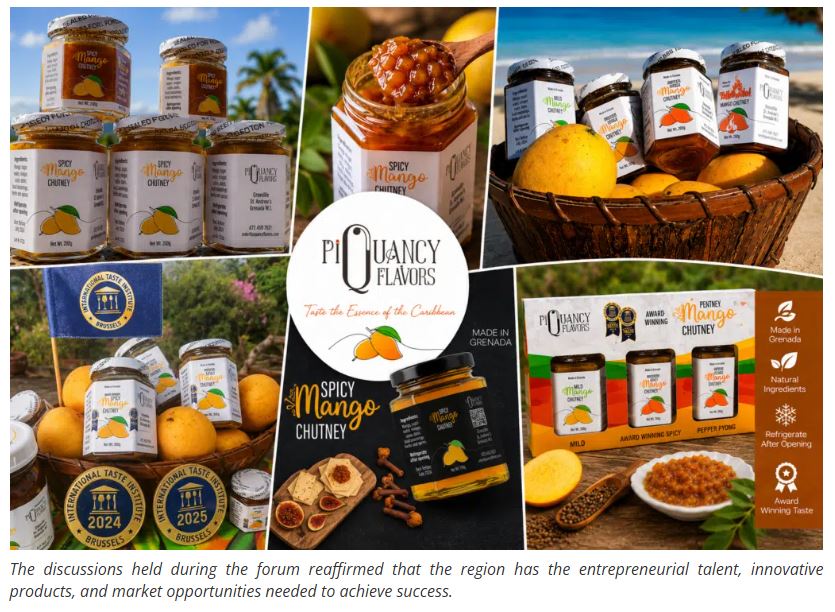
Harnessing, channelling and championing the AgriMSE potential
The Caribbean is very capable of producing quality products. The frank exchanges at the forum reinforced the view that the Caribbean possesses the entrepreneurial talent, innovative products and market opportunities needed for success. For IICA-TT, this is very evident from working closely with a large number of AgriMSEs over at least, the last seven years.
The next step is creating the systems, partnerships and logistics that allow those businesses to compete, grow and thrive. For AgriMSEs, this remains an uphill battle, as summarised by CDB economist Xavier Ajani Malcolm during the CDB’s 56th Annual Meeting early this year in Nassau, The Bahamas.
According to Malcom, “the prevalence of informal employment limits the region’s ability to scale up production because businesses remain fragmented rather than growing into larger enterprises capable of increasing output quickly. It also hampers technological innovation, as formal institutions are needed to spread new technologies in a planned and coordinated way.… If you have large organisations that can immediately scale up production, that’s better than if you have fragmented sets of informal employment.”
It is true that the AgriMSE sector remains fragmented, same for the agriculture sector in general. Back in 2005 a fragmented and unorganized private sector in agriculture was number four among the ten key binding constraints in the Jagdeo Initiative, a strategic regional framework focused on removing constraints to agricultural development and improving food security.
While agri-food value-added products are listed as priority for production expansion, exports and import replacement targets in the ‘CARICOM 25 x 2025 + 5’ strategic framework, limitations of 2005 still exist, and even more so, for the large and growing number AgriMSEs. Harnessing, effectively channelling and championing the potential of their creativity and diversity in both food and non-food agro-based products is essential not only to drive the export target, but to also inject dynamism and formality in the farm sector, the ultimate producer of the agricultural raw materials. Therefore, investing in AgriMSEs within a broader framework of MSME and agriculture development is a ‘win-win’ across the board.
Participants agreed that no single institution can solve these challenges independently. Instead, coordinated partnerships among governments, development agencies, private logistics companies, distributors, financiers and business support organisations will be essential to building sustainable regional value chains.
IICA representative in Barbados, Allister Glean underscored the importance of “focusing on practical interventions rather than isolated training activities to support businesses from the earliest stages of development through to sustained participation in Caribbean and extra-regional markets”.
The IICA-CDB initiative aims to move beyond traditional training programmes to provide entrepreneurs with tangible support that enables real commercial growth, including improvements in packaging and branding, accessing distributors, undertaking trial exports, strengthening compliance with market requirements and securing financing needed to scale-up sustainably and export. As participants concluded, success will ultimately be the number of Caribbean products consistently reaching consumers throughout the region and beyond.