




By Johnny Coomansingh
Earlier this week, I visited the town of Debe in South Trinidad. Debe is like the capital of Indian delicacies. Doubles, aloo pie, chachoree, saheena, biganee and barfi are sold in several outlets on the main street. On my way back home, I stopped for two biganee and a Solo AppleJ soft drink at Hassanali’s Green Shed. Biganee consists of strips or slices of eggplant wrapped in a flour dough or coated in a seasoned split peas batter and deep fried until crisp. I saw the other delicacies but biganee is what I have come to love.
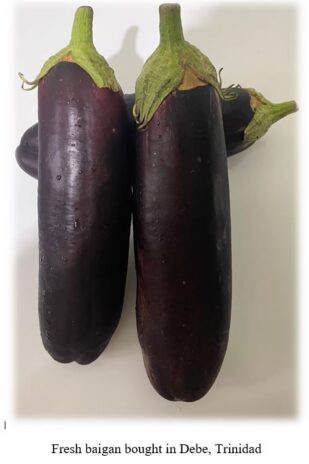
Eggplant, (Solanum melongena), otherwise known as aubergine, melongene, baigan or brinjal is a plant species of the nightshade family. Eggplant is a relative of toxic plants like belladonna or deadly nightshade. Potatoes, tomatoes and peppers belong to the same nightshade family. In Trinidad, some people refer to the fruit (vegetable) as ‘belongen.’ Historians believe the British coined the term ‘eggplant’ during their occupation of India. Nevertheless, people were suspicious of the new crop when it was introduced to Europe in the Middle Ages. Originally, eggplant comes from Asia, where it still grows wild. Eggplants made their way to Europe with the Islamic empire in the seventh and eighth centuries.
In the 17th Century, eggplant was referred to as the ‘Mad Apple’ in Italy; labelled melanzana, loosely translated to ‘mad apple.’ It was wrongly assumed that eating it would cause insanity, epilepsy, or even leprosy. Eggplant has a history of fear. Wild varieties of eggplant were much more bitter and spongy. Modern breeding has made the fruit completely safe and highly nutritious. Plant breeders have practically outbred the bitterness, making the eggplant a healthy dietary staple, rich in fibre, vitamins, and antioxidants.
I personally prefer the use of the Sanskrit word ‘baigan’ or ‘bhaigan.’ The word baigan is a form of slang in certain regional dialects of India, like Hyderabadi Urdu. Depending on the context, it can mean ‘worthless,’ ‘waste,’ or ‘gibberish, for example, “baigan ki baataan nakko karo” means “don’t talk nonsense.”
There are many varieties of baigan including Dusky or classic — the familiar eggplant shape with shiny purple skin, Epic — teardrop-shaped with purple-black skin, Black bell — pear-shaped with glossy black skin, Ghostbuster — long, white, oval, Ichiban — long, thin, purple, Slim Jim — thin, bright purple, and Easter egg — small, oval that’s colored white, orange, yellow, or green. Eggplant fruits can also come with various other colours; pink, orange, and even striped skin. I have cultivated both white and purple varieties with excellent results.
My good friend, Tony Deyal, told me that he does not eat baigan because he had too much of it in his childhood. I don’t blame him. In my childhood, I had some real issues with baigan. Sometimes my mother would cook a couple baigan with leftover chicken, beef, fish or salted cod (saltfish), but I was always reluctant to partake of the fare. For whatever reason, I remember bringing up some curried baigan; it just wouldn’t stay down. From that day, I resisted baigan. It was not until later in life that I came to relish a dish we know as baigan choka.
In Trinidad and Tobago and Guyana, baigan choka is a smoky dish, made with fire-roasted, mashed eggplant mixed with garlic, hot peppers, and other spices. This choka is usually eaten with saada roti. Baigan choka is even more delightful when combined with roasted tomatoes. Roasting the baigan and tomatoes on a fireside (chulha) is best. Saada roti is a fluffy flatbread made with all-purpose flour, baking powder, salt and water. The dough is kneaded, formed into loiya (small rounds), rolled flat with a belna (rolling pin) and saykayed (cooked) on a hot griddle (tawa) until lightly charred and puffy. Although this choka is highly favoured in Trinidad, there are other dishes where baigan is used as the prime ingredient.
Suzy Karadesh, in her article ‘The Baba Ganoush Dish’ published in The Mediterranean Dish (May 20, 2026), admitted:
“Growing up in Egypt, I ate ‘baba ganoush’ regularly… Baba ganoush—also known as baba ganouj, muttabal, or salat hatzilim—is a smoky, rich, and creamy eggplant dip, traditionally made by mixing tender roasted (or charred) eggplant and nutty tahini with garlic, citrus, and spices…This smoky eggplant dip has travelled across borders; you can find endless variations.
Apart from baba ganoush, the Italian dish ‘eggplant parmesan’ is another favourite. Bethany Kramer in her article: ‘Classic Eggplant Parmesan’ published in A Simple Palate (March 25, 2026) presented:
“Growing up, I adored eggplant parm! If you’ve never had it, eggplant parmesan is an Italian dish made up of slices of eggplant coated in flour and breadcrumbs, then baked in layers of rich marinara and melted cheese! It’s a must-try for any Italian food lovers.”
Do you like baigan? That’s the big question.
According to Rachel Ajmera, MS, RD, in her article: ‘7 Surprising Benefits of Eggplants,’ reviewed by Jerlyn Jones, MS, MPA, RDN, LD, CLT updated February 27, 2025 in HealthLine:
“Eggplants are a nutrient-rich food that contains fiber, vitamins, and minerals. They may benefit your overall health, including your heart…Although often considered a vegetable, they’re technically a fruit… In addition to its unique texture and mild flavour, eggplant has a host of potential health benefits.” The article takes a deep look at the health benefits of eggplants:
“Rich in many nutrients: A two-thirds cup (100 grams) of raw eggplant contains the following nutrients: Calories: 26; Carbs: 5.4 grams; Fiber: 2.4 grams; Protein: 0.85 gram; Manganese: 0.106 mg; Potassium: 222 mg. Eggplants also contain small amounts of other nutrients, including niacin, magnesium, and copper.
High in antioxidants: In addition to containing a variety of vitamins and minerals, eggplants boast a high number of antioxidants. Antioxidants are substances that help protect the body from damage caused by harmful substances known as free radicals…Eggplants are especially rich in anthocyanins, a type of pigment with antioxidant properties that gives them their vibrant color. In particular, an anthocyanin in eggplants called nasunin is especially beneficial. A 2016 study found that nasunin protects against oxidative damage during aging.
May reduce the risk of heart disease: Thanks to their antioxidant content…eggplants may help reduce the risk of heart disease. A 2019 study suggested that eating foods containing anthocyanins (found in eggplant) helps to reduce inflammatory markers that increase the risk of heart disease.
May promote blood sugar control: Adding eggplants to your diet may help keep your blood sugar in check. This is primarily because eggplants are high in fiber, which passes through the digestive system intact. Fiber can lower blood sugar by slowing the rate of digestion and absorption of sugar in the body. Slower absorption keeps blood sugar levels steady and prevents spikes and crashes. Polyphenols, which are natural plant compounds found in foods like eggplant, may reduce sugar absorption and increase insulin secretion, both of which can help lower blood sugar.
Could help with weight loss: Eggplants are high in fiber and low in calories, making them an excellent addition to any weight loss regimen. Fibre moves through the digestive tract slowly and can promote fullness and satiety, reducing calorie intake. Eggplants are often used as a high-fiber, low-calorie replacement for higher-calorie ingredients in recipes.
May have cancer-fighting benefits: Eggplants contain several substances that have the potential to fight cancer cells. For example, solasodine rhamnosyl glycosides (SRGs) are a type of compound found in some nightshade plants, including eggplant. Test-tube studies have shown that SRGs could cause the death of cancer cells and may also help reduce the recurrence of certain types of cancer. Though research on the topic is limited, SRGs have been shown to be especially effective against skin cancer when applied directly to the skin. According to the National Cancer Institute, a diet rich in plant foods such as fruits and vegetables has been associated with a lower risk of certain cancers, including cancers of the mouth, pharynx, larynx, oesophagus, stomach, and lungs.
Very easy to add to your diet: Eggplant is incredibly versatile and can be easily incorporated into your diet. It can be baked, roasted, grilled, or sautéed and enjoyed with a drizzle of olive oil and a quick dash of seasoning. It can also be used as a low-calorie replacement for many high-calorie ingredients.”
Stephanie Watson also wrote on ‘The Health Benefits of Eggplant’ in webMD, including risks. Her work supports the information presented in HealthLine. Christine Mikstas, RD, LD reviewed her work (December 12, 2024):
“The eggplant has been an ingredient in traditional medicine for thousands of years. In the ancient Indian system of ayurvedic medicine, practitioners used white eggplant to treat diabetes and the roots to relieve asthma. While eggplant isn’t the most nutritious vegetable, it does give you a decent supply of potassium and fiber. And at just 25 calories and less than 1 gram of fat per serving, it’s a pretty guilt-free food — as long as you don’t soak it in oil. Eggplant has antioxidants like vitamins A and C, which help protect your cells against damage. It’s also high in natural plant chemicals called polyphenols, which may help cells do a better job of processing sugar if you have diabetes. Early lab studies in cells suggest that eggplant protects against the type of deoxyribonucleic acid (DNA) damage that leads to cancer. But researchers still need to confirm this benefit in humans.
Eggplant and other nightshade vegetables have the chemical solanine, which some people claim adds to inflammation and makes diseases like arthritis worse. There’s no solid evidence that the small amount of solanine in eggplant worsens arthritis symptoms. But if you notice that your joint pain flares up after you eat eggplant, avoid it. Rarely, people are allergic to eggplant. Symptoms of an allergic reaction include a rash, swelling of the face, itching, hives, and a hoarse voice.”
In conclusion, a few lines from my calypso titled: Baigan Choka (2014) should give a crisp ending to the suggestions above. The song reveals the advice that Sundar Popo (deceased), the ‘Father of Chutney Music’ gave to me in a dream:
“In the land of sugarcane
So far from Port of Spain
Right dey inside he place
In Lalbeharry Trace
He tell mih what tuh sing
No need for worrying
The rel chutney master
Tell mih sing ‘bout baigan choka.
Chorus
Doh sing about yuh nana
Doh sing about yuh aja
Doh sing ‘bout marijuana
And all the Trini kankah
Jus light up the chulha
Roast and bring the flavor
Add garlic and some pepper
Sing ‘bout baigan choka!
The healing properties
In fighting all disease
To fight obesity
An excellent remedy
Sing about the baigan
Tuh improve yuh digestion.
Baigan fuh the gas…
Doh worry whe it pass.
Doh bother ‘bout Basanti
And who eh like yuh bowjee
Ah poultice fuh yuh nipple
When yuh seeing trouble
The glykoalkaloids
And bioflavonoids
They say it killing cancer
Check Google fuh the answer.”