



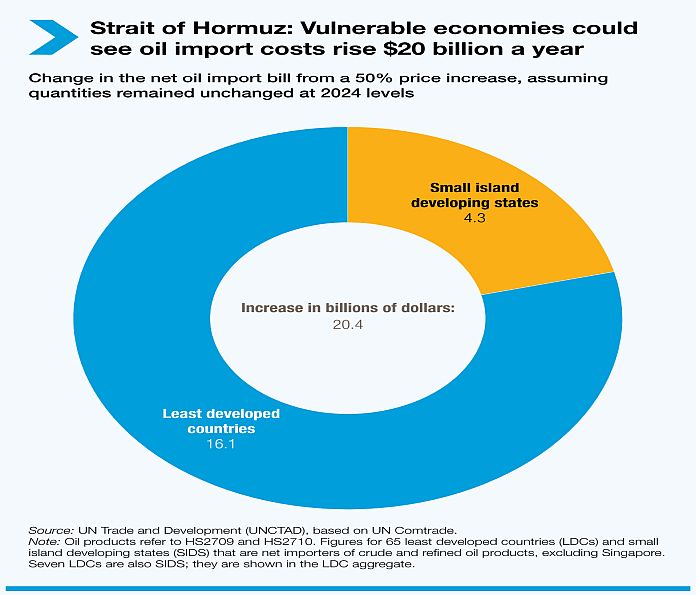
- A sustained oil price surge could add more than $20 billion a year to the oil import bill of vulnerable economies that depend on imported fuel.
- Nearly 1 billion people live in countries highly exposed to rising fuel costs.
- Least developed countries and small island developing states are greatly exposed to the oil shock.
- The third edition of a new UNCTAD monitoring series tracks the rising oil import costs linked to the Strait of Hormuz disruptions.
GENEVA, Switzerland – Rising oil prices triggered by disruptions linked to the Strait of Hormuz are placing growing pressure on vulnerable economies, threatening to increase import costs, fuel inflation and strain public finances across some of the world’s poorest countries.
The findings come from “Strait of Hormuz Disruptions: The burden of oil price shocks on vulnerable economies”, a new edition of a UN Trade and Development (UNCTAD) monitoring series examining the evolving economic consequences of disruptions linked to one of the world’s most important energy corridors.
This edition focuses on least developed countries and small island developing states – economies that are often highly dependent on imported fuel and have limited capacity to absorb external shocks.
The series builds on recent UNCTAD analysis warning that disruptions in the Strait of Hormuz could trigger wider trade, food, transport and financial shocks, and highlighting the importance of early-warning data to understand how such risks spread through the global economy.
From geopolitical shock to development challenge
While tensions in the region may fluctuate, their economic consequences can linger far longer.
Prior to the recent disruptions, the Strait of Hormuz handled roughly one-fifth of global oil shipments. Since the disruptions began on 28 February this year, crude oil prices have risen sharply, increasing costs across transport networks, supply chains and energy markets worldwide.
For vulnerable economies, however, the impact is particularly acute.
Of the 75 vulnerable economies analysed by UNCTAD, 65 are net oil importers, with imports heavily concentrated in refined oil products. Together, they are home to nearly 1 billion people, with more than 30 percent of the population living on less than $3 a day.
UNCTAD estimates that, based on current import levels, a sustained 50 percent increase in refined oil prices could raise their annual net oil import bill by more than $20 billion.
Assuming oil import quantities remain at 2024 levels, least developed countries would absorb roughly $16 billion more to sustain the oil import quantities, while small island developing States would face around $4 billion.
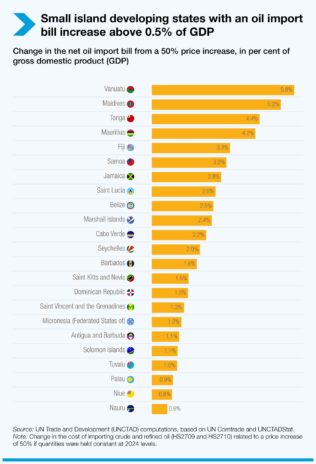
For several countries, the increase could exceed 5 percent of GDP – including Mauritania at 7.3 percent, the Gambia at 6.3 percent, Vanuatu at 5.8 percent, the Maldives at 5.2 percent and Burkina Faso at 5 percent — creating difficult trade-offs between paying for essential imports and investing in development priorities.
Furthermore, some rely on the Gulf region for a significant share of their energy imports, adding the extra burden of securing alternative supplies.
The burden extends beyond energy
Higher oil prices affect much more than fuel bills.
They raise transport and freight costs, contribute to inflation, weaken purchasing power, put additional pressure on public budgets already stretched by debt and external shocks and can lead to slower economic growth.
Tracking the longer-term impact
The new monitoring series reflects a broader challenge facing the global economy: geopolitical tensions increasingly generate economic consequences that spread well beyond the immediate area of conflict.
As uncertainty continues, the question is no longer only how markets react to disruption, but how countries with the least capacity to absorb shocks can protect development gains and strengthen resilience for the future.
Future editions of the series will continue tracking how these impacts evolve across trade, transport, energy and development.