



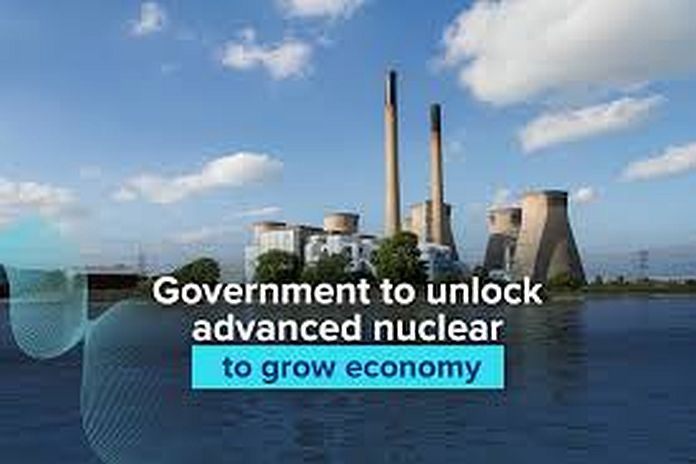
- Plans to speed up building of pioneering nuclear technology to power AI boom and grow economy with clean energy
- Government to recognise most credible advanced nuclear projects to help unlock private investment and get projects off the ground
- New nuclear projects could create thousands of jobs across the country as part of nuclear “golden age”
LONDON, England – Britain could see some of the world’s first advanced nuclear power stations powering factories and AI data centres, as part of the government’s “golden age” of nuclear to support jobs, drive growth and protect billpayers with homegrown clean energy.
The government, on Wednesday 4 February published a first-of-its-kind framework which aims to stimulate private investment in innovative nuclear technologies across the country, providing a clear route to market and support for credible projects to get them off the ground.
Britain is one of the first to champion the development of cutting-edge nuclear projects driven by the private sector, recently announcing major commercial deals between UK and US companies. This includes plans for X-Energy and Centrica to build 12 advanced modular reactors in Hartlepool, supporting 2,500 jobs, as well as plans for Holtec, EDF, and Tritax to build small modular reactors at the former coal-fired power station Cottam in Nottinghamshire, providing clean, secure power to data centres on the site.
Meanwhile, TerraPower is working with engineering firm KBR to explore the potential deployment of its Natrium advanced reactor technology in the UK and beyond.
To speed up deployment of advanced nuclear and attract private investment, government is launching a “pipeline” of credible projects that meet essential readiness criteria. A “concierge-style” service will help developers understand requirements around UK planning, regulation and fuel, as well as enabling them to crowd-in private investment.
Advanced nuclear technologies – including advanced, small, and micro modular reactors – are manufactured in factories, meaning they could be built quicker and at a lower cost, with skilled jobs located across multiple regions. They can provide clean energy to the grid or directly to private industrial consumers to meet growing clean energy demand and help decarbonise industry.
It follows the biggest government investment in nuclear power for a generation, greenlighting Sizewell C in Suffolk and selecting Wylfa in North Wales to host the country’s first small modular reactors.
Minister for Nuclear Patrick Vallance said:
“Advanced nuclear technology could revolutionise how we power industry and propel the AI data centre boom – delivering more clean energy and jobs. We are seizing the opportunity to become a frontrunner in this space as part of our golden age of nuclear, creating the conditions for the industry to flourish.”
Developers can use the Advanced Nuclear Framework to submit proposals to join the pipeline from March this year, which will then be assessed by experts in government and Great British Energy-Nuclear according to key criteria such as technology status, developer capability, and financing plans.
Successful applicants would receive in principle government endorsement. While they would be expected to be privately financed, it would also open up discussions on what support from the government might be needed to help get projects off the ground, while providing value to the taxpayer and billpayer, including:
- Revenue support once projects are operational;
- Risk protections for extremely rare events to develop projects with little risk for the taxpayer.
Additionally, projects can approach the National Wealth Fund, who can act as a catalytic investor for projects that meet their investment criteria, and help derisk further private investment.
Advanced nuclear reactors use novel fuels and coolants so operate at higher temperatures, which can provide excess heat for industrial processes in factories or data centres. Developers are aiming for their first AMRs to be operational in the UK by the mid-2030s.
The Nuclear Decommissioning Authority is releasing surplus land for clean energy projects , including at Chapelcross in Scotland, Pioneer Park in Cumbria, and Trawsfynydd in Wales.
The government is also publishing a Statement on Civil Nuclear Fuel Use , which sets out the requirements for uranium-based fuels used in civil nuclear reactors, providing clarity for the sector. It ensures alignment with national objectives for energy security, environmental protection, and long-term spent fuel and waste management.
Neil Cooper, Chief Financial Officer at Great British Energy-Nuclear said:
“Today’s announcement is hugely positive for the nuclear industry in the UK and signals the start of a disciplined and transparent partnership between government and the private sector, built on evidence, not optimism. GBE‑N is ready to play its full part with objectivity and consistency, at pace.”