



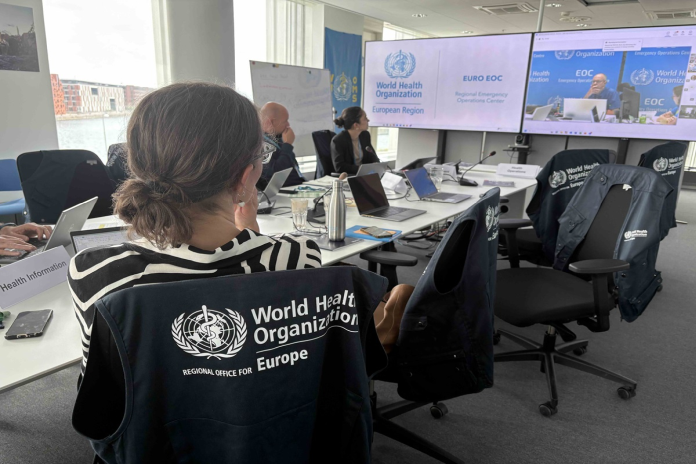
 GENEVA, Switzerland – On 25 June, the World Health Organization (WHO) concluded its participation in a 36-hour nuclear emergency exercise organized by the International Atomic Energy Agency (IAEA).
The exercise was part of the IAEA’s Level 3 Convention Exercise (ConvEx-3), the highest and most complex level of its emergency exercises. These large-scale exercises are conducted every three to five years to test emergency preparedness and response capacities and identify areas in need of improvement. The last ConvEx-3 exercise took place in 2021 in cooperation with the United Arab Emirates.
The exercise involved more than 75 countries and 10 international organizations and was based on a simulated accident at a nuclear power plant in Romania, resulting in the release of significant amounts of radioactive material. Participating countries and organizations exchanged information in real time, assessed evolving risks, coordinated communications, and decided on appropriate protective actions, including the medical response.
As part of the simulation, WHO set up an Incident Management Support Team composed of experts from country, regional and headquarters offices. The WHO teams liaised with national authorities to monitor the public health impact, developed public health messages on protective actions, and provided guidance on mental health support for affected communities and emergency responders.
New elements this year included the close coordination of protective measures by neighbouring countries Bulgaria and the Republic of Moldova, the deployment of international assistance missions and the additional challenge of cybersecurity threats. An expanded social media simulator was used to test crisis communication strategies.
By simulating high-risk cross-border nuclear emergencies, these exercises test existing structures and technical readiness, help build trust and strengthen a coordinated global response. WHO’s ongoing work to strengthen radiation protection of the public, patients and workers worldwide includes providing member states with evidence-based guidance, tools and technical advice on public health issues related to ionizing and non-ionizing radiation.
Following the exercise, the IAEA will compile and publish a detailed review of best practices and areas for improvement. WHO will review the lessons learned and adjust processes accordingly.